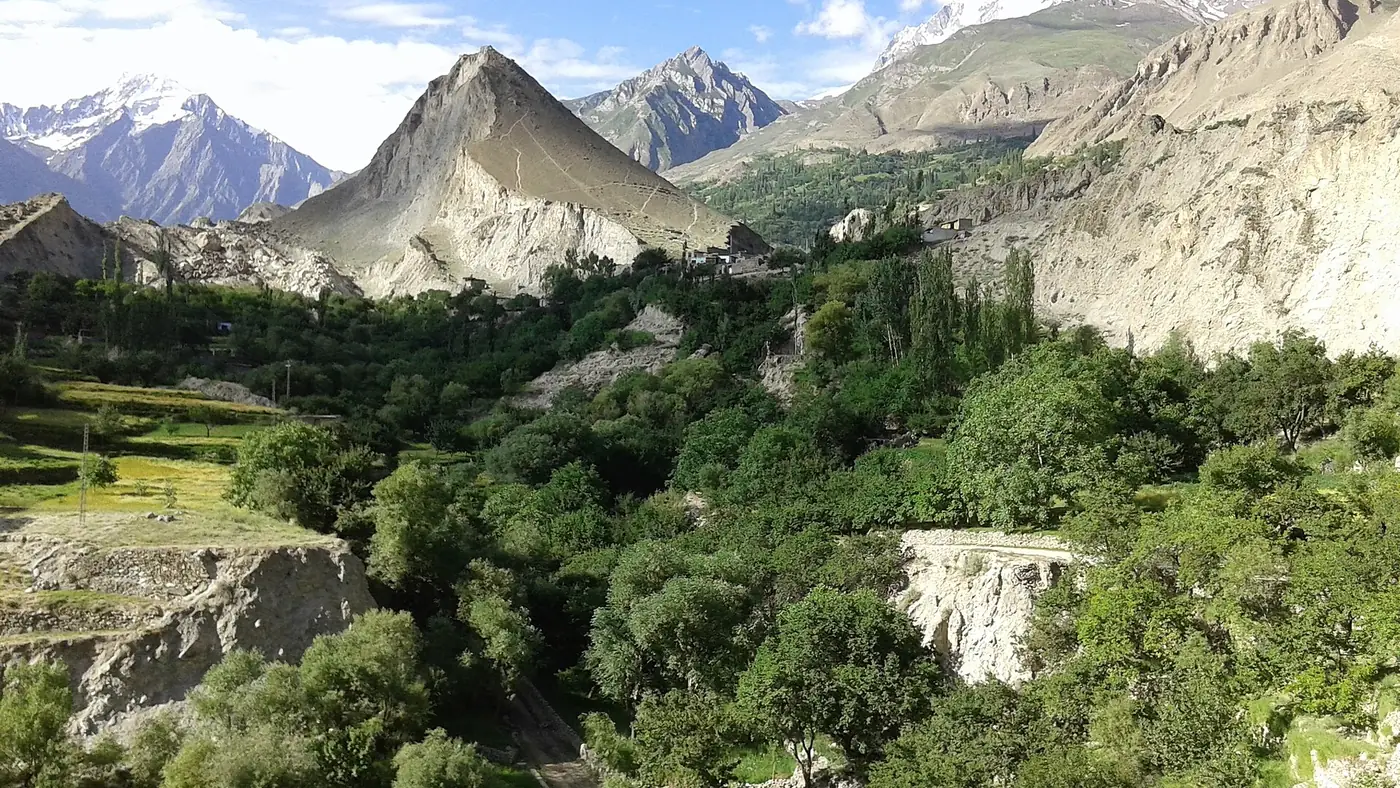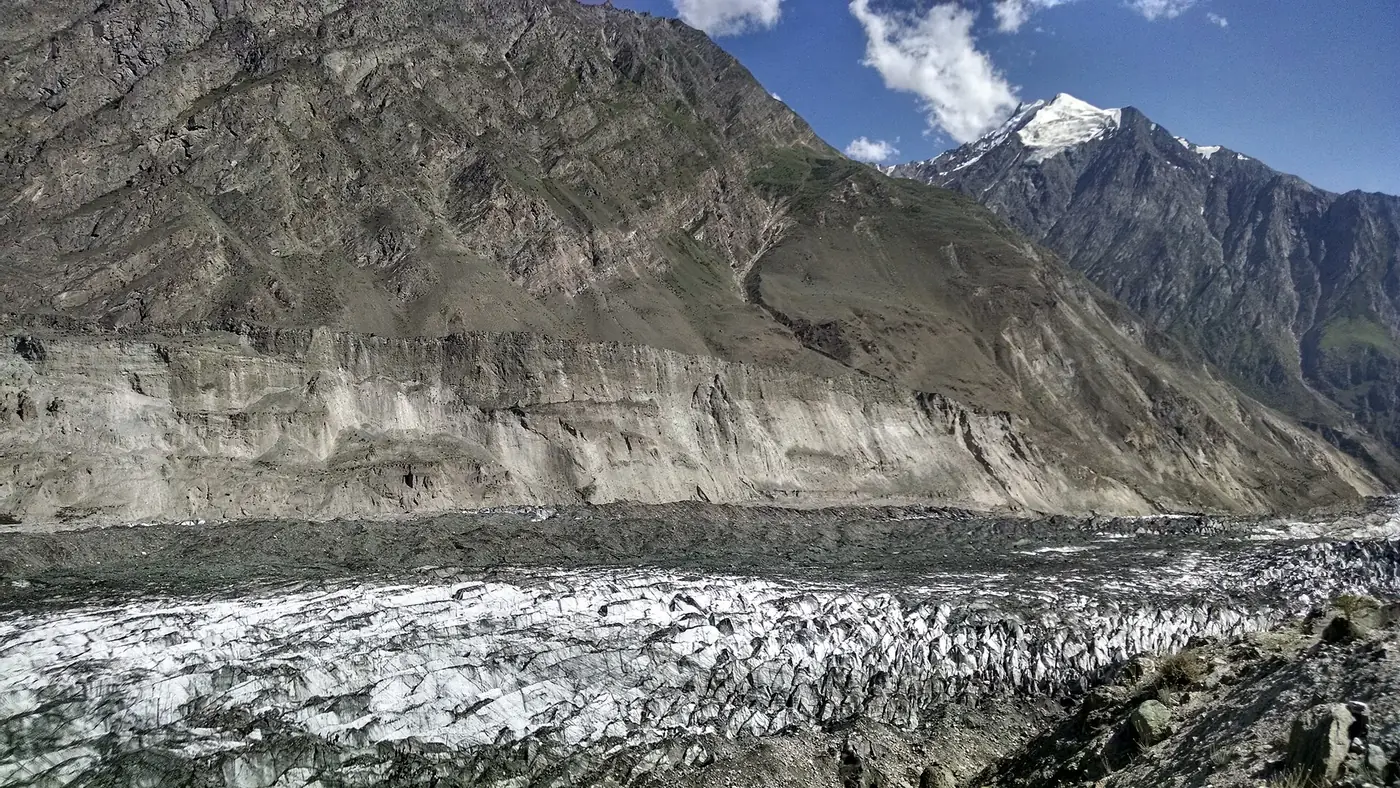
The Rakaposhi View Point is a roadside stop on the Karakoram Highway at Ghulmet in Nagar, about 70 km north of Gilgit and 30 km short of Karimabad. Here the highway passes about 11 km from the summit of Rakaposhi, 7,788 metres, and you look almost straight up its north face from a row of cafés beside a cold glacier stream. Give it 30 minutes to an hour, and try to pass in the early morning or late afternoon, when the light is best and the summit is most often clear of cloud.
Locally it is also called Zero Point. This guide covers where exactly the stop is, what you are looking at, the cafés and the stream, how to time it for a clear view and good photographs, and whether to spend a night there.
| At a glance | |
|---|---|
| Where | Ghulmet, Nagar, on the Karakoram Highway |
| From Gilgit | About 70 km, roughly 1.5 hours |
| From Karimabad | About 30 km, 40 minutes to an hour |
| Altitude | About 2,000 m at the road |
| The mountain | Rakaposhi, 7,788 m, about 11 km away |
| Time needed | 30 minutes to an hour |
| Best light | Early morning and late afternoon |
| Clearest months | September and October |
| Facilities | Cafés, tea stalls, small shops, a few small hotels |
| Cost | Nothing; you pay only for what you eat |
Where is the Rakaposhi View Point?
Driving north from Gilgit, the highway enters Nagar at Chalt and runs east along the Hunza river through Nilt and Thol. Ghulmet comes next, and the viewpoint is right on the highway there, a short cluster of buildings where the road opens out and the whole mountain appears above you. A few kilometres further on are Pisan and the turning for Minapin, and after that the highway crosses into Hunza district on the way to Aliabad and Karimabad.
Almost everyone stops here on the drive up to Hunza, as our guide to the Gilgit to Hunza drive describes with the other stops on that road. You can also come back for it as a short outing from Karimabad, which is often the better plan when cloud hides the mountain on the day you arrive.
The highway is busy with trucks and buses, and it is narrow through the village. Pull fully off the road to park, don't stop on the carriageway for a photograph, and keep children close when you cross.
What you are looking at
From the viewpoint, Rakaposhi stands almost due south of you, and you are looking at its north face. The road is at about 2,000 metres and the summit is some 5,800 metres higher, only about 11 km away in a straight line. Few places on earth put that much mountain in front of a road.
The glacier below the face, pointing down towards you, is the Ghulmet glacier. The stream that runs through the viewpoint comes down from the ice on this side of the mountain, which is why it is so cold even in July.
The people of the valley call the mountain Dumani, usually translated as "mother of mists", and you will soon see why: cloud gathers around the upper face on many summer days. Our guide to Rakaposhi mountain covers its height, its names and the story of the first ascent in 1958.
The cafés and the glacier stream
The viewpoint has grown from a tea stall into a small roadside settlement. There are restaurants and cafés, tea stalls, small general shops, stalls selling gemstones and handicrafts, and a few small hotels and a campsite for anyone who wants to stay.
The reason to linger is the stream. Small terraces have been built beside the meltwater as it tumbles down through the site, and in summer people sit on them with their tea, many with their feet in the water. It is icy, fast and very refreshing after a hot drive from Gilgit.
A few things to know:
- Try the chapshuro. The meat-filled flatbread of Hunza and Nagar is the local speciality here, cooked to order, so allow a little time. Our guide to traditional food in Gilgit-Baltistan explains the other dishes you will meet on the way north.
- Tea comes in many forms, including local herbal teas. Ask prices before you order for a large group.
- Watch children at the stream. The water is shallow on the terraces but fast and very cold, and the stones are slippery.
- Take your rubbish with you. The stream runs on down to the Hunza river, and a busy summer day leaves the site littered.
When is the best time to stop?
Time of day
Because the mountain lies to the south, around midday you are looking towards the sun. The face falls into shadow, the air is hazy, and photographs come out flat. The better times are:
- Early morning, from sunrise until about 9 or 10. The air is at its cleanest, the summit is most often free of cloud, and in summer the low sun from the east lights the face from the side.
- Late afternoon, the last two hours or so before sunset, when the light comes from the west across the face. Cloud that built up at midday sometimes clears towards evening.
In summer, cloud tends to gather on the summit from late morning. If Rakaposhi is clear when you pass, stop then rather than promising yourself the return journey.
Season
September and October usually give the clearest, steadiest views, often with fresh snow on the upper face. May and June are often good in the mornings. July and August are warm and busy, with more haze and afternoon cloud, though mornings can still be sharp.
In winter the highway stays open, apart from occasional closures for snow and rockfall, and the air is often very clear. The sun stays low in the south, though, so the face is in shadow for most of the day. For weather month by month, see our guide to Hunza weather.
Photo tips
- Use the stream and the terraces as foreground. A picture of the summit alone loses the 5,800 metres of rise that make this view special.
- Zoom in as well. A phone zoom or a longer lens picks out the ice cliffs and ridges of the upper face.
- Expose for the snow. On bright days, tap on the mountain before you shoot, or the summit will burn out to white.
- Ask before photographing people, particularly women. Nagar is a conservative area, and a polite question is always welcome.
- Stay off the road when framing a group shot; step back onto the terraces instead.
Should you spend a night at Ghulmet?
Most people stop for tea and drive on. A night at the viewpoint, or nearby at Minapin, makes sense if you want both the evening and the early morning light on the mountain, or if you want somewhere quieter than the Karimabad bazaar. The rooms are simple, and there is little to do after dark beyond sitting outside with the mountain. It suits couples, photographers and walkers more than families who want restaurants and a choice of places to go.
Minapin, a few kilometres further on, is the starting point for the walk to Rakaposhi base camp, which takes you much closer to the ice. It is an overnight trek rather than a stroll from the road.
Is it worth stopping?
Yes, for almost everyone on the road to Hunza. It costs half an hour, needs no walking at all, and shows you one of the greatest rises from valley to summit anywhere, from a café table. It is the easiest close view of a great Karakoram peak for families with young children, older parents or anyone who cannot manage a trek.
It is not somewhere to plan a day around. There is nothing to do beyond the view, the stream and a meal, and on a cloudy day it is just a busy roadside stop. If the mountain is hidden when you pass, you will see it again from Karimabad, and sunrise or sunset over Rakaposhi from Eagle's Nest above Karimabad is the natural companion to this view.
Our nine-day Gilgit, Hunza and Khunjerab tour stops here on the drive from Gilgit to Karimabad.
Frequently asked questions
Where is the Rakaposhi View Point?
At Ghulmet in Nagar district, on the Karakoram Highway about 70 km north of Gilgit and 30 km before Karimabad. It is signed and lined with cafés, so you cannot miss it.
How far is the Rakaposhi View Point from Karimabad?
About 30 km, which takes 40 minutes to an hour by road. It makes an easy half-day outing from Hunza if you missed the view on the way up.
Is there an entry fee at the Rakaposhi View Point?
No. It is a roadside stop on the highway; you pay only for food, drinks or anything you buy from the shops.
What is the best time to see Rakaposhi from the viewpoint?
Early morning, before cloud builds on the summit, or the last couple of hours before sunset. September and October usually give the clearest views.
Why is it called Zero Point?
It is the local name for the spot on the highway closest to the mountain. The summit is about 11 km away and nearly 5,800 metres higher than the road.
Can you stay overnight at the Rakaposhi View Point?
Yes. There are a few small hotels and a campsite at the viewpoint, and more guesthouses in nearby Minapin. Staying lets you see the mountain in both evening and morning light.