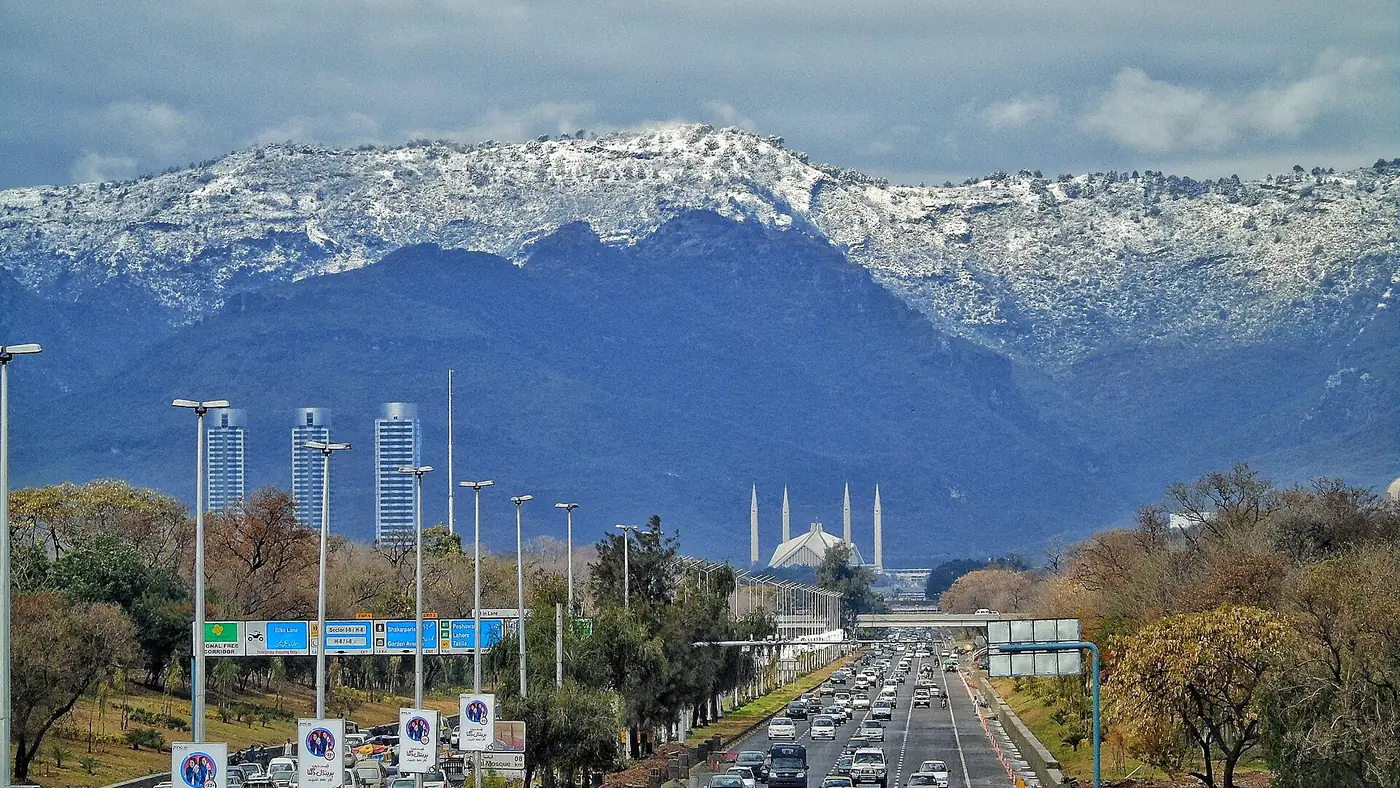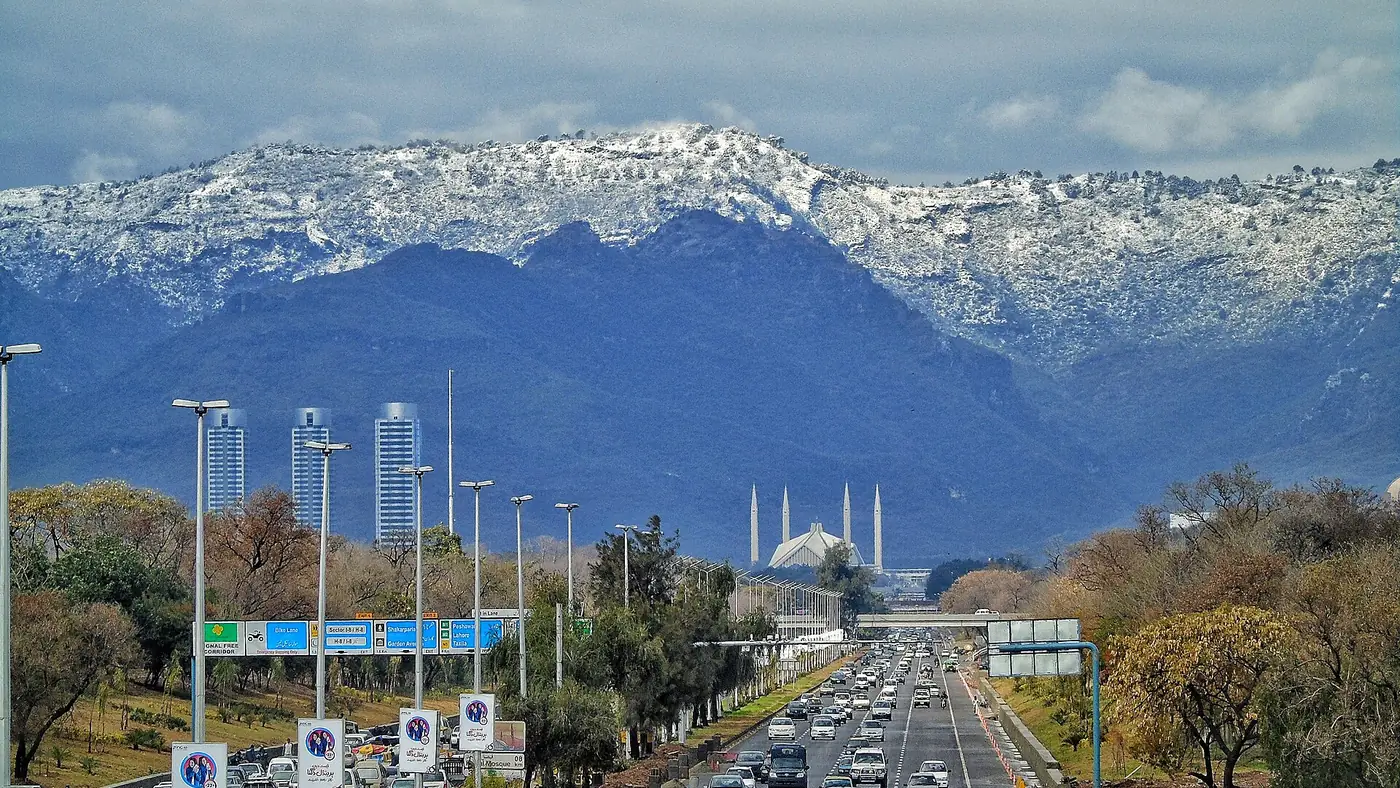
The best places to visit in Islamabad fall into three clusters. Along the foot of the Margalla Hills are Faisal Mosque, the Daman-e-Koh viewpoint, Saidpur Village and the hiking trails. On the Shakarparian hills in the south-east are the Pakistan Monument and its museum, and Lok Virsa's Heritage Museum. And to the east is Rawal Lake, with Lake View Park beside it. Two days covers them comfortably: one for the hills, one for Shakarparian and the lake. Most of the headline sights are free, and the museums charge modest fees.
Islamabad is a young, spread-out city, so the trick is to see it area by area rather than criss-crossing it. This guide lists each place with the time it needs and any fee, then suggests an order that makes sense.
| Place | Area | Time to allow | Entry |
|---|---|---|---|
| Faisal Mosque | Margalla foothills | 45 min to 1.5 hours | Free |
| Daman-e-Koh | Margalla foothills | 45 min to 1.5 hours | Free |
| Saidpur Village | Margalla foothills | 1 to 2 hours, with a meal | Free |
| Margalla Hills trails | Margalla foothills | 1.5 hours to a half-day | Free for individuals |
| Pakistan Monument and museum | Shakarparian | 1.5 to 2 hours | Museum PKR 200 for adults (2026) |
| Lok Virsa Heritage Museum | Shakarparian | 1.5 to 2 hours | PKR 150 for adults (2026) |
| Lake View Park and Rawal Lake | East, off Murree Road | 1 to 3 hours | Small entry fee |
| F-9 Park | City centre | 1 hour | Free |
| Golra Sharif and the railway museum | Western edge | 1.5 to 2 hours | Small fee at the museum |
Fees are as listed by the operators in 2026 and change from time to time.
Along the Margalla Hills
The hills that frame the north of the city hold most of Islamabad's best-known sights, all within a few minutes' drive of each other along Margalla Road.
Faisal Mosque
The capital's defining building, designed by the Turkish architect Vedat Dalokay and completed in 1986, with a tent-shaped hall and four minarets about 90 metres tall. It was the largest mosque in the world until 1993. Entry is free; visit between prayers, dress modestly, and avoid Friday midday. Our Faisal Mosque visitor guide covers timings, the dress code and where women can go.
Time: 45 minutes to an hour and a half. Best: late afternoon, before Maghrib.
Daman-e-Koh
A viewpoint terrace on the hills at about 730 metres, directly above the city, reached by a short road off Margalla Road or on foot by Trail 2. From the top you see Seventh Avenue running away into the city, Faisal Mosque and, on a clear day, Rawal Lake. Entry is free, and there are restaurants and snack stalls. See our Daman-e-Koh guide for access, the bus and the walk up.
Time: 45 minutes to an hour and a half. Best: sunset and the first hour of dark, or a clear morning.
Saidpur Village
An old village at the foot of the hills below Daman-e-Koh, dating back to the Mughal period and named after a Gakhar chief, Said Khan. The CDA restored it from 2006 as an arts and crafts village, and it now has restaurants and cafés in the old buildings, craft shops and a 16th-century Hindu temple, which is preserved but not in use for worship. Entry is free; you pay only for what you eat.
Time: an hour or two, with a meal. Best: the evening, after Daman-e-Koh.
The Margalla Hills trails
Six numbered trails climb from the edge of the city into the Margalla Hills National Park. Trail 3, opposite F-6, is the steep classic; Trail 5, opposite F-5, starts gently along a stream; Trail 2 is the short walk to Daman-e-Koh; and Trail 6, behind Faisal Mosque, is closed except on guided tours. They are free for individual hikers and best walked early in the morning. Our comparison of every Margalla Hills trail helps you pick one.
Time: an hour and a half to a half-day. Best: first light, October to March.
Pir Sohawa
The road continues above Daman-e-Koh to Pir Sohawa, at about 1,100 metres on the top of the ridge, for wider views and cooler air. Its big restaurants, including Monal, were demolished in 2024 under a Supreme Court order, so go for the drive and the view rather than a meal.
Time: an hour or so, by car.
Shakarparian and the Pakistan Monument
The low hills of Shakarparian, in the south-east of the city on the way to Rawalpindi, hold the national monument and the capital's two best museums, all within a short walk or drive of each other.
The Pakistan Monument and museum
The monument, inaugurated in 2007 and designed by the architect Arif Masoud, is shaped like an opening flower: four large petals for the four provinces' peoples and three smaller ones for the other regions and communities. It stands on the western hill of Shakarparian, with views across both cities, and it is lit at night.
Beside it, the Pakistan Monument Museum, run by Lok Virsa, tells the story of the independence movement, with a wax museum, and corners on Quaid-e-Azam and Allama Iqbal. It opens Tuesday to Sunday from 10 am to 8 pm and is closed on Mondays. Lok Virsa lists tickets at PKR 200 for adults and PKR 100 for students, with children under seven free (2026).
Time: an hour and a half to two hours. Best: late afternoon, staying for the lights.
Lok Virsa Heritage Museum
Pakistan's national museum of folk heritage, on Garden Avenue in Shakarparian: galleries of costumes, jewellery, embroidery, woodwork, musical instruments and life-size scenes from communities across the country. It is one of the best introductions to Pakistan's regional cultures anywhere, and children tend to like the dioramas. It is closed on Mondays. Lok Virsa lists tickets at PKR 150 for adults and PKR 80 for students, with children under seven free (2026). The Lok Virsa website has current details for both museums.
Time: an hour and a half to two hours.
Shakarparian Park and the Natural History Museum
The Shakarparian hills themselves are a large park with viewpoints over the city and trees planted by visiting heads of state. Close by on Garden Avenue, the Pakistan Museum of Natural History has galleries of fossils, minerals and wildlife that suit families with younger children. The Rose and Jasmine Garden, near the Shakarparian area, is at its best in spring.
Time: an hour each, or combine them into a half-day with the museums.
Rawal Lake and Lake View Park
Rawal Lake, the reservoir on the Korang river that supplies water to Rawalpindi and Islamabad, lies on the eastern side of the city. Lake View Park, on its shore off Murree Road, is the capital's big family park, run by the CDA, with boating, a large bird aviary, play areas, walking paths and food stalls. There is a small entry fee, and activities are charged separately.
It is busy on weekends and holidays, and at its most pleasant on a weekday afternoon in spring or autumn. Go at sunset for the light on the water.
Time: one to three hours, depending on the children.
In the city
- F-9 Park (Fatima Jinnah Park) is one of the largest parks in Islamabad, right in the city centre, with jogging tracks and open lawns. Good for an early walk or a picnic.
- Constitution Avenue runs past the Parliament, the Supreme Court and the Presidency. These are in the high-security Red Zone, so treat them as buildings to see from the road.
- Kohsar Market (F-6) and Jinnah Super (F-7) are the classic places to eat and walk in the evening. The malls of the Blue Area and Centaurus are nearby for shopping.
On the western edge
- Golra Sharif is home to the shrine of Pir Meher Ali Shah, a major Sufi shrine. Dress modestly, and expect big crowds during the urs.
- The Pakistan Railways Heritage Museum, at the old Golra Sharif railway station, has galleries of railway relics from the colonial era onwards. It keeps daytime hours and charges a small fee.
- Shah Allah Ditta, at the western end of the Margallas, has old caves in the hillside and a shrine; Trail 7 starts nearby.
A sensible order: Islamabad in two days
Day one: the Margalla foothills
- Early morning: a trail. Trail 3 to the first viewpoint, or the stream section of Trail 5. Skip it if you are not walkers.
- Late morning: F-9 Park or Kohsar Market for breakfast and a rest, or back to the hotel in summer.
- Afternoon: Faisal Mosque, after Asr.
- Sunset: Daman-e-Koh, staying for the lights.
- Evening: Saidpur Village for dinner.
Day two: Shakarparian and the lake
- Late morning: Lok Virsa Heritage Museum. Remember it is closed on Mondays.
- Lunch in the city, or at Kohsar Market or Jinnah Super.
- Afternoon: Pakistan Monument and museum, and a walk on Shakarparian.
- Evening: Lake View Park by Rawal Lake, or back to the monument to see it lit.
With a third day, add Golra Sharif and the railway museum, or take a day out of the city: see our guide to day trips from Islamabad for Taxila, Rohtas Fort, Khewra and more.
When to visit, and getting around
The most comfortable months are October to April, when days are mild and clear. From May to July the city is very hot, and sightseeing is best kept to early mornings and evenings. The monsoon, from July to September, is green but humid, with heavy downpours.
Distances in Islamabad are short but not walkable between areas. Ride-hailing apps are the easiest way to get around, the Metro Bus runs along the city's main axis to Rawalpindi, and the CDA's feeder buses serve some sights, including Faisal Mosque and Daman-e-Koh.
Who Islamabad suits
Islamabad suits families, first-time visitors to the north, and anyone who likes green space, easy hiking and a calm city. It is clean and well organised, and it makes a gentle first or last stop on a trip to the mountains.
It suits travellers less well if they want old bazaars and centuries of history, which the capital, built from the 1960s, simply does not have. For that, spend a day in Rawalpindi's old city, go to Taxila, or plan a few days in Lahore. If Islamabad is the start of a longer trip north, tell us your dates and we will help you plan around it.
Frequently asked questions
What is the most famous place in Islamabad?
Faisal Mosque, the city's defining landmark, followed by the Pakistan Monument and the view from Daman-e-Koh.
How many days are enough for Islamabad?
Two days covers the main sights: one for Faisal Mosque, Daman-e-Koh, Saidpur and a trail, and one for the Pakistan Monument, Lok Virsa and Rawal Lake. A third day allows a trip to Taxila or Rohtas Fort.
What are the free places to visit in Islamabad?
Faisal Mosque, Daman-e-Koh, Saidpur Village, the Margalla Hills trails, Shakarparian and F-9 Park are all free. The museums and Lake View Park charge modest fees.
What are the timings of the Pakistan Monument Museum?
Lok Virsa lists it as open Tuesday to Sunday from 10 am to 8 pm, closed on Mondays. The Lok Virsa Heritage Museum is also closed on Mondays.
What is the best time to visit Islamabad?
October to April, when the weather is mild. Summer is very hot, so plan outdoor sightseeing for early morning and evening.
Is Islamabad good for families?
Yes. Lake View Park, the Natural History Museum, Lok Virsa's dioramas, Daman-e-Koh and the short Trail 2 all work well with children.