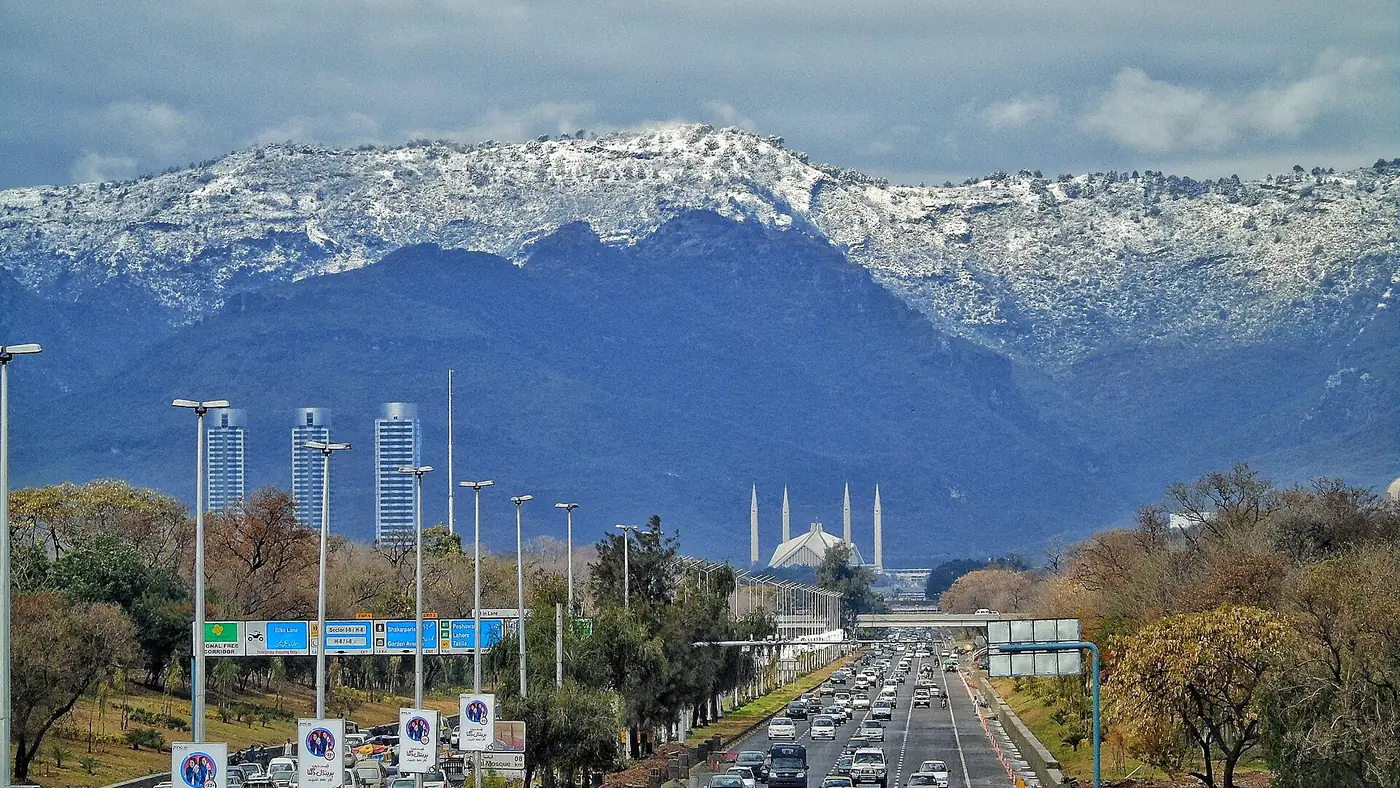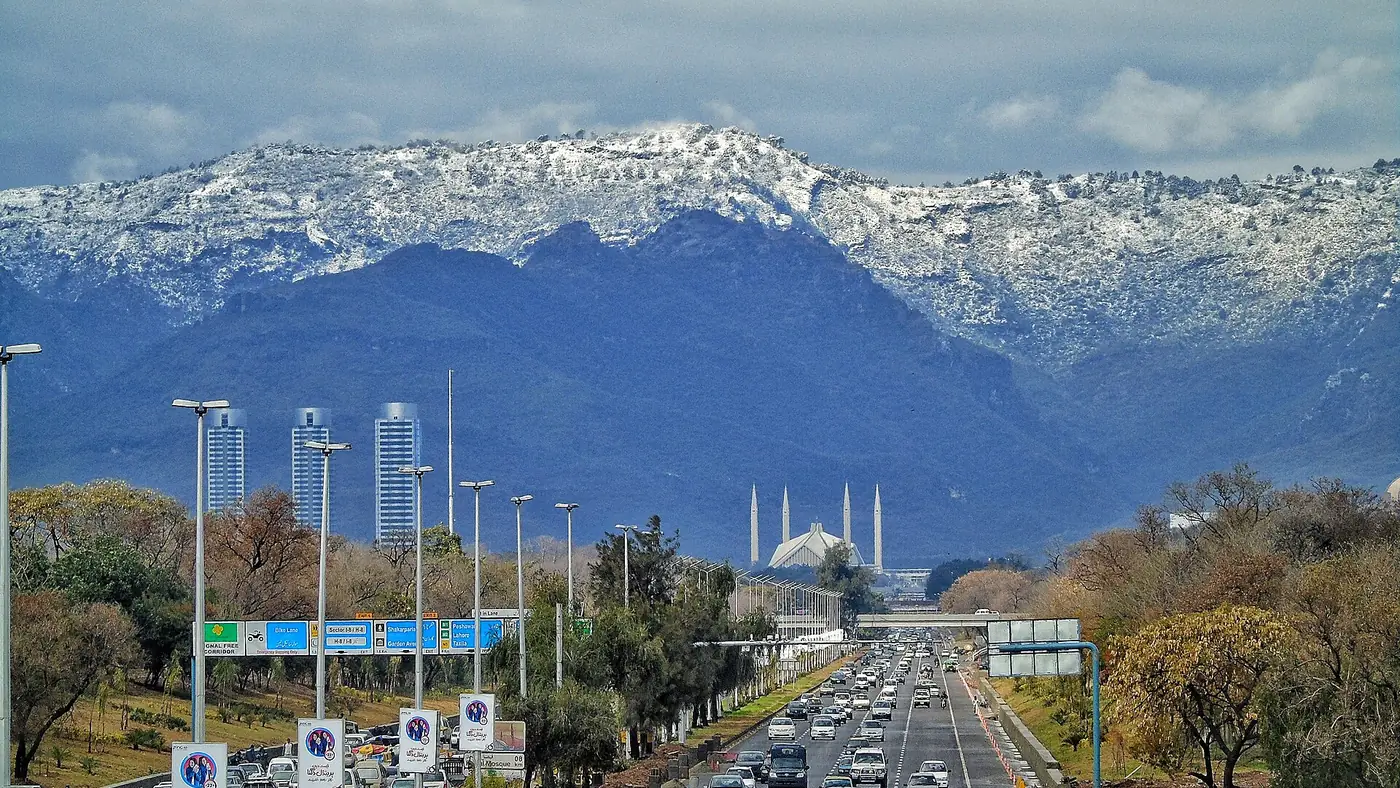
The Margalla Hills trails are numbered 1 to 6, all climbing from the northern edge of Islamabad into the Margalla Hills National Park. For a first hike, choose Trail 3 if you want a steep, short workout with a city view, Trail 5 if you want a gentler start along a stream, or Trail 2 if you are walking with children, because it is the shortest and ends at the Daman-e-Koh viewpoint. Trail 1 and Trail 4 are longer and quieter, and Trail 6, behind Faisal Mosque, has been closed to the public since 2022 except on guided tours.
All of them are free for individual hikers, all are best walked in the morning, and all should be off by dusk. This guide compares each trail by start point, length, climb, shade and weekend crowds, then covers the rules, the seasons and what to carry.
| Trail | Starts | Ends | Time up, roughly | Best for |
|---|---|---|---|---|
| Trail 1 | Behind sectors E-8 and E-9 | Pir Sohawa road | About 2 hours | Fit hikers wanting quiet |
| Trail 2 | Old Marghazar Zoo, below Daman-e-Koh | Daman-e-Koh | 1 to 1.5 hours | Families, a short first hike |
| Trail 3 | Margalla Road, opposite F-6 | Viewpoint, then Pir Sohawa | 30–50 minutes to the viewpoint; 1.5–2 hours to the top | A steep workout with a view |
| Trail 4 | Pir Sohawa road, near its start | Loop via Dhok Jeevan | A half-day loop | Experienced hikers in a group |
| Trail 5 | Margalla Road, opposite F-5 | Pir Sohawa road | 2.5 to 3.5 hours | A gentler start, stream in the first stretch |
| Trail 6 | Behind Faisal Mosque | Chak Jabbi | Guided tours only | Leopard zone; closed to the public |
Times vary a great deal with fitness, stops and the heat. The figures above are the typical ones given by the CDA and experienced hikers, not promises.
Which Margalla trail should you choose?
- Never hiked before, or with children: Trail 2 to Daman-e-Koh, or the first, stream-side part of Trail 5.
- Want a proper workout in under two hours: Trail 3 to the first viewpoint and back.
- Want a longer day in the forest: Trail 5 all the way to the Pir Sohawa road, or Trail 3 to the top.
- Want to avoid crowds: Trail 1 or Trail 4, on a weekday, with company.
- Want to see the leopard zone: book a guided Trail 6 tour through the Islamabad Wildlife Management Board.
The trails one by one
Trail 1
Trail 1 starts at the western end of the range, behind sectors E-8 and E-9, near where Margalla Road meets Agha Shahi Avenue. It climbs over a series of ridges to the Pir Sohawa road, and most people take about two hours to reach the top.
It is far quieter than Trails 3 and 5. It suits fit hikers who want solitude and know the hills, ideally in a small group. It is not a good first trail or one for young children.
Trail 2
Trail 2 is the shortest of the numbered trails. It starts beside the old Marghazar Zoo at the foot of the hills and climbs to the Daman-e-Koh viewpoint in about an hour to an hour and a half, where there are food stalls, tea and a play area. From Daman-e-Koh a path carries on higher to Cactus Ridge for anyone who wants more.
It is short but not flat: expect some steep, rocky sections. It is the easiest choice for families, and it has the advantage of a reward at the top that children understand. Our guide to Daman-e-Koh covers the viewpoint and the walk.
Trail 3
Trail 3 is the oldest and best-known trail in Islamabad, starting from its own car park on Margalla Road opposite sector F-6. From the trailhead you can climb to the first viewpoint either straight up the steep fire lane, or by the gentler bird loop paths on either side. The viewpoint takes 30 to 50 minutes and looks straight over the city.
Most people turn round there. Beyond it the trail carries on for another 45 minutes to an hour, past rest spots with benches, to Pir Sohawa at the top of the ridge. It is the steepest of the popular trails, with little respite on the fire lane, and on weekend mornings it is one of the two busiest. See our full Trail 3 guide for the viewpoints, the timings and how fit you need to be.
Trail 4
Trail 4 is the quiet one. Its usual starting point is a marked car park near the start of the Pir Sohawa road, from where it loops through the forest around the village of Dhok Jeevan and back, a walk of roughly 8 km. It also links sideways to Trails 3 and 5, and towards the Trail 6 area.
The path is narrower and the forest denser than on the main trails, and there are far fewer people. That makes it good for experienced hikers and poor for beginners, who can lose the way. The Islamabad Wildlife Management Board has locked the Trail 4 gates overnight in the past because of leopard activity, so start early and be out well before dark.
Trail 5
Trail 5 is the most popular trail in the range, and for many people the most pleasant. It starts from a car park on Margalla Road opposite sector F-5, at Dara Jangla, where there is a plant nursery, a picnic area and a campsite. The first stretch follows a stream through shaded forest on a gentle gradient, before the path turns steeper and rockier on the climb to the Pir Sohawa road.
The CDA gives two and a half to three and a half hours for the trail. You can also walk just the stream section and turn back, which makes an easy outing. Our Trail 5 guide covers the parking, the route and what to expect on the climb.
Trail 6
Trail 6 starts behind Faisal Mosque and climbs a forested valley to Chak Jabbi, an abandoned village on the ridge. Since January 2022 the area has been a leopard preservation zone, fenced and closed to the general public, after leopards were repeatedly photographed there.
The Islamabad Wildlife Management Board runs guided tours of the zone for a fee, booked through the board. Don't try to walk in on your own. If you are visiting the mosque, our Faisal Mosque guide covers what you can see nearby.
Other trails
Trail 7, opened in 2022, runs about 5 km from sector C-12 near Shah Allah Ditta to Kanthala village, at the western end of the hills. There are also longer unnumbered routes further east, including the climb to Tilla Charouni, at 1,604 metres the highest point in the national park. They need more experience and, usually, a guide.
Rules, fees and hours
- Individual hikers pay nothing. There is no entry fee or permit for walking the trails on your own or with friends.
- Organised groups need permission. Since late 2023, schools, companies, NGOs and tour organisers running hikes or events in the national park have had to apply to the Islamabad Wildlife Management Board and pay a fee.
- Hike in daylight only. The board advises against being on the trails at dawn, dusk or night, when leopards are most active, and specifically discourages evening and full-moon hikes. Plan to be off the trail well before sunset.
- No fires, no smoking. The hills burn easily in the dry months before the monsoon, and fires are common.
- Take your rubbish home, and don't feed the monkeys.
When to hike the Margalla trails
October to March is the best season: cool mornings, clear air after rain, and comfortable walking through the middle of the day. In December and January it can be properly cold at dawn.
April to June is hot. Start at first light and be down by mid-morning, carry plenty of water, and remember that this is fire season. July to September brings the monsoon: the streams on Trail 5 run full and the forest is at its greenest, but paths are slippery, and heavy rain can make stream crossings unsafe.
On any weekend morning, Trails 3 and 5 are busy from early on and their car parks fill up. Weekday mornings are much quieter.
What to carry
- More water than you think, at least a litre per person; there is no safe drinking water on the trails
- Proper shoes with grip, not sandals or smooth trainers
- A hat and sunscreen from April to October
- A light snack; don't count on stalls at the top
- A charged phone
- A warm layer for early winter mornings
Pir Sohawa, where Trails 1, 3 and 5 end, is no longer the restaurant stop it was: the big restaurants, including Monal, were demolished in 2024 under a Supreme Court order, and only small licensed kiosks were allowed to stay along the road.
Safety on the trails
The Margalla trails are well used, close to the city and generally safe in daylight, but they are real hill paths:
- Don't hike alone on the quieter trails, and tell someone your route.
- Come down the way you went up unless you know the connecting paths well. The wildlife board gives the same advice, because trying a new route down late in the day is how hikers get lost.
- Leopards are shy and avoid people; the risk is being on the trail at the wrong time, not the animal itself.
- Monkeys gather where people eat. Keep food out of sight.
- Streams rise fast in heavy rain. Don't cross fast water on Trail 5.
For more on Islamabad beyond the hills, see our guide to places to visit in Islamabad. If you are warming up in the Margallas for a trek further north, tell us your plans.
Frequently asked questions
Which is the easiest Margalla Hills trail?
Trail 2, from the old zoo to Daman-e-Koh, is the shortest. The first stream-side stretch of Trail 5 is the gentlest walking, and you can turn back whenever you like.
Which Margalla trail is the hardest?
Of the popular trails, Trail 3 is the steepest, especially the fire lane to the first viewpoint. Trails 1 and 4 are longer and more remote, and need more experience.
Is there an entry fee for the Margalla Hills trails?
Not for individual hikers. Organised groups and events need permission from the Islamabad Wildlife Management Board and pay a fee.
Is Trail 6 open?
No. Trail 6 has been a leopard preservation zone since January 2022 and is open only on guided tours arranged by the Islamabad Wildlife Management Board.
What time do the Margalla trails close?
There is no single closing time, but the wildlife board advises hiking in daylight only and being off the trails before dusk. Trail 4's gates have been locked overnight in the past.
Are there leopards on the Margalla trails?
Yes, leopards live in the national park, but they are shy and avoid people. Sightings on the main trails are very rare; stick to daylight hours and you are very unlikely to meet one.