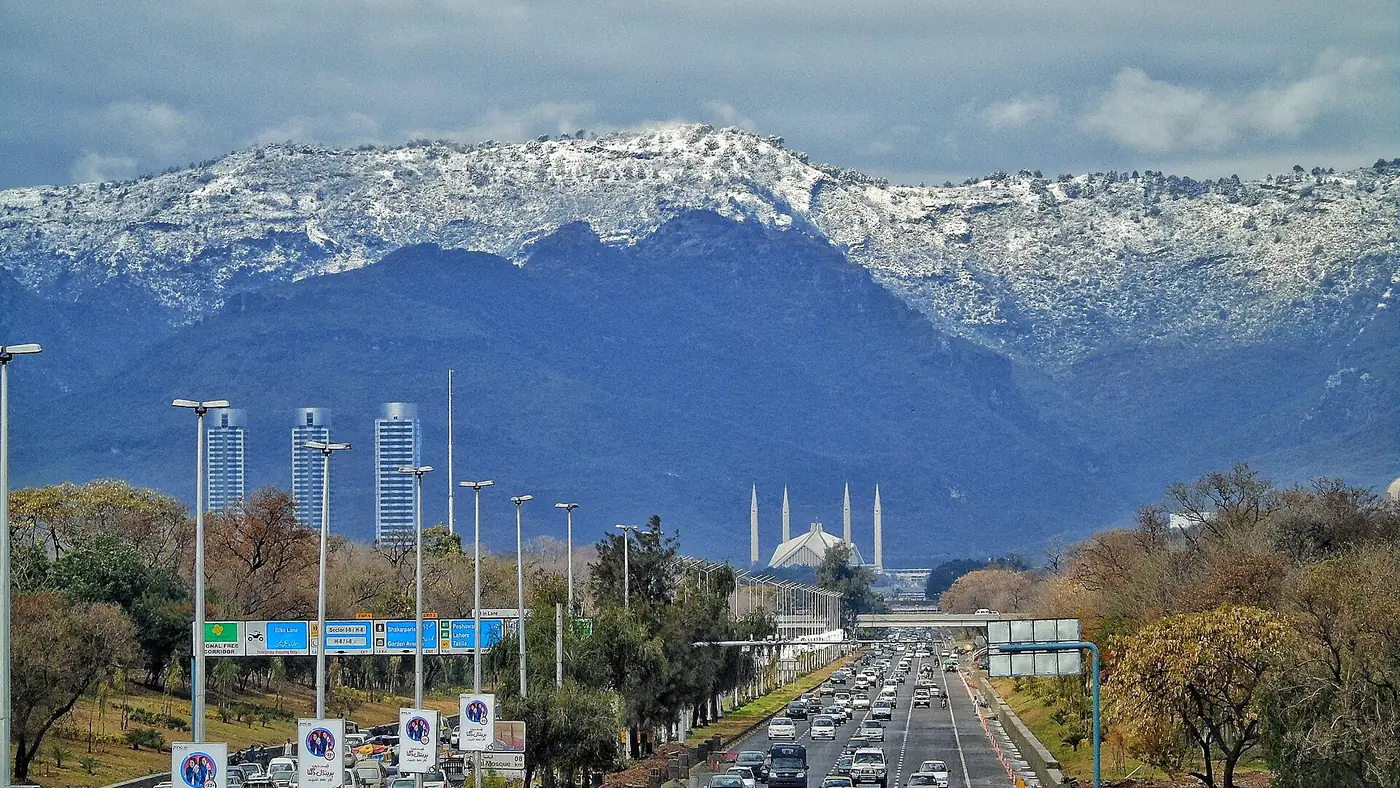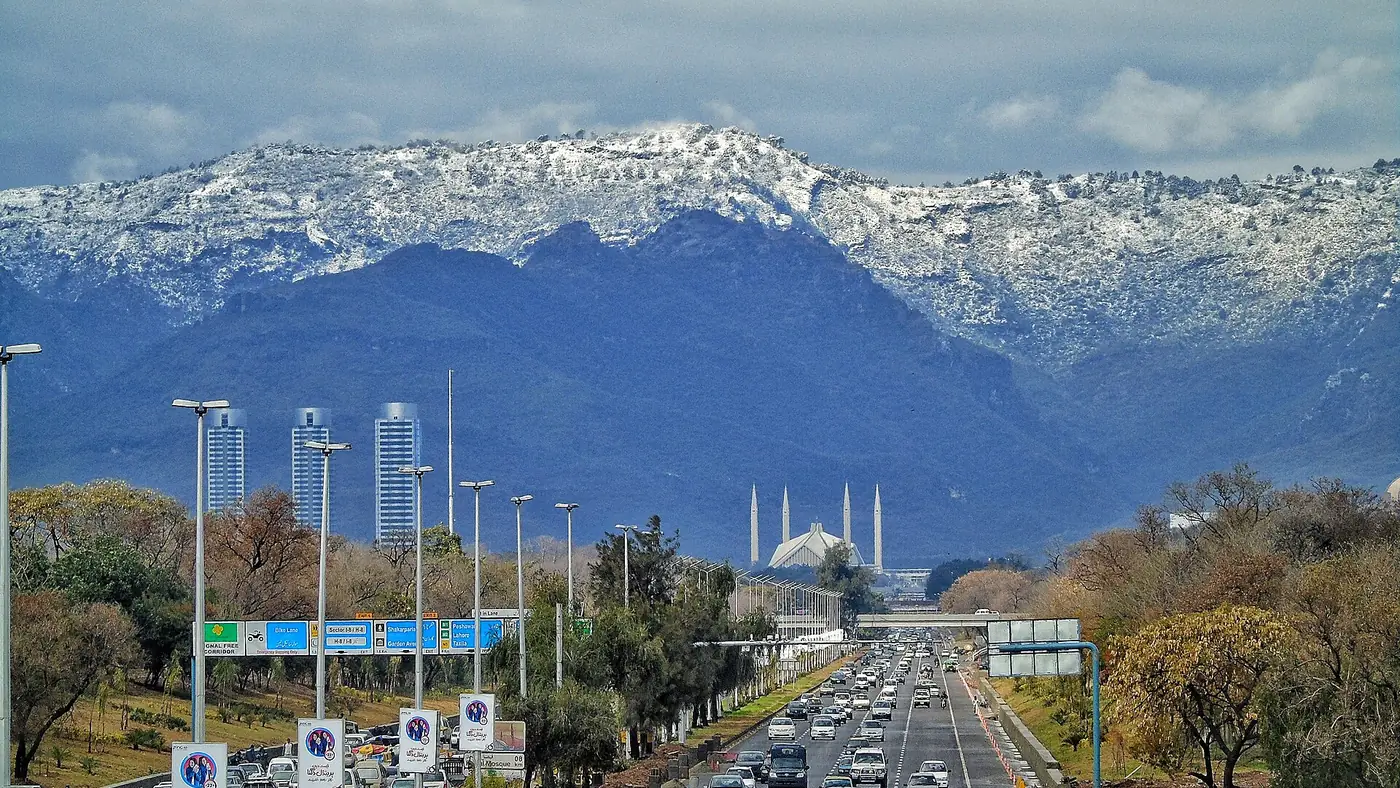
Daman-e-Koh is Islamabad's classic viewpoint, a terrace on the Margalla Hills at about 730 metres, directly above the city. You reach it by a short, winding road off Margalla Road beside the old Marghazar Zoo, then walk or take a CDA golf cart from the car park to the terrace. Entry is free, it is open from morning into the evening, and from the top you look down Seventh Avenue to Faisal Mosque, the city grid and, on a clear day, Rawal Lake. You can also walk up in about an hour on Trail 2.
It is one of the first places visitors to the capital are taken, and it is at its best either on a clear morning or at dusk, when the city lights come on. This guide covers how to get there by car, bus or on foot, when to go, what you are looking at, food and facilities, and how to fit it into a day.
| At a glance | |
|---|---|
| Where | Margalla Hills, above sector E-7 |
| Height | About 730 m, roughly 150 m above the city |
| Entry | Free |
| Open | Morning into the evening, daily |
| By car | Daman-e-Koh road, off Margalla Road by the old zoo |
| By bus | CDA feeder route ST-01 from PIMS |
| On foot | Trail 2, about an hour up |
| Time needed | 45 minutes to 1.5 hours |
How do you get to Daman-e-Koh?
By car or ride-hailing
The road to Daman-e-Koh leaves Margalla Road close to the old Marghazar Zoo and the Japanese Park, at the northern edge of the city near sectors E-7 and F-7, and climbs a short series of bends to the car park below the viewpoint. Expect 15 to 30 minutes from most of central Islamabad, depending on traffic.
The road is narrow and winding, and on holiday evenings and weekends the traffic backs up on the way in and the car park fills. If it is busy, a ride-hailing car that drops you at the top and leaves again saves a lot of waiting.
From the car park, the CDA runs golf carts up to the viewpoint terrace, which helps with older parents and small children. You can also walk; it is not far.
By bus
The CDA's feeder bus route ST-01 runs from PIMS hospital to Daman-e-Koh, stopping on the way at F-8 Markaz, F-9 Park, Faisal Masjid, F-7 Markaz and the zoo. The published timetable shows departures from PIMS roughly every hour from mid-morning to late afternoon, taking about 40 minutes to the top. Check the current timetable before relying on it, and note that it covers daytime hours only, so for a sunset visit plan another way home.
On foot, by Trail 2
Trail 2 climbs from beside the old zoo at the foot of the hill to Daman-e-Koh. It is the shortest of the Margalla trails, but steep in places, and most people take about an hour, a little more with stops. The reward at the top is the view and a cup of tea.
A few things to know:
- Walk it in daylight. The Islamabad Wildlife Management Board advises against being on any Margalla trail at dusk or after dark, when leopards and other wildlife are most active. If you want to stay for the city lights, walk up and take a car down.
- Carry water. There is none on the trail itself.
- Wear proper shoes. The path is rocky and slippery after rain.
- Keep going if you want more. From Daman-e-Koh a path continues higher to a spot known as Cactus Ridge, for a quieter view.
For the other trails and how they compare, see our guide to every Margalla Hills trail.
When is the best time to go?
The hour before sunset and the first hour of dark is the most popular time, and for good reason: you see the city in daylight, watch the light go, and then see the grid of streetlights come on. The CDA itself singles out the night view. It is also the busiest time, especially on Friday, Saturday and Sunday evenings.
Morning is quieter, cooler in summer, and often clearer, particularly after rain. It is the time for photographs of Faisal Mosque.
Through the year:
- October to March brings the clearest air and pleasant days, though on some winter mornings smog or haze over the plains can flatten the view. Evenings get cold at the top from December to February, so take a layer.
- April to June is hot, so come early in the morning or in the evening.
- July to September, the monsoon, can hide the view under cloud one hour and clear it the next. The days after heavy rain are often the sharpest of the year.
What you see from the terrace
The terrace faces south over the city, and the view is essentially a map of Islamabad laid out below you. What to look for:
- Seventh Avenue, running straight away from the foot of the hill into the city. Islamabad's grid of sectors is easiest to understand from here.
- Faisal Mosque, to the right, its four minarets and tent-shaped hall standing out at the foot of the hills.
- The Pakistan Monument on the Shakarparian hills, and beyond it the sprawl of Rawalpindi.
- Rawal Lake, to the left in the distance, on a clear day.
- The green belts between the sectors, which from up here show how much of the city is still trees.
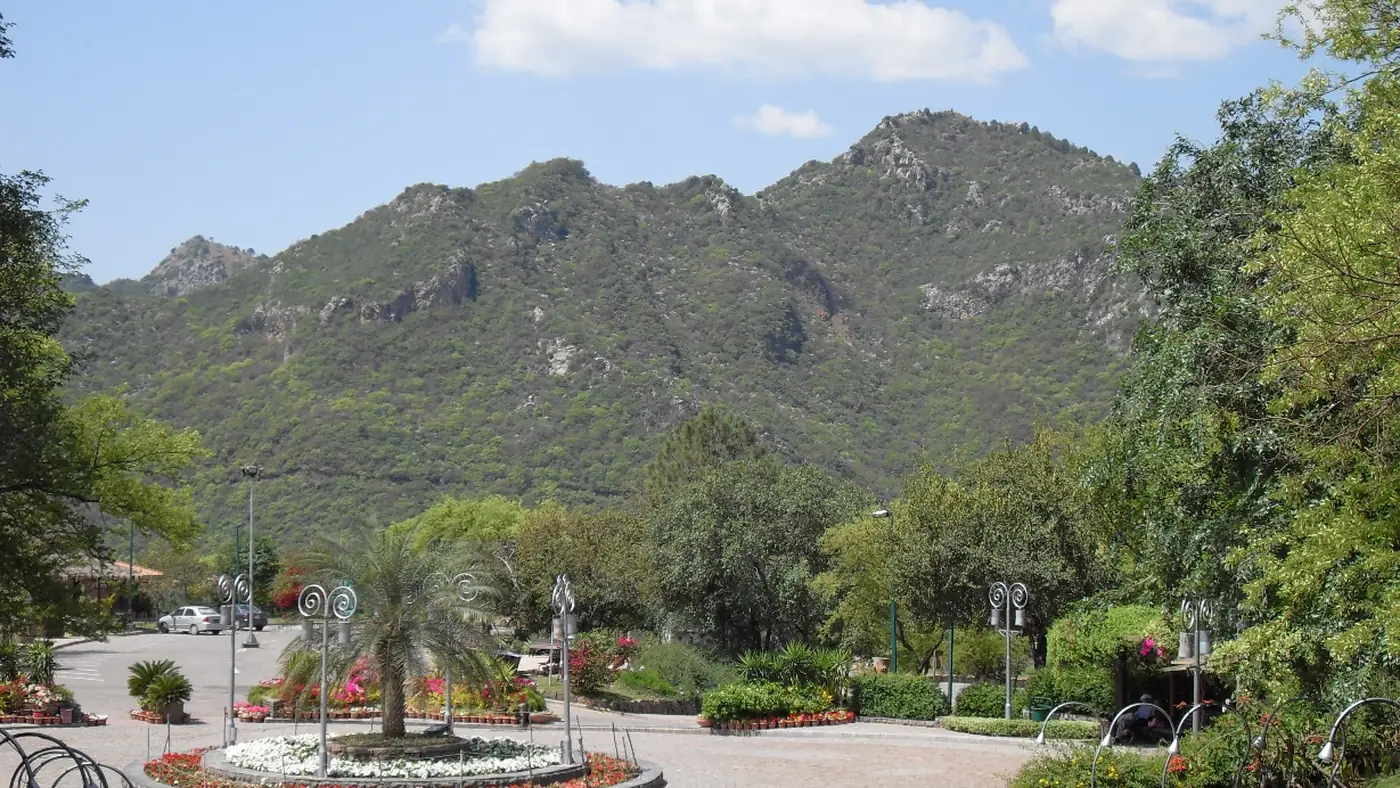
Telescopes and a large interpretive map on the terrace help you pick out the landmarks. Behind you, the forested ridges of the Margalla Hills rise towards Pir Sohawa.
Food and facilities
There are restaurants and snack stalls at Daman-e-Koh, with tea and street food and a play area for children, so a family visit can easily include a meal or at least a snack. On busy evenings, expect queues.
If you would rather eat somewhere with more choice, Saidpur Village, at the foot of the hills below Daman-e-Koh, has several restaurants in restored old buildings and makes a good stop on the way down.
Monkeys and other wildlife
Daman-e-Koh is known for its monkeys, which come for the snacks visitors bring. They are fun to watch and a nuisance at close quarters:
- Don't feed them, however much children want to.
- Keep food, drinks and plastic bags out of sight.
- Don't try to take anything back from a monkey that has grabbed it.
- Keep small children close, and don't crouch down to a monkey's level for a photograph.
Leopards live in the wider Margalla Hills and have been reported coming down closer to the city in winter. They are shy and rarely seen, and the terrace itself is busy and safe; the advice to stay off the trails after dark is about the forest, not the viewpoint.
Going further: Pir Sohawa and beyond
The Pir Sohawa road climbs on above Daman-e-Koh to the top of the ridge, at about 1,100 metres, with wider views and cooler air. Its best-known restaurants, including Monal, were closed and demolished in 2024 after a Supreme Court ruling on commercial building in the national park, and although a court decision in July 2026 reopened the legal question, the buildings are gone, so don't expect a restaurant meal at the top. Small licensed kiosks along the road were allowed to carry on. Go for the drive and the view, and take food with you.
The chairlift that once linked Daman-e-Koh to Pir Sohawa was stopped over environmental concerns, so you need a car to go higher.
How to fit Daman-e-Koh into a day
Daman-e-Koh is a short hop from the other sights at the foot of the hills. A simple half-day:
- Late afternoon: Faisal Mosque. Visit between Asr and Maghrib; our Faisal Mosque visitor guide covers timings and dress.
- Sunset: Daman-e-Koh. Drive up about 45 minutes before sunset, and stay for the lights.
- Evening: Saidpur Village for dinner on the way down.
Walkers can swap the first step for a morning on Trail 3, whose trailhead is a few minutes along Margalla Road. For the rest of the city, see our guide to places to visit in Islamabad.
Is Daman-e-Koh worth it?
Yes, especially on a first visit to Islamabad. In under an hour it explains the city's layout better than any drive around it, and it costs nothing. Families, older parents and anyone short of time get the view without a hike.
It suits people less well if they dislike crowds: on weekend evenings it is busy, the road is slow and the terrace is shoulder to shoulder. In that case, go on a weekday morning, or walk up one of the trails instead, where the views are nearly as good and the company is thinner. If you are passing through Islamabad and want a day in the city built into a trip north, tell us your plans.
Frequently asked questions
Is there an entry fee for Daman-e-Koh?
No. Entry to the viewpoint is free; you pay only for food and drinks.
What are the timings of Daman-e-Koh?
It is open daily from morning into the evening, and the city lights after dark are one of its main draws. Closing times are not widely published, so check locally if you plan a late visit.
How do I get to Daman-e-Koh by public transport?
The CDA's ST-01 feeder bus runs from PIMS hospital via F-8 Markaz, F-9 Park, Faisal Masjid and F-7 Markaz to Daman-e-Koh, roughly hourly in the daytime. Ride-hailing apps are the easier option in the evening.
How long is the hike to Daman-e-Koh?
Trail 2, from beside the old zoo at the foot of the hill, takes most people about an hour. It is short but steep in places; walk it in daylight and carry water.
Can you see Faisal Mosque from Daman-e-Koh?
Yes. Faisal Mosque is one of the clearest landmarks from the terrace, along with Seventh Avenue, the Pakistan Monument and, on a clear day, Rawal Lake.
Is Daman-e-Koh the same as Pir Sohawa?
No. Daman-e-Koh is the lower viewpoint, about 730 metres up and close to the city. Pir Sohawa is further up the same road, at the top of the ridge.