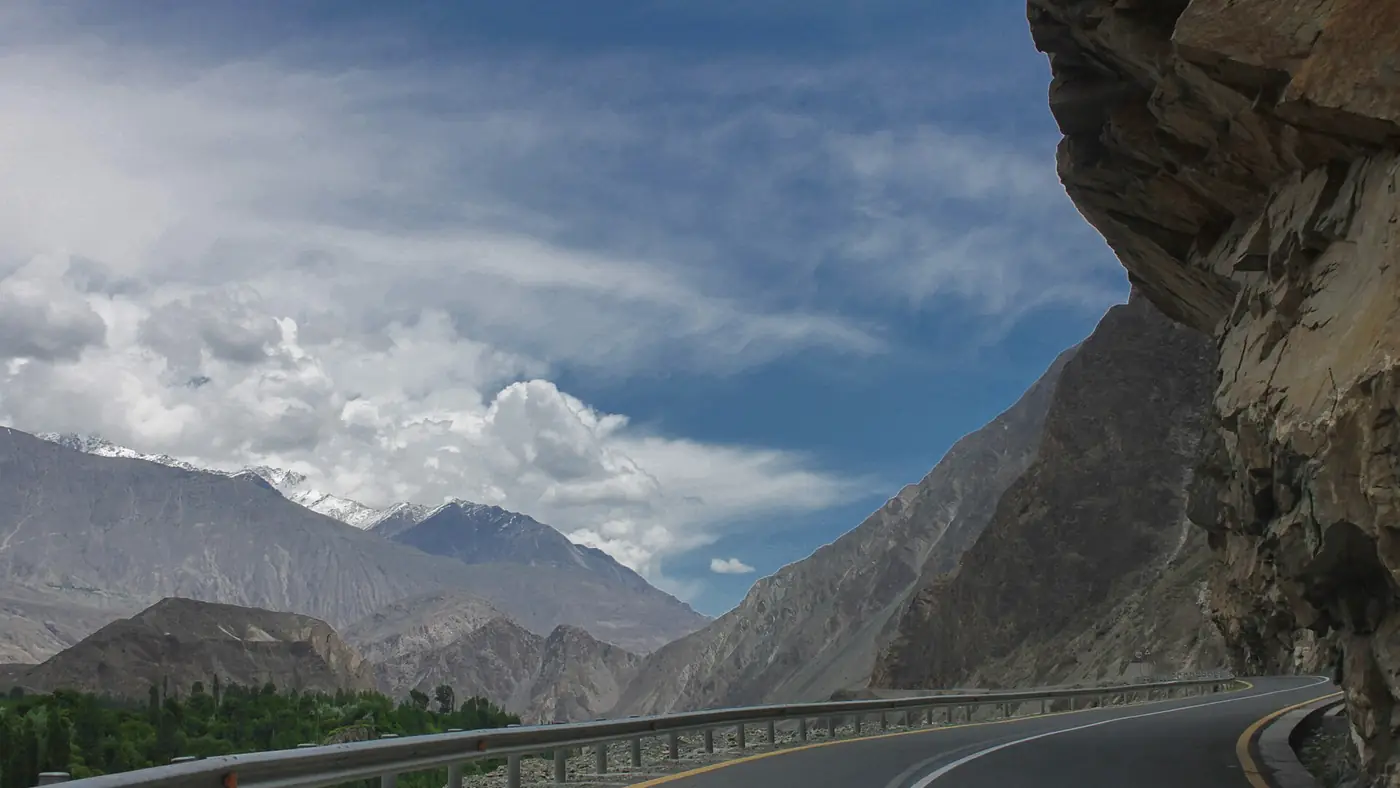
The Pak-China Friendship Tunnels are the five tunnels that carry the Karakoram Highway past Attabad Lake in upper Hunza. Together they run for a little over 7 km, inside a 24 km stretch of new road that was built between 2012 and 2015 to replace the highway drowned by the lake. For a driver they are simple: paved, lit and two lanes wide, and the whole realigned section takes 20 to 30 minutes from the southern end of the lake to Gulmit.
This guide explains why the tunnels were needed, what was built and by whom, how to drive through them, and where you can and can't stop for the lake.
| At a glance | |
|---|---|
| Where | Karakoram Highway, between Attabad and Gulmit, upper Hunza |
| Tunnels | Five, about 7.1 km in all |
| Longest tunnel | About 3.4 km |
| Realigned road | 24 km, with two large bridges and 78 smaller bridges and culverts |
| Built by | China Road and Bridge Corporation, for the National Highway Authority |
| Construction | July 2012 to September 2015 |
| Opened | 14 September 2015 |
| Reported cost | About US$275 million |
| From Karimabad | About 30 to 40 minutes to the first tunnel |
Why were the tunnels built?
On 4 January 2010 a landslide came down at Attabad village and blocked the Hunza river. Twenty people died, and the river backed up behind the debris into a lake that by June 2010 was about 21 km long and more than 100 metres deep. It drowned Ayeenabad, much of Shishkat, a large part of Gulmit, and some 19 km of the Karakoram Highway.
That cut Gojal, the upper half of Hunza, off from the rest of the country by road. It also cut Pakistan's only road link to China. For more than five years people, goods and even vehicles crossed the lake by boat and barge, loaded at one end and unloaded at the other. Every trip up or down the valley, and every consignment to or from the Khunjerab border, depended on the boats and the weather.
The answer was a new road around the lake, higher up the mountainside on its eastern side, and for much of the way that meant going through the mountain rather than along it.
What was built
The contract went to the China Road and Bridge Corporation (CRBC), the Chinese state company that was also rebuilding the highway from Raikot Bridge to Khunjerab at the time. Work started on 26 July 2012 and the completion ceremony was held on 14 September 2015, when Prime Minister Nawaz Sharif opened the road. The cost is usually given as about US$275 million.
The project had three parts:
- Five tunnels, 7,136 metres in all according to CRBC. The two long ones do most of the work: about 3,360 metres and 2,736 metres. The other three are short, at roughly 435, 410 and 195 metres.
- Two large bridges, including the long crossing of the Hunza river at Shishkat, near the northern end of the lake, which brings the road across to Gulmit.
- 78 small bridges and culverts where side streams cross the new alignment.
The name reflects who paid for and built it. Pakistan's side of the highway was first built by the army's Frontier Works Organisation with Chinese engineers in the 1960s and 1970s, and the rebuilding after 2008 was again Chinese-led. At the opening, the Prime Minister called Gilgit-Baltistan a vital link in the China-Pakistan Economic Corridor, which follows this road. Our guide to the history of the Karakoram Highway covers the older story.
Driving through the tunnels
Heading north from Karimabad, you come down to the highway at Ganish, follow the river upstream and meet the lake at its southern end, beside the main boat landing. The first tunnel starts close by. From there the road alternates between tunnels and short open stretches along the lake before crossing the river at Shishkat and reaching Gulmit.
The tunnels are straightforward to drive, but they reward a little care:
- Headlights on before you go in, and take sunglasses off. The change from bright lake light to the tunnel takes your eyes a few seconds.
- No overtaking inside. The tunnels are two lanes, one each way, with no hard shoulder.
- Keep your distance from trucks. This is the main road to China and goods lorries use it all day. In a tunnel, dust and exhaust hang in the air behind them.
- Watch for cyclists and motorbikes, who are harder to see in the half-light.
- Don't stop inside a tunnel or at its mouth, for photographs or anything else. If you break down, put your hazard lights on and stay with the car unless it is unsafe.
The tunnels were built with lighting and ventilation, and the National Highway Authority contracts out their day-to-day running. Even so, treat the lighting as a help rather than a guarantee, and drive as though the car ahead might stop without warning.
Where to stop for the lake
The tunnels themselves are not the sight. The lake is, and the realigned road gives you several chances to see it.
- The main landing at the southern end, beside the first tunnel, with parking, cafés and boats. It is busiest from late morning to mid-afternoon in summer.
- The open stretches between tunnels, where the road runs along the water. Stop only where there is a proper space off the carriageway, never on the approach to a tunnel mouth.
- The Shishkat and Gulmit end, where the lake narrows and the view back down the water is quieter. The staircase to Ondra Fort above Gulmit gives the widest view of all; our guide to things to do in Gulmit covers the climb.
For the colours, the boats and the best time of day, see our Attabad Lake guide.
Winter, rain and closures
The tunnels keep much of this stretch out of the weather, which is one reason the highway to Gulmit and Passu stays open through the winter. The places to watch are the open sections in between and the tunnel mouths, where meltwater can freeze into patches of ice on cold mornings. Slow down as you come out into the light, and expect the first few metres beyond each portal to be the slippery ones.
The tunnels are rarely what closes the road. The trouble is further north, where side streams cross the highway beyond Gulmit: in August 2025, floodwater buried the bridge at Gulmit and blocked the highway for a time. In July and August especially, check before you set out. Our guide to Karakoram Highway road status explains where to look.
What the tunnels changed
Before 2015, a trip from Karimabad to Passu or Khunjerab meant a boat across the lake and a vehicle on the other side. The tunnels turned it back into a short drive, and that opened Gojal to the day trips most visitors now take for granted: lunch in Gulmit, the Hussaini bridge, the Passu Cones and the drive to the border.
They also turned a disaster into a destination. The boating on Attabad grew out of the ferry years, and the lake is now the most visited place in the valley. For people who live in Gojal, the change mattered more than any view: the hospitals, markets and offices of Gilgit are once again a drive away, whatever the weather.
Is it worth stopping?
For the tunnels alone, no. There is nothing to see inside, and stopping in or near them is unsafe. Drive through, and give your time to the lake on either side.
For the lake, yes, and the tunnels are what make it easy. On a day trip from Karimabad, stop at the landing on the way north if it is early, and otherwise on the way back in the late afternoon, when the light is softer and the crowds have thinned. Our nine-day Gilgit, Hunza and Khunjerab tour spends a morning on the lake before carrying on through the tunnels to Passu. For the wider valley, see our Gilgit and Hunza page.
Frequently asked questions
How long are the Pak-China Friendship Tunnels?
The five tunnels add up to about 7.1 km. The longest is about 3.4 km and the next about 2.7 km; the other three are each under half a kilometre.
How many tunnels are there at Attabad Lake?
Five, spread along a 24 km realigned section of the Karakoram Highway between the southern end of the lake and Gulmit.
Who built the Attabad tunnels?
The China Road and Bridge Corporation built them for Pakistan's National Highway Authority, with Chinese financial support. The project cost about US$275 million.
When did the Attabad tunnels open?
On 14 September 2015, after work that began in July 2012. Before that, people and vehicles crossed Attabad Lake by boat for more than five years.
Can you stop inside the tunnels?
No. There is no hard shoulder, and trucks use the road all day. Stop only at the boat landing or in proper spaces off the road between tunnels.
Are the Attabad tunnels open in winter?
Yes. The Karakoram Highway through the tunnels to Gulmit, Passu and Sost is kept open all year, though ice at the tunnel mouths and snow on the open stretches call for slow, careful driving.