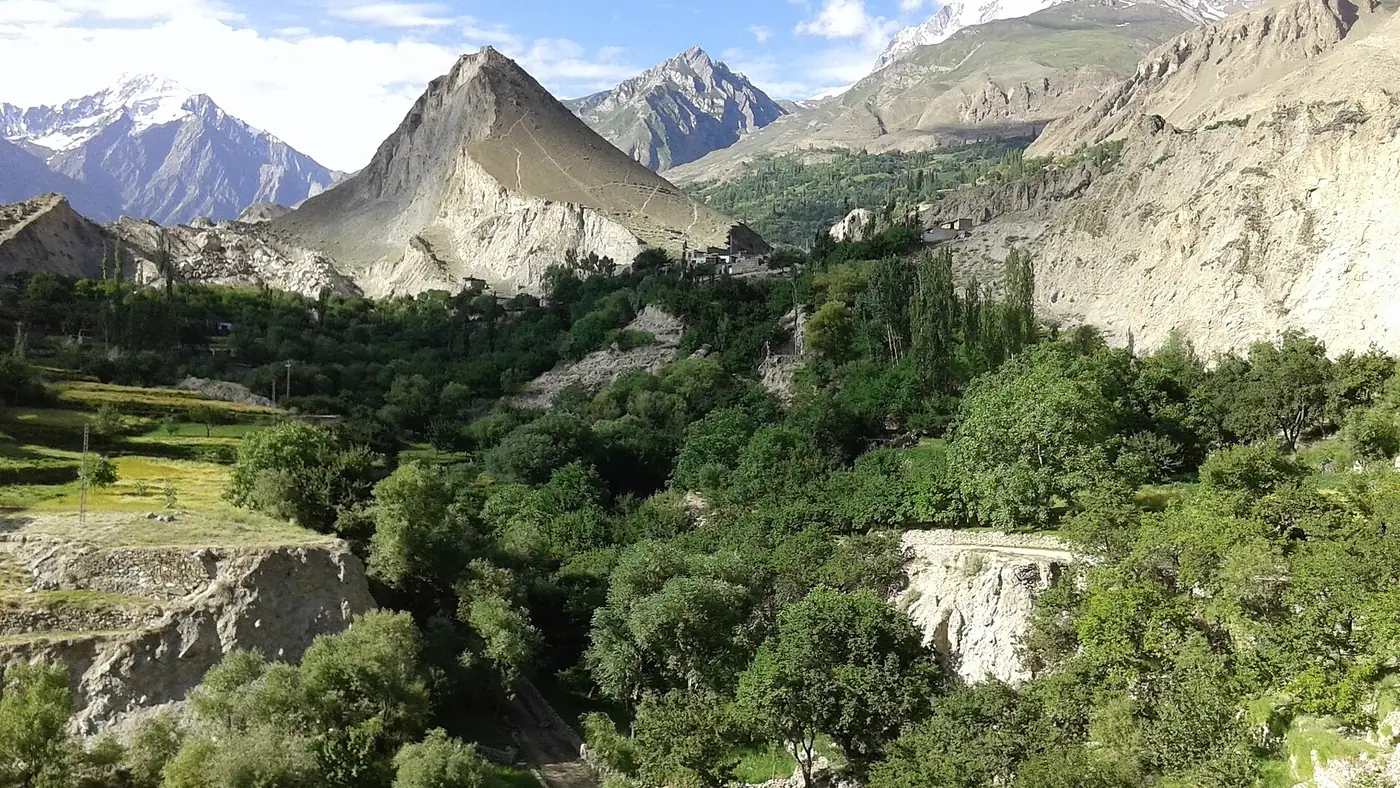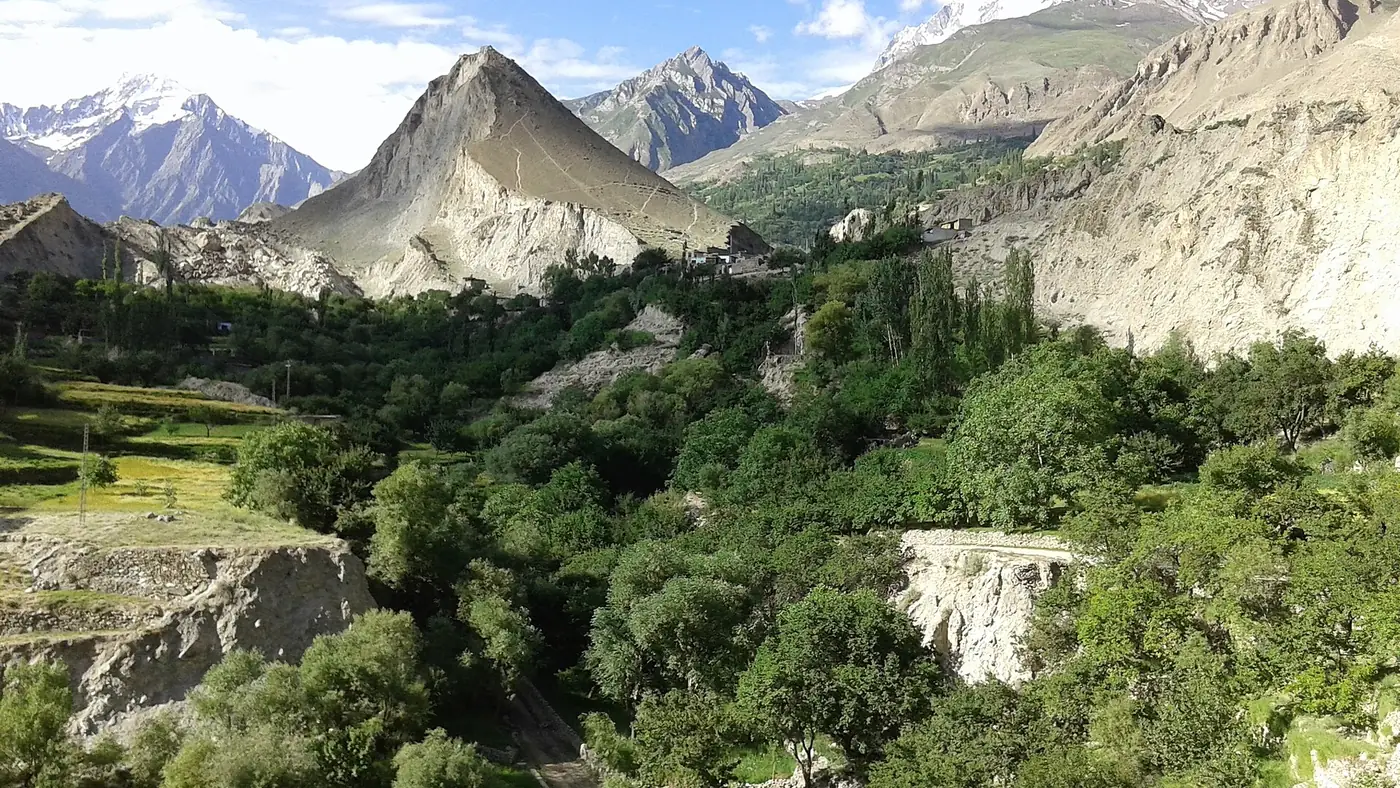
Nagar was an independent kingdom for centuries, ruled by its own Mirs from Nagar Khas, until a British military campaign in 1891 brought it under colonial control and Pakistan finally abolished the state in 1972. For most of that history it was locked in rivalry with Hunza, the kingdom across the river that shares its language and, by tradition, its origin.
This guide sets out how Nagar and Hunza came to be two states rather than one, how Nagar's Mirs ruled it, the campaign that ended its independence, and what remains of that history in the valley today.
| At a glance | |
|---|---|
| Ruling dynasty | The Mirs of Nagar, from the Maglot line |
| Old capital | Nagar Khas |
| Rival kingdom | Hunza, across the Hunza river |
| Key event | The Hunza-Nagar Campaign, December 1891 |
| End of the state | Abolished by Pakistan in August 1972 |
| Last ruler | Mir Shaukat Ali Khan |
| Languages | Burushaski and Shina |
| Religion | Predominantly Twelver Shia |
One river, two kingdoms
Nagar and Hunza sit on opposite banks of the Hunza river, and local tradition explains why with a story about twins. According to accounts recorded by British officers in the nineteenth century, an early ruler of the combined territory had twin sons, Moghlot and Girkis, who were hostile to each other from birth. Unable to settle which of them should succeed him, their father divided the kingdom between them: the south bank went to Moghlot, whose descendants became the Mirs of Nagar, and the north bank went to Girkis, whose line became the rulers of Hunza.
Whatever its historical accuracy, the story reflects something real: Hunza and Nagar share a language, Burushaski, a landscape, and centuries of contact, yet for most of their history they were rivals rather than allies, with raiding and shifting alliances between them a recurring feature of local politics into the nineteenth century.
The Mirs of Nagar
Nagar was ruled by its own line of Mirs, based at Nagar Khas, for generations before the British arrived in the region. Like Hunza, Nagar paid periodic tribute to more powerful neighbours over the centuries, including Kashmir under the Dogra rulers from the mid-1800s, while keeping its own ruler and its own internal affairs.
Religion set Nagar apart from Hunza in a way that still shapes the two valleys today. Nagar's population became predominantly Twelver Shia, while Hunza's became largely Ismaili, a difference that outsiders driving through both valleys can still see in the styles of mosque and imambargah along the road. Our guide to the difference between Hunza and Nagar covers this alongside the geography.
The 1891 campaign
Nagar's independence ended in a short but hard-fought campaign. In 1891, suspicious of contact between the rulers of Hunza and Nagar and Russian and Chinese agents to the north, the British sent a force under Colonel Algernon Durand from Gilgit to bring both states under control.
The decisive fighting happened at Nilt, a fort a short way up the valley from Chalt. British and Kashmir state forces besieged it from 1 December 1891; after assaults on 2 and 3 December failed to take it directly, Captain Fenton Aylmer led a party of sappers who blew open the main gate, and the fort fell in close fighting, at a cost of six British casualties against far heavier losses on the defending side. Three Victoria Crosses were awarded to British officers during the campaign.
The Mir of Nagar, Raja Azur Khan, tried to escape towards Chinese territory as the British advanced but was arrested. Nagar and Hunza were both occupied, and new rulers acceptable to the British were installed in each state, which then continued as princely territories under British and later Kashmiri suzerainty rather than fully independent kingdoms.
From princely state to Pakistan
Nagar carried on as a princely state through the first half of the twentieth century, ruled by its own Mir but answerable to outside authority, first British and then, after 1947, Pakistani. Mir Shaukat Ali Khan, who came to the throne in 1940, was its last ruler.
In August 1972, Zulfiqar Ali Bhutto's government abolished the remaining princely states of the north, including Nagar, and merged the territory into what was then called the Northern Areas, now Gilgit-Baltistan. The old distinction between Nagar and Hunza survives today mainly as district boundaries, and in the separate identities and memories of the two valleys, rather than as any political division.
What remains to see
Unlike Hunza, which kept Baltit and Altit forts as its royal seats and has restored both as museums, Nagar has no equivalent grand fort open to visitors. Nagar Khas, the old capital, is now the district headquarters and a quiet farming settlement of terraced fields, worth slowing down for on the drive to Hopper rather than a destination in itself.
Nagar's more visible history today is in memory and custom rather than buildings: its Shia festivals and mourning processions, its polo team, which was one of the strongest in the northern areas through the mid-twentieth century, and the everyday Burushaski and Shina spoken in its villages. Our guide to places to visit in Nagar valley covers what there is to see today, and our Gilgit and Hunza page sets Nagar in the context of the wider region.
Frequently asked questions
Was Nagar once part of Hunza?
By tradition they were one kingdom, split between twin brothers whose descendants became the rival ruling families of Hunza and Nagar. They were separate, independent states for most of their recorded history.
When did Nagar stop being an independent state?
Its independence effectively ended with the British campaign of December 1891. It continued as a princely state under outside authority until Pakistan abolished it in August 1972.
What caused the Hunza-Nagar campaign of 1891?
British concern over Russian and Chinese influence on the northern frontier, and the refusal of the rulers of Hunza and Nagar to accept British authority. The campaign's decisive battle was the fall of Nilt fort in December 1891.
Who was the last ruler of Nagar?
Mir Shaukat Ali Khan, who had ruled since 1940, was the last Mir of Nagar before the state was abolished in 1972.
Is there a fort or palace to visit in Nagar today?
Nagar has no restored royal fort comparable to Baltit or Altit in Hunza. Nagar Khas, the old capital, is now a quiet administrative village worth a stop on the way to Hopper rather than a historical site in its own right.