
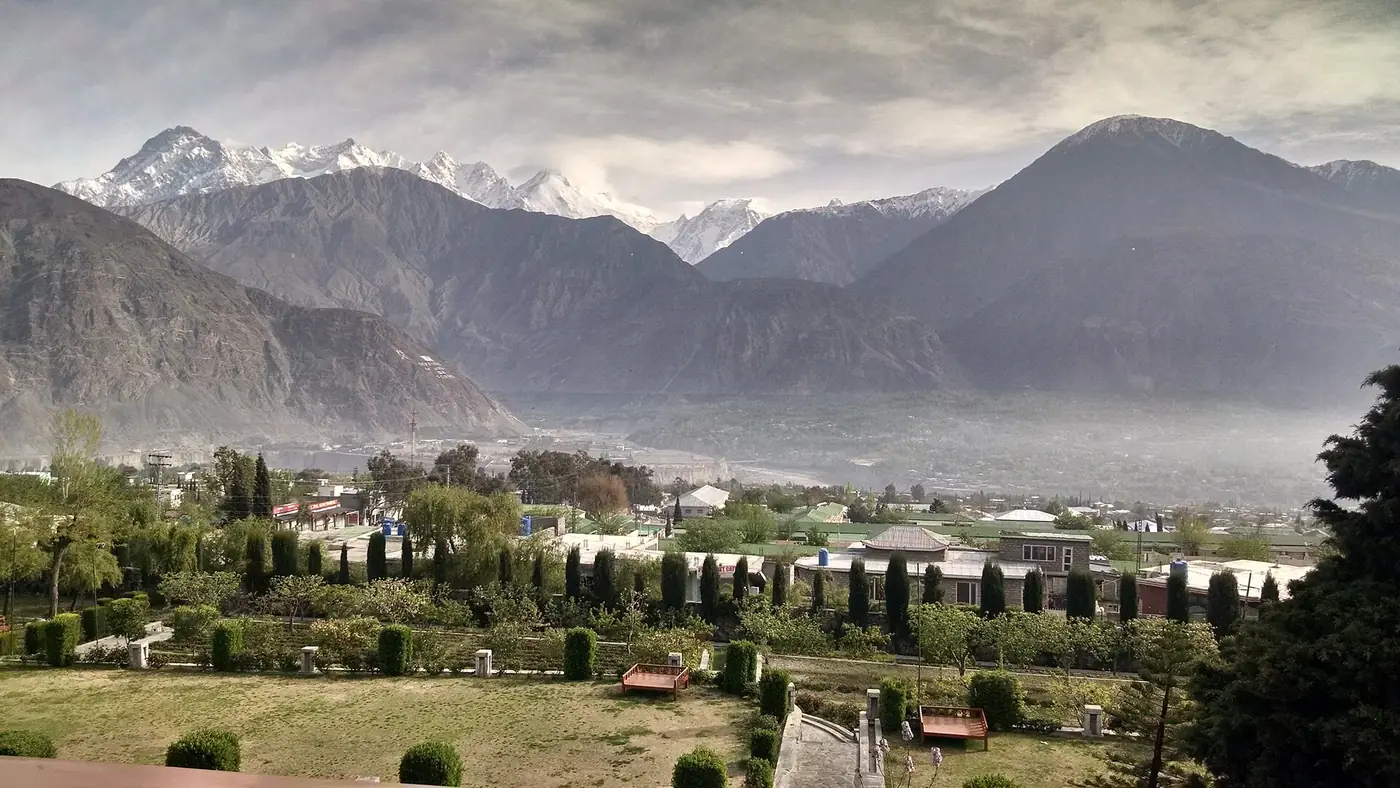

Gilgit's history runs from a Buddhist crossroads on the routes between Kashmir, Tibet and Central Asia, through a run of small local kingdoms, into a British agency during the Great Game, and finally into Pakistan after a local uprising in 1947. Little of this is obvious just passing through on the way to Hunza, but the layers are still visible if you know where to look, from a carved Buddha in a cliff outside town to the bazaars where the old trade routes met.
The Buddhist era
Buddhism reached Gilgit by around the 2nd century CE, arriving along the same trade routes that carried goods between South and Central Asia. From the 7th to 9th centuries, the Buddhist Patola Shahi dynasty ruled the area, at a time when it was contested between Tang dynasty China and the Tibetan Empire, both of which saw the routes through Gilgit as strategically important. Chinese pilgrims travelling to India, including Faxian around 400 CE and Xuanzang around 629 CE, recorded a region dotted with monasteries and stupas.
The clearest physical trace of this period is the Kargah Buddha, a large standing figure carved into a cliff face a short drive from the city, usually dated to around the 7th century. The Gilgit manuscripts, among the oldest surviving Buddhist texts in the world, were also found near the city, underlining how significant Gilgit once was as a centre of Buddhist learning.
The Dardic kingdoms
Gilgit sits within what is historically called Dardistan, home to Dardic-speaking peoples whose languages, including Shina, blend Iranian and Sanskritic influences. Between the 14th and 16th centuries, Sufi missionaries from Persia and Central Asia brought Islam to the region, gradually ending the Buddhist era. What followed was several centuries of small, competing local kingdoms, principally Hunza, Nagar, Skardu and Yasin, which repeatedly allied with and fought against each other and, later, the outside powers pressing in from the south.
The Great Game and British control
By the 19th century, Gilgit had become a point of interest in the Great Game, the rivalry between the British and Russian empires for influence in Central Asia. Concerned about the possibility of Russian expansion reaching the northern approaches to British India, the British established the Gilgit Agency in 1889 to bring the region under closer military and political control. Kashmir's Dogra rulers, who had already annexed Gilgit-Baltistan to their princely state earlier in the century, remained the nominal authority, with the British administering the Agency directly for long stretches, including a lease from 1935 that ran until just weeks before independence in 1947.
1947 and the road to Pakistan
Dogra rule was deeply unpopular with Gilgit's largely Muslim population, and when the Maharaja of Jammu and Kashmir acceded to India in October 1947 rather than Pakistan, the Gilgit Scouts rose up. On 1 November 1947, they took the Dogra governor into custody in a bloodless coup, and the Pakistani flag was raised in Gilgit the following day. A short-lived provisional government gave way within weeks to administration from Pakistan. The date is now marked annually; our guide to Gilgit-Baltistan Independence Day covers the uprising and how the anniversary is observed.
Gilgit-Baltistan's constitutional status has remained unresolved since, tied to the wider Kashmir dispute between Pakistan and India, and the region continues to be administered under its own arrangements rather than as a full province.
What a visitor can still see of this history
Most of Gilgit's layered past is visible within a short trip around the city and its immediate surroundings: the Kargah Buddha and the Buddhist-era rock carvings across the river at Danyor, the old bazaars that grew up where the Silk Road-era trade routes converged, and the general sense, once you know the background, that a small city at a river junction has mattered to a lot of outside powers over a very long time. Our guide to Gilgit and Hunza covers how to combine a look at this history with the rest of a trip north.
Frequently asked questions
Was Gilgit part of the Silk Road?
Gilgit lay on routes connecting Kashmir, Tibet and Central Asia that carried Buddhist pilgrims, traders and goods for centuries, and it is often described loosely as part of the wider Silk Road network rather than on the single main route between China and the Mediterranean.
When did Gilgit become part of Pakistan?
Gilgit joined Pakistan following the uprising of 1 November 1947, when the Gilgit Scouts overthrew the Dogra governor. Administration formally passed to Pakistan in mid-November of that year.
What is the Kargah Buddha?
A large standing Buddha carved into a cliff face west of Gilgit, usually dated to around the 7th century, from the period when the Buddhist Patola Shahi dynasty ruled the region.
Why was Gilgit important in the Great Game?
The British saw Gilgit's location as a strategic gateway on the northern approaches to India, and established the Gilgit Agency in 1889 largely to guard against feared Russian expansion into the area.
Is Gilgit-Baltistan a province of Pakistan?
No. It is administered under its own self-governance arrangements rather than as a full province, reflecting its unresolved status within the wider Kashmir dispute between Pakistan and India.