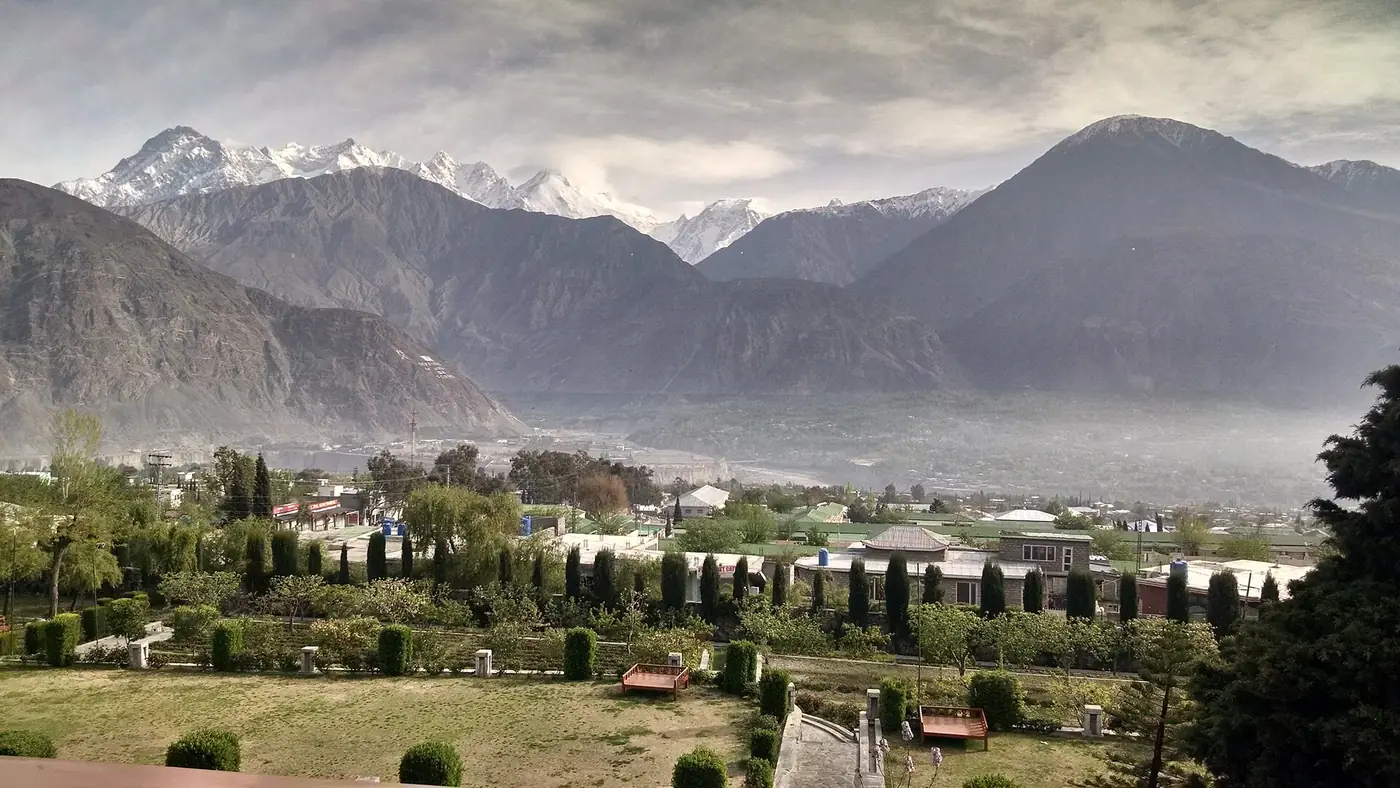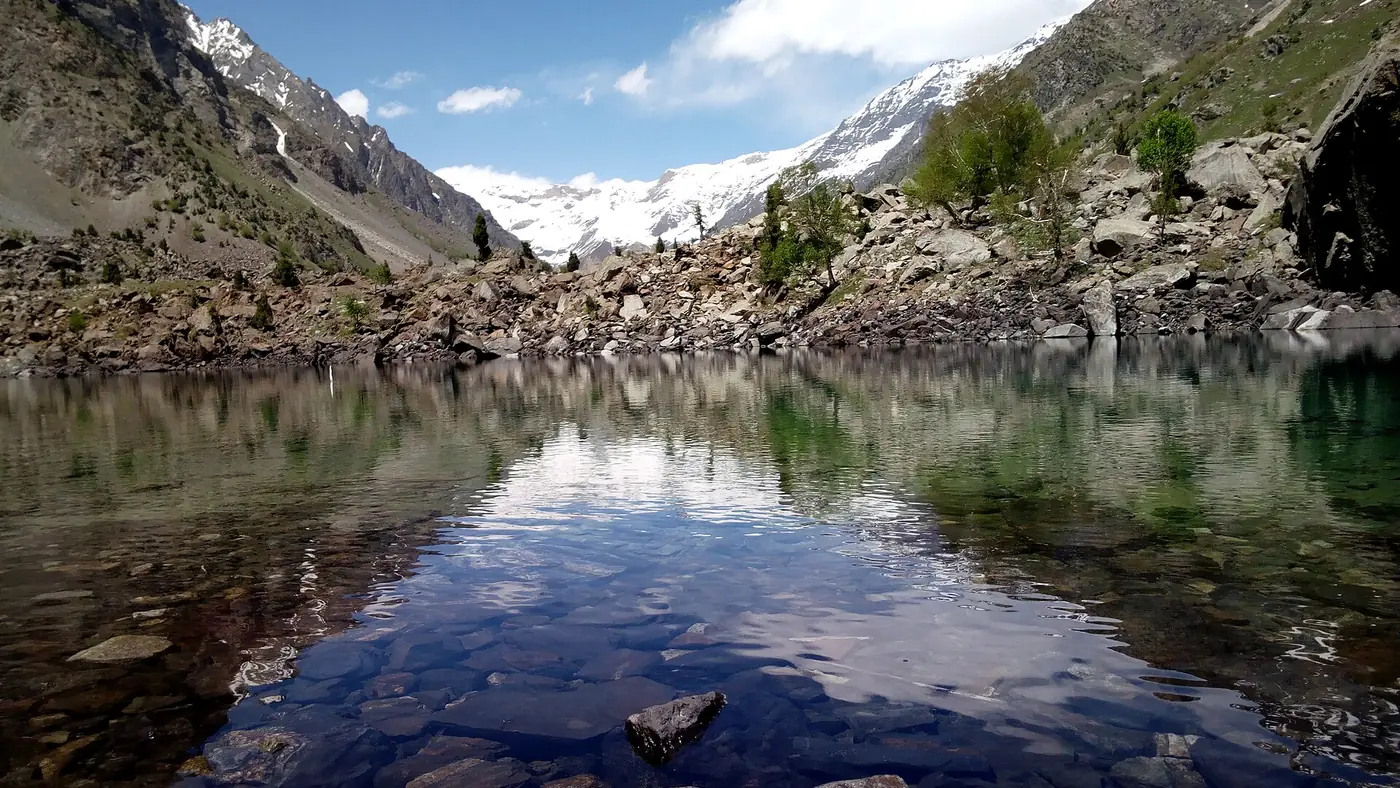
The Kargah Buddha is a standing Buddha carved into a cliff face in the Kargah nala, about 10 km west of Gilgit city. It is usually dated to around the 7th century, when Gilgit was ruled by the Buddhist Patola Shahi kings and sat on the trade routes between Kashmir, Tibet and Central Asia. From the city it is a short drive, the visit takes about an hour, and the best time to go is early morning or late afternoon, when the air is cooler and the light falls across the rock.
This guide covers what you actually see, the history behind it, the monastery and manuscripts found a short way upstream, the local legend, and how to plan the visit.
| At a glance | |
|---|---|
| Where | Kargah nala, about 10 km west of Gilgit city |
| Date | Usually placed around the 7th century |
| Time needed | About an hour; longer with a walk up the stream |
| Getting there | Taxi or car from Gilgit |
| Best time of day | Early morning or late afternoon |
| Best months | April to May and September to October; summer afternoons are hot |
| Fee | We found no reliable report of an entry fee |
What is the Kargah Buddha?
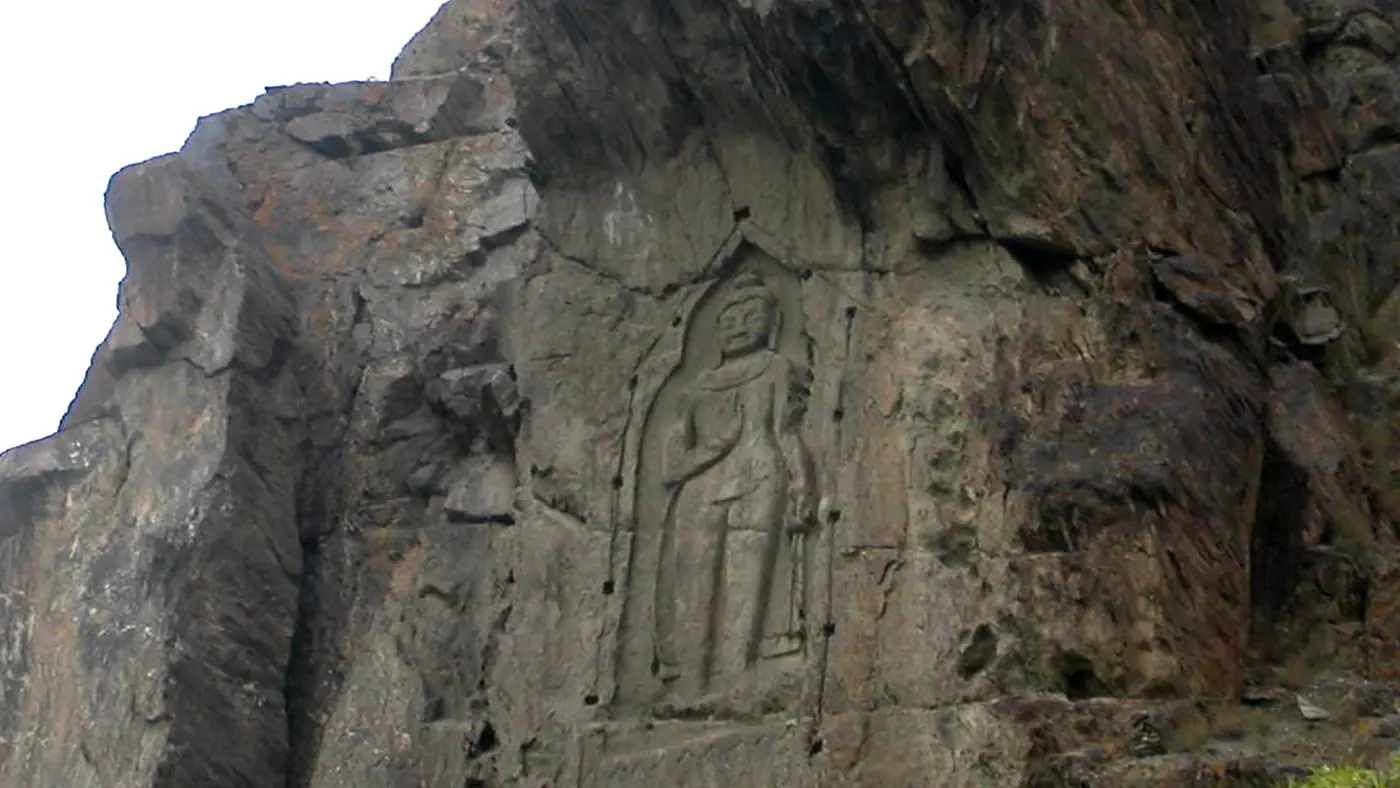
It is a single standing figure of the Buddha, carved in outline into a smooth rock face high on the cliff, where the Kargah and Shukogah streams meet. The Buddha's right hand is raised to his chest and his left hangs by his side. Around the figure are rows of holes cut into the rock, which most likely held the beams of a wooden canopy or shelter that once protected it.
Published figures for its size vary widely, from about three metres to fifteen, partly because some sources measure the figure and others its height on the cliff. Don't arrive expecting the scale of Bamiyan. It is a modest, finely drawn carving on a large cliff, and its interest lies in its age and its setting rather than its size.
You see it from below and from a set of steps built up towards it in recent years, which bring you much closer and give a view down the valley.
Who carved it, and when?
Between roughly the 3rd and 11th centuries, Gilgit was an important Buddhist centre. From the 6th to the 8th century it was the seat of the Patola Shahis, a dynasty of Buddhist kings who paid for gilded statues and the copying of sacred texts. The Kargah Buddha is generally attributed to their time, and most sources place it around the 7th century.
The same kings left their names in stone elsewhere around Gilgit. The Danyor rock inscriptions, beside the Karakoram Highway across the river, record the reign of Navasurendrāditya-nandin in the 7th century. Their rule faded in the 8th century, after Tibetan armies took Gilgit and the region passed between Tibetan and Chinese influence. Islam came later, and with it the local story that turned the Buddha into something else entirely.
The carving was discovered by archaeologists in 1938–39. The Gilgit Development Authority has since paid for walls, paths and viewing places at the site, and the Gilgit-Baltistan tourism department calls it the most admired short outing from the city.
The monastery and the Gilgit manuscripts
About 400 metres upstream from the Buddha, digging in 1931 uncovered the remains of a Buddhist monastery and three stupas. Inside the stupas were manuscripts written in Sanskrit on birch bark, now known as the Gilgit manuscripts.
They are thought to date from the 5th and 6th centuries and are among the oldest surviving Buddhist manuscripts from South Asia. They include sutras from the Buddhist canon, among them the Lotus Sutra, as well as texts on medicine, folk tales and philosophy. The collection is on UNESCO's Memory of the World register. None of it is in Gilgit: the manuscripts are held in India, at the National Archives in New Delhi and in Srinagar, and two are at the British Library in London.
It is worth knowing, as you stand below the carving, that this small valley was once a place of study as well as worship.
The legend of the yachini
Ask in Gilgit about the carving and you may hear a different story. In local tradition the figure is not a Buddha at all but a yachini or yakshini, a man-eating giantess who terrorised the valley until a holy man pinned her to the rock. The holes around the figure, in this telling, are the nails that hold her there, and she will stay pinned as long as they do.
It is a good example of how a place keeps its landmarks by giving them new meanings. Visitors from Buddhist countries, particularly Japan and South Korea, come to see a Buddha, while the giantess is the story told locally. Both are part of the site now.
How to get there from Gilgit
The Buddha is on the road up the Kargah valley, about 10 km from the centre of Gilgit. The simplest way is a taxi or a car with a driver from your hotel, who can wait while you walk up. Agree the price for the return trip, including the waiting time, before you set off.
At the site, a short path crosses a small bridge over the stream and leads past a water mill to the steps. The steps are steep in places but solid, with places to stop and look back. Allow an hour in all, a little longer if anyone in the group is slow on steps.
The approach was in poor condition in 2019; by 2021 visitors were reporting an improved road and the new steps. After heavy rain, ask your driver how the road is before you set off.
A visit combines easily with the other sights on the west and north sides of the city. A typical half-day:
- Kargah Buddha, first thing, before the heat.
- A walk up the Kargah stream, where people from Gilgit come for picnics in the shade.
- Back through the city and across the river to Danyor, for the suspension bridge, the rock inscriptions and the Chinese cemetery.
Our guide to places to visit in Gilgit covers Danyor and the bazaars for the rest of the day.
When to go, and when the light is best
Time of day. Go in the early morning or late afternoon. In summer, Gilgit's afternoons average around 35°C, which is no temperature for climbing steps. The carving is also a shallow outline on the rock, and like most rock carvings it shows up best when the sun falls across it at an angle. In flat midday glare, or in full shade, the figure is harder to pick out and to photograph. If the light is poor when you arrive, walk up the stream for half an hour and look again on the way back.
Season. April and May, and September and October, are the most comfortable months, with warm days and cool mornings. In winter the site is still reachable, since it lies at about the same height as Gilgit, and a clear, cold morning can be a fine time to visit, but check the road after snow. Our Gilgit weather guide covers the months in detail.
Visiting respectfully
- Stay on the steps and don't touch the carving. It has survived some 1,300 years; it doesn't need handprints.
- Take your rubbish back with you. The stream below is used by the people who live along it.
- Ask before flying a drone, and be prepared to be told no.
- Dress modestly, as you would anywhere in Gilgit, and be considerate of families picnicking by the water.
Is the Kargah Buddha worth the trip?
Yes, if you are spending a day in Gilgit. It is one of the city's oldest monuments and its most striking, it takes little time, and the Kargah valley is a pleasant escape from the traffic. For anyone interested in the Buddhist history of the northern valleys, it is essential, and it pairs naturally with the Danyor inscriptions from the same dynasty.
If you are driving straight through Gilgit to Hunza with no time to spare, you can skip it without missing the main point of your trip. But if you have flown in and need an easy first morning at a lower altitude, it is an ideal start. Our Gilgit, Hunza and Khunjerab tour visits it on the second day, with Danyor, and our Gilgit and Hunza page covers the region as a whole. If you need a base for the night, see our guide to hotels in Gilgit.
Frequently asked questions
How far is the Kargah Buddha from Gilgit?
About 10 km west of the city centre, up the Kargah valley. It is a short drive by taxi or hired car.
How old is the Kargah Buddha?
It is usually dated to around the 7th century, the time of Gilgit's Buddhist Patola Shahi kings. It was discovered by archaeologists in 1938–39.
How long does a visit take?
About an hour for the walk up the steps and the view. Allow longer if you want to walk up the stream or picnic.
Is there an entry fee for the Kargah Buddha?
We found no reliable report of a ticket being charged. Check locally, as arrangements at heritage sites can change.
What is the legend of the Kargah Buddha?
Local tradition says the figure is a yachini, a man-eating giantess pinned to the rock by a holy man, and that the holes around it are the nails that hold her.
What is the best time to visit the Kargah Buddha?
Early morning or late afternoon, when it is cooler and the sun falls across the carving. Spring and autumn are the most comfortable seasons.