Gilgit weather by month runs from hot, dry summers to cold, clear winters, with two comfortable seasons in between. In July the city averages 36°C in the afternoon and 18°C at night; in January it is about 10°C by day and −3°C at night. It barely rains, around 108 mm in a whole year, and the most comfortable months to be in the city are April, May, September and October.
Below is the month-by-month picture from the Pakistan Meteorological Department's Gilgit station, then what each season feels like on the ground, what to wear, and how Gilgit's weather differs from the valleys you will visit from it.
| Month | Day / night average | Rain, mm | Record high / low | What it feels like |
|---|---|---|---|---|
| January | 10°C / −3°C | 5 | 18°C / −10°C | Cold, dry, often clear |
| February | 13°C / 0°C | 7 | 22°C / −9°C | Still cold at night |
| March | 18°C / 5°C | 12 | 29°C / −3°C | Mild days, cold nights |
| April | 24°C / 9°C | 24 | 37°C / 1°C | Warm, showery, blossom |
| May | 29°C / 12°C | 25 | 42°C / 4°C | Warm to hot, some rain |
| June | 34°C / 15°C | 9 | 44°C / 5°C | Hot afternoons |
| July | 36°C / 18°C | 15 | 46°C / 10°C | The hottest month |
| August | 35°C / 18°C | 15 | 44°C / 10°C | Hot, sometimes stormy |
| September | 32°C / 12°C | 8 | 42°C / 3°C | Warm days, cooler nights |
| October | 26°C / 6°C | 6 | 36°C / −3°C | Clear and pleasant |
| November | 18°C / 0°C | 2 | 28°C / −9°C | Crisp days, freezing nights |
| December | 12°C / −2°C | 5 | 25°C / −11°C | Cold and dry |
Averages are long-term figures for the Gilgit station, which sits at about 1,500 metres. Any given year can run hotter, colder, wetter or drier.
Why Gilgit's weather is so dry
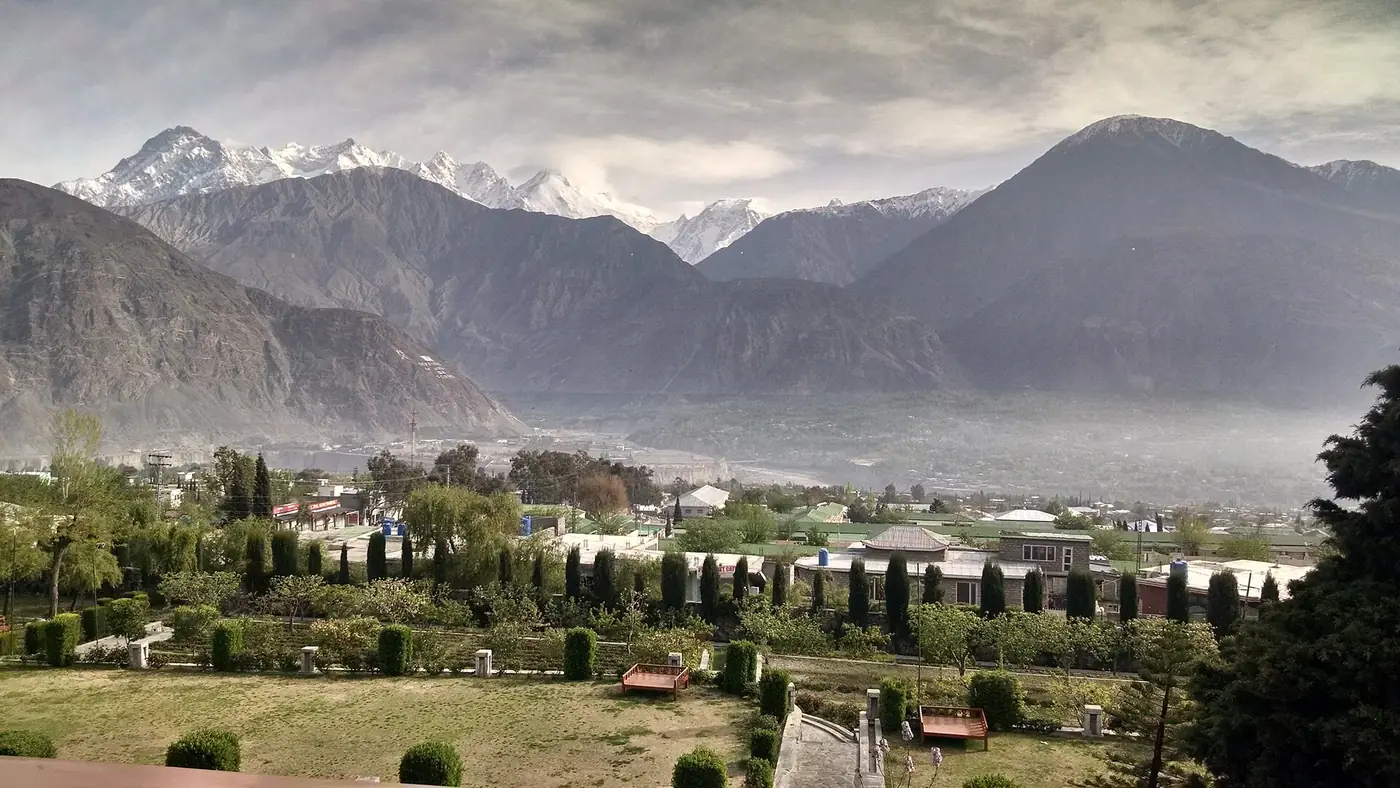
Gilgit is in the rain shadow of the Himalaya and the Karakoram, which block most of the monsoon. Its climate is classed as cold desert, and the bare brown mountains around the city show it. The green in Gilgit is all irrigated: orchards and poplars fed by channels from the rivers and side streams.
Two things follow from that. First, the humidity is low for most of the year, below 30 percent on an average spring or early-summer day, so 35°C in Gilgit feels less oppressive than 35°C in Lahore, though the sun is fierce. Second, the difference between day and night is large, often 15 to 20 degrees, so a warm afternoon tells you little about the evening.
How hot does Gilgit get in summer?
From June to August, Gilgit is hot. Afternoon averages run from 34°C to 36°C, and the record at the Gilgit station is 46.3°C, set in July. The whole Indus and Gilgit river corridor bakes in a heatwave: on 5 July 2025 Chilas, two hours down the road, reached 48.5°C, its highest ever, and Bunji, near the meeting of the Gilgit and Indus rivers, 46.1°C.
What that means on the ground:
- Do the sights early. The Kargah Buddha, Danyor and the Jutial walks are best before 10 in the morning or after 5 in the evening.
- Rest in the middle of the day, or spend it in the car on the way somewhere higher.
- Check the room. Ask whether your hotel has air conditioning and backup power, because load-shedding can switch it off when you need it most.
Nights stay warm, at 15°C to 18°C. Summer is also when the city fills with travellers heading to Hunza, Naltar and Khunjerab, all of which are far cooler.
Spring: March to May
Spring is short and lovely. March afternoons are mild at around 18°C, and by May they reach 29°C. Apricot and cherry blossom comes to the orchards around Gilgit a little earlier than in Hunza, because the city is lower.
April and May are also the wettest months, each bringing around 25 mm, which is still very little. It comes as showers and passing storms. In the valley itself that is a nuisance; on the high ground above, fresh snow and low cloud can ground the flights from Islamabad.
Nights are cold in March and still cool in May, so a jacket earns its place.
Autumn: September to November
September is still warm, at around 32°C in the afternoon, but the evenings are pleasant and the air is at its clearest. October is the best month for many people: dry, sunny days in the mid-20s, nights around 6°C, and the poplars and orchards turning gold through the month.
By November, days are crisp at about 18°C and nights fall to freezing. It rains least of all, barely 2 mm on average, so skies are usually clear. It is a good time for a quiet visit, as long as you pack for the cold evenings.
Winter: December to February
Winter in Gilgit is cold and mostly dry. January averages about 10°C in the afternoon and −3°C at night, and the record low at the station is −11°C. With so little precipitation, snow in the city itself is usually light; the heavy snow falls higher up, in Naltar and the side valleys. Some recent winters have been unusually dry: in January 2026, residents across Gilgit-Baltistan described bare mountains and far less snow than normal.
The harder part of winter is not the temperature but the power. Most of the region's electricity is hydropower, and as the streams freeze, output falls. In recent winters, parts of Gilgit-Baltistan have had power for only a few hours a day. Ask any hotel how it heats rooms and whether it has a generator, and bring warm clothes for indoors as well as out.
Winter is also when Naltar's ski slopes open, about two hours from the city. Our guide to skiing in Naltar covers the season and how to get up there in snow.
What to wear in Gilgit, season by season
June to August
- Light, loose cotton that covers shoulders and knees, for comfort and for the bazaar
- A hat, sunglasses and high-factor sunscreen
- A light jacket or fleece for the trips up to Hunza, Naltar or Khunjerab
April, May, September and October
- Layers: T-shirts, a long-sleeved shirt and a fleece or light jacket
- A warmer layer for evenings in April and late October
- Comfortable shoes for walking; the Kargah and Jutial paths are dusty
November to March
- A proper winter jacket, a warm hat and gloves
- Thermal layers, which matter indoors when the power is off
- Warm socks and closed shoes
Whatever the month, carry a scarf or shawl against dust, and a water bottle.
Gilgit versus the valleys around it
Gilgit is lower and hotter than almost everywhere you will visit from it. As a rough rule, the air cools by six to seven degrees for every thousand metres you climb, so:
- Karimabad in Hunza, at around 2,500 metres, is roughly six degrees cooler than Gilgit on the same day. Our Hunza weather guide has the month-by-month figures.
- Naltar Bala, at close to 3,000 metres, is cooler still, with cold nights even in July.
- Khunjerab Pass, at 4,693 metres, can be close to freezing in the wind in mid-summer.
So even in a July heatwave in Gilgit, pack a warm layer for the day trips. For the whole region, including Skardu and when the high passes open, see our Gilgit-Baltistan weather guide.
Which months are best for a visit?
April to May and late September to October are the most comfortable in Gilgit itself: warm days, cool nights, and blossom or autumn colour. October in particular combines clear skies with far fewer flight cancellations than winter or spring.
June to August is hot in the city but the best time for everything around it, since all the roads and passes are open. Plan to spend the heat of the day on the road to Hunza or Naltar rather than in Gilgit.
November to March suits travellers after quiet, cold, clear days, skiing at Naltar, or cheaper rooms, and who can live with short days and power cuts. Our when to go page compares the seasons across the north, and our guide to hotels in Gilgit covers what to ask about heating and air conditioning when you book.
Frequently asked questions
What is the hottest month in Gilgit?
July, with an average afternoon high of about 36°C. The record at the Gilgit weather station is 46.3°C.
How cold is Gilgit in winter?
In January, afternoons average about 10°C and nights about −3°C. The coldest reading on record at the station is −11°C.
Does it snow in Gilgit city?
Sometimes, but usually lightly, because Gilgit gets very little winter precipitation. Heavy snow is more common in the higher valleys such as Naltar.
Does it rain much in Gilgit?
No. Gilgit gets only about 108 mm of rain and snow a year, most of it in April and May. Summer storms in the side valleys can still cause flash floods and landslides.
What should I wear in Gilgit in October?
Light layers for warm afternoons in the mid-20s, and a fleece or jacket for evenings that drop to around 6°C.
Is Gilgit too hot to visit in summer?
The afternoons are hot, often mid-30s, but the air is dry and the nearby valleys are much cooler. Sightsee early and late, and spend the middle of the day travelling up to Hunza or Naltar.