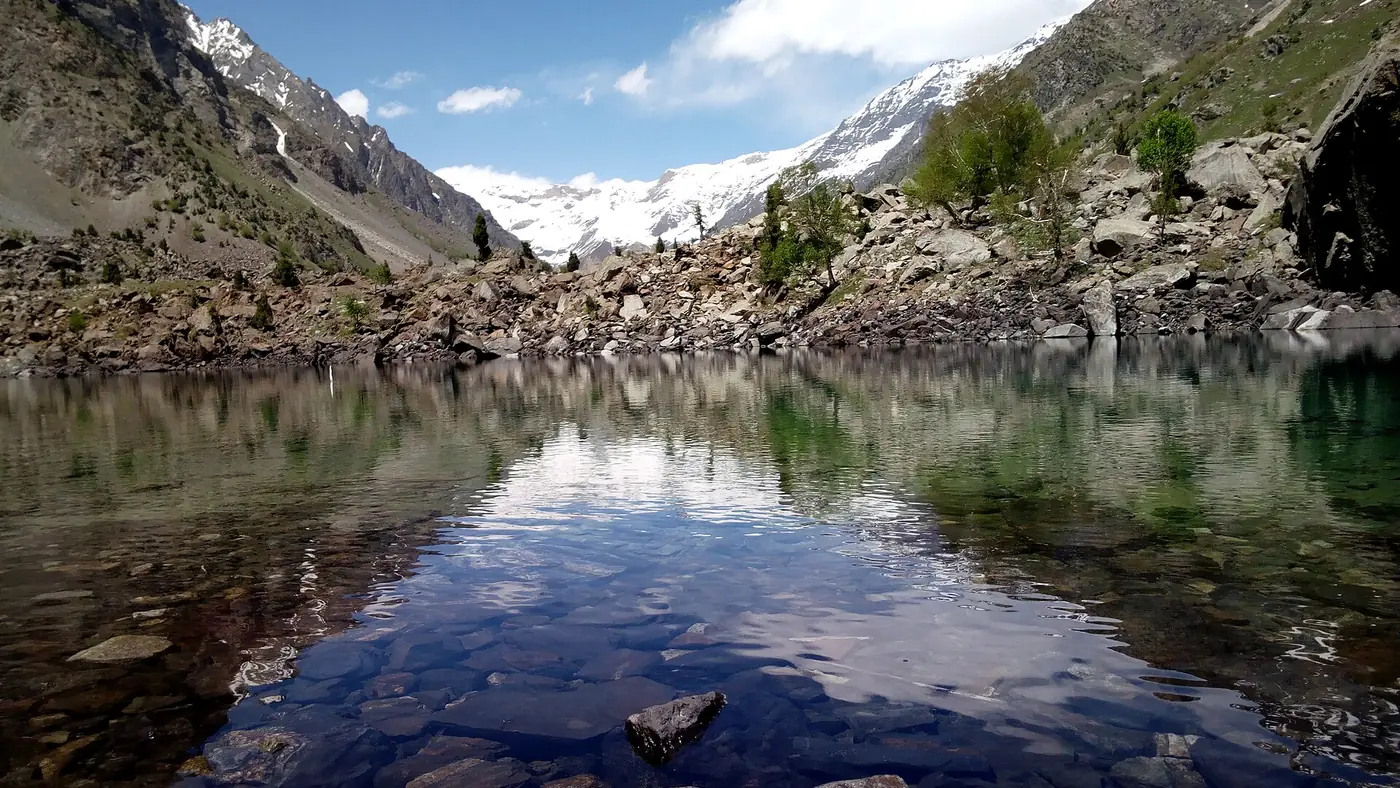
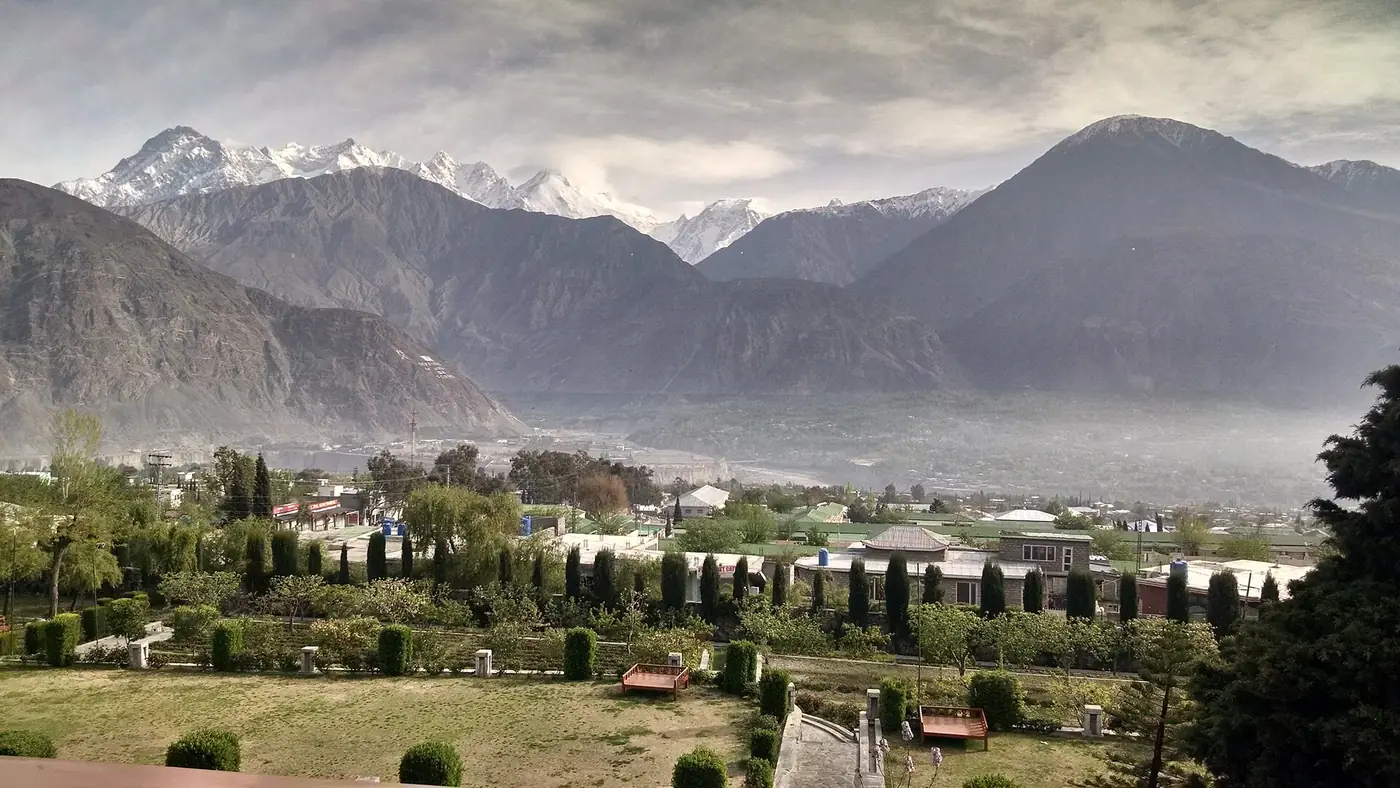
The places to visit in Gilgit city are mostly about its long history: the Kargah Buddha, carved into a cliff about 10 km west of town; Danyor across the river, with its old suspension bridge, Buddhist-era rock inscriptions and the Chinese cemetery; and the busy bazaars in the centre. That is a full, unhurried day. With a second day, go out to one of the valleys close by, such as Naltar or Bagrot, or to the point near Jaglot where three great mountain ranges meet.
Most travellers pass through Gilgit on the way to Hunza and see none of this. This guide covers what is worth stopping for, how long each place takes, and how to fit it into one or two days.
| At a glance | |
|---|---|
| Altitude | About 1,500 m |
| Time needed | One day for the city sights; two with a valley trip |
| Most comfortable months | April, May, September and October |
| Summer heat | Afternoon highs can pass 40°C |
| Kargah Buddha | About 10 km west of the city |
| Chinese cemetery, Danyor | About 10 km from the city |
| Getting around | Taxis in town; a hired car or jeep for the valleys |
| Tourist Police | Dial 1422 |
Kargah Buddha
The Kargah Buddha is the one sight in Gilgit that nobody should miss. It is a standing Buddha about 15 metres tall, cut into a rock face in the Kargah valley around the 7th century, when Gilgit was an important Buddhist centre on the old Silk Road routes.
The figure is carved high on the cliff face and is seen from below. Local tradition has a different story for it: that it is a yakshini, a man-eating spirit, pinned to the rock by a holy man.
About 400 metres upstream, excavations in 1931 found the remains of a Buddhist monastery and three stupas containing manuscripts. The Gilgit manuscripts, Buddhist texts written on birch bark and discovered in Gilgit that year, are the oldest manuscript collection from what is now Pakistan. They are held today in India and at the British Library in London.
It is a short drive from the city, and an hour is enough for the visit. The Kargah valley is also where people from Gilgit go for a picnic by the water, so on a hot afternoon it is a good place to sit in the shade for a while.
Danyor: the bridge, the inscriptions and the Chinese cemetery
Danyor lies on the far side of the river from the main town, and three of Gilgit's sights are here, close enough to see in a morning.
The Danyor suspension bridge
The long suspension bridge between Danyor and the Karakoram International University side of the river was built between 1957 and 1960 by Ahmed Ali, a self-taught engineer from Hunza known locally as Thakedar Bereno. It is about 510 feet long and eight feet wide, was restored in 2017, and is now open to people on foot only. At the Danyor end the path passes through a short tunnel, with the shrine of Shah Sultan Ali Arif above it.
Walk across it rather than just photographing it; the view up and down the river is worth the few minutes.
The Danyor rock inscriptions
Beside the Karakoram Highway in Danyor is a large boulder carved with Sanskrit inscriptions from the 7th and 8th centuries, from the reign of a Buddhist-era king named Navasurendrādityanandi. It is protected under the Antiquities Act. To most visitors it is a rock with lines on it; to anyone interested in Gilgit's Buddhist past, it is a rare piece of written evidence. Ask your driver to stop, as it is easy to pass without noticing.
The Chinese cemetery
Also in Danyor is the cemetery where Chinese engineers and workers who died building the Karakoram Highway are buried. It was set up in the early 1970s, while the road was still being built. Many Pakistani and Chinese workers lost their lives on the KKH, and a few quiet minutes here make the road you drove in on look different.
Gilgit's bazaars
Gilgit is the main market town of the region, and its bazaars are busy, practical places that serve the valleys around it. For visitors, the interest lies in a few kinds of shop:
- Gemstones and jewellery. The mountains of Gilgit-Baltistan produce aquamarine, tourmaline, topaz and garnet, and the gem shops around the NLI market area sell them loose and set. Unless you know stones, buy something you like at a price you are happy with rather than as an investment.
- Dried fruit and nuts. Dried apricots, mulberries, walnuts and almonds from the valleys.
- Woollens and caps. Shawls, waistcoats and the round wool cap worn across Gilgit-Baltistan.
- Chinese goods. Goods from China come down the Karakoram Highway through Gilgit, and Chinese household goods fill a good part of the bazaar.
The bazaars are at their liveliest in the late afternoon and early evening, once the heat has gone. Carry cash, as smaller shops rarely take cards.
Chinar Bagh and the story of 1 November
Chinar Bagh is the public garden in the centre of town, named for its chinar trees. It holds the Yadgar-e-Shuhada, the memorial to those who died in the uprising of 1 November 1947, when the Gilgit Scouts overthrew the Dogra governor and the region went on to join Pakistan. The main ceremony of Gilgit-Baltistan's Independence Day is held here every year on 1 November.
Also in the city is the old British cemetery. Among the graves is that of George Hayward, the British explorer killed near the Darkot Pass in 1870, whose headstone was paid for by the Maharaja of Kashmir.
Neither place takes long. Together they fill an hour at the end of the day, before the bazaar.
The Taj Mughal monument above Jutial
For a short walk with a view, climb to the Taj Mughal monument, a stone tower on the ridge south of the city. It is said to have been built about 700 years ago by Taj-ud-Din Mughal, a ruler from Badakhshan who took Gilgit in the 14th century, and the Gilgit-Baltistan tourism department has recently restored it.
The path starts about a kilometre from the city, and the tourism department puts the walk from the base at around half an hour. Allow longer in summer heat, go early in the morning, and take water. The reward is the whole of Gilgit laid out below you.
Valleys near Gilgit for a second day
Gilgit's real advantage is what lies within an hour or two of it.
- Naltar valley. Pine forest, the Air Force ski slopes and a string of coloured lakes, reached by jeep from Nomal. The lakes make a full day from Gilgit and are better with a night in the valley. Our Naltar valley guide covers the jeep road and where to stay.
- Bagrot valley. About 17 km from Gilgit, a farming valley of alpine pastures below Rakaposhi, Diran and Dubani. It makes a good half-day drive.
- The junction of three mountain ranges. About 45 km south of Gilgit on the Karakoram Highway, near Jaglot, is the viewpoint where the Himalaya, Karakoram and Hindu Kush meet. It is easy to combine with arriving or leaving by road.
- Rakaposhi from Ghulmet. On the way north to Hunza, the Karakoram Highway passes beneath Rakaposhi, and Ghulmet is the usual place to stop and look. Most people see it on the drive to Karimabad rather than as a separate trip.
A plan for one or two days in Gilgit
One day
- Morning: Kargah Buddha, before the heat, with time to walk up the stream.
- Late morning: Danyor. Walk the suspension bridge, then stop at the rock inscriptions and the Chinese cemetery.
- Lunch and a rest through the hottest part of the day.
- Late afternoon: Chinar Bagh and the old British cemetery.
- Evening: the bazaar, for dried fruit, gemstones and dinner.
Two days
Add a full day in Naltar, leaving Gilgit early by jeep, or a half-day in Bagrot followed by the walk to the Taj Mughal monument in the evening.
Taxis are easy to find in town. For the day, a car with a driver from your hotel makes it simple to link the sights, as they are spread out on both sides of the river. Summer afternoons in Gilgit are hot, so put anything outdoors in the morning or evening.
Is Gilgit worth a stop?
Gilgit is a working town, not a pretty one: traffic, government offices, a university and a lot of dust. If you have four days in the north and your heart is set on Hunza, drive straight through and you will not have missed a great deal.
Stop if you are interested in history, if you have flown in and want an easy first day at a lower altitude, or if you are going on to Naltar. A day here also breaks the long road north, and you will enjoy Hunza more for arriving rested. It is why our Gilgit, Hunza and Khunjerab tour spends its second day in Gilgit, on the Kargah Buddha and Danyor.
The city is generally calm and well used to visitors, but it has seen occasional protests and unrest over the years. Check local news before you go and follow any advice from the police. If you are still deciding where to base yourself, our Gilgit and Hunza page covers the wider region, and the Islamabad to Gilgit flight guide covers getting here by air.
Frequently asked questions
How far is the Kargah Buddha from Gilgit?
About 10 km west of the city, up the Kargah valley. It is a short drive, and an hour is enough for the visit.
Is one day enough to see Gilgit?
One day covers the main sights in the city and at Danyor comfortably. Add a second day for Naltar or Bagrot.
Can I visit Naltar as a day trip from Gilgit?
Yes, by jeep, if you leave early. The drive and the lakes make a long day, and a night in Naltar is more relaxed.
What is the best time to visit Gilgit?
April, May, September and October are the most comfortable. June to August can be very hot in the city, with afternoon temperatures that can pass 40°C.
What should I buy in Gilgit?
Dried apricots and walnuts, local woollens and caps, and gemstones if you know what you are buying. The bazaars around the NLI market area are the place to start.
Is Gilgit safe for tourists?
Gilgit is generally calm and used to visitors. There have been occasional protests and unrest over the years, so check local news before travelling and follow police advice.