The Danyor rock inscriptions are a large boulder carved with Sanskrit text from the 7th or 8th century, standing beside the Karakoram Highway in Danyor, across the river from Gilgit city. It is one of the oldest surviving pieces of writing in Gilgit-Baltistan and a marker of the centuries when this valley was a Buddhist centre on the routes between South and Central Asia.
This guide covers what the inscription says as far as it is known, why it matters, and how to fit a visit to it in with the rest of Danyor.
| At a glance | |
|---|---|
| Location | Danyor, on the Karakoram Highway, across the Gilgit river from the city |
| From Gilgit | About 10 km, a short drive over the Danyor bridge road |
| Date of the carving | 7th to 8th century AD |
| Script | Late Brahmi, Sanskrit language |
| Protection | Listed under the Pakistan Antiquities Act |
| Time needed | 10 to 15 minutes at the rock itself |
| Combine with | The Danyor suspension bridge and the Chinese cemetery, both nearby |
What the inscription is
The carving sits on a large boulder on the left bank of the Gilgit river, close to the highway. It bears a Sanskrit text in late Brahmi script, and scholarship on it, including work by the archaeologist Ahmad Hasan Dani, links it to the reign of a Palola Sahi dynasty ruler named in some readings as Navasurendradityanandi, who held Gilgit in the mid-7th century. The Palola Sahis were the Buddhist ruling family of Gilgit for several centuries, and inscriptions from their reigns, carved into rock faces along old routes through the valley, are among the few written records of that period to survive.
Weathering has faded parts of the text over the centuries, and readings of the exact wording differ between scholars. What is agreed is that it is a genuine, dated piece of Gilgit's Buddhist-era history, from the same broad period as the Kargah Buddha carving and the Gilgit manuscripts found nearby.
Why it is worth stopping for
On its own, the rock is not dramatic: a boulder with faded lines cut into it, easy to drive past without noticing. Its value is what it represents. Gilgit-Baltistan has relatively few surviving written records from before Islam arrived in the region, and a dated royal inscription, carved in place rather than found loose, ties a specific ruler to a specific spot on the ground.
It sits close to other reminders of the same era. The Kargah Buddha, about 10 km away on the other side of the city, is a carved figure from a similar period, and the Gilgit manuscripts, Buddhist texts on birch bark found nearby in 1931, are the oldest surviving manuscripts from what is now Pakistan. Seen together, they sketch a Gilgit that was a meeting point of trade and religion long before it became a stop on the Karakoram Highway.
Getting there
The inscriptions are beside the highway in Danyor, on the same short stretch of road as the Danyor suspension bridge. From central Gilgit it is about a 10-km drive: cross the Gilgit river towards Danyor and follow the Karakoram Highway a short distance north. A taxi or hired car can reach it in fifteen to twenty minutes.
There is no ticket office or formal visitor centre. Ask your driver to slow down and point it out, since it sits at the roadside among ordinary buildings and is easy to miss on a first pass.
What else to see at Danyor
Danyor holds three sights close enough together to cover in a single stop:
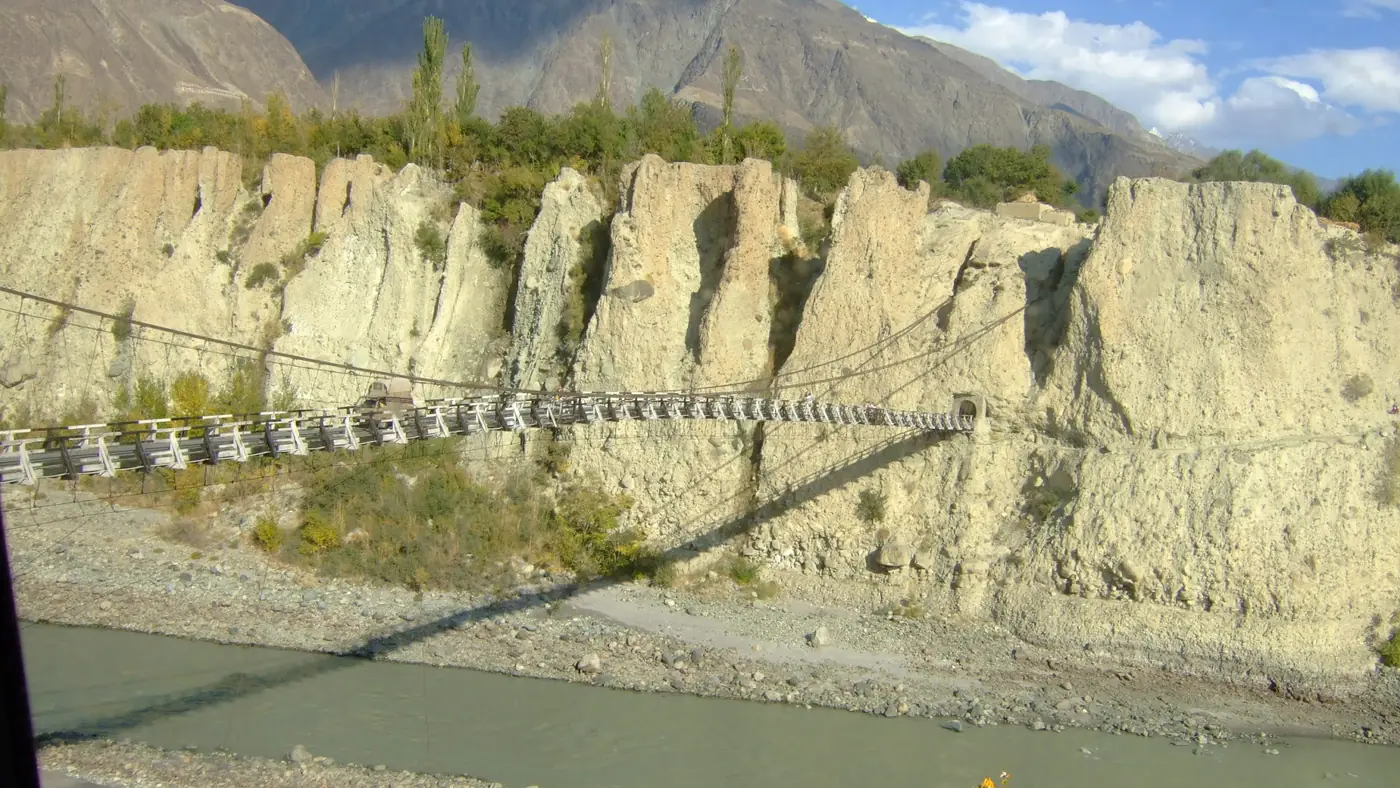
- The suspension bridge, a long pedestrian crossing over the Gilgit river, worth walking across for the river view alone.
- The rock inscriptions, covered here.
- The Chinese cemetery, the resting place of Chinese workers who died building the Karakoram Highway. Our guide to the Chinese cemetery in Gilgit covers its history and how to visit respectfully.
Together, a stop at Danyor takes an hour or so, and fits well into a morning that also covers the Kargah Buddha and Gilgit's bazaars. Our guide to one day in Gilgit sets out a full itinerary, and our wider guide to places to visit in Gilgit covers the city as a whole.
Is it worth the stop?
For most visitors passing through Gilgit on the way to Hunza, the Danyor rock inscriptions are a five-minute stop rather than a destination in themselves, and worth making only because it costs so little time given how close it is to the bridge and the cemetery. Anyone with a specific interest in early Gilgit-Baltistan history, or working through the region's Buddhist-era sites more systematically, will get more out of it, ideally alongside the Kargah Buddha on the same day.
If your time in Gilgit is very short, put the Kargah Buddha and the Chinese cemetery ahead of the rock inscriptions; they carry more for most visitors in the same few minutes.
Frequently asked questions
What language is the Danyor rock inscription written in?
Sanskrit, carved in a late form of the Brahmi script used across South Asia in the first millennium AD.
How old is the Danyor rock inscription?
It dates from the 7th or 8th century AD, from the period of Gilgit's Palola Sahi rulers.
Where exactly is the Danyor rock inscription?
Beside the Karakoram Highway in Danyor, on the far bank of the Gilgit river from the city, close to the Danyor suspension bridge.
How long does it take to visit?
Ten to fifteen minutes at the rock itself. Most visitors combine it with the nearby bridge and the Chinese cemetery, which together take about an hour.
Is there an entry fee?
No. There is no ticket office or formal visitor facility at the site.