
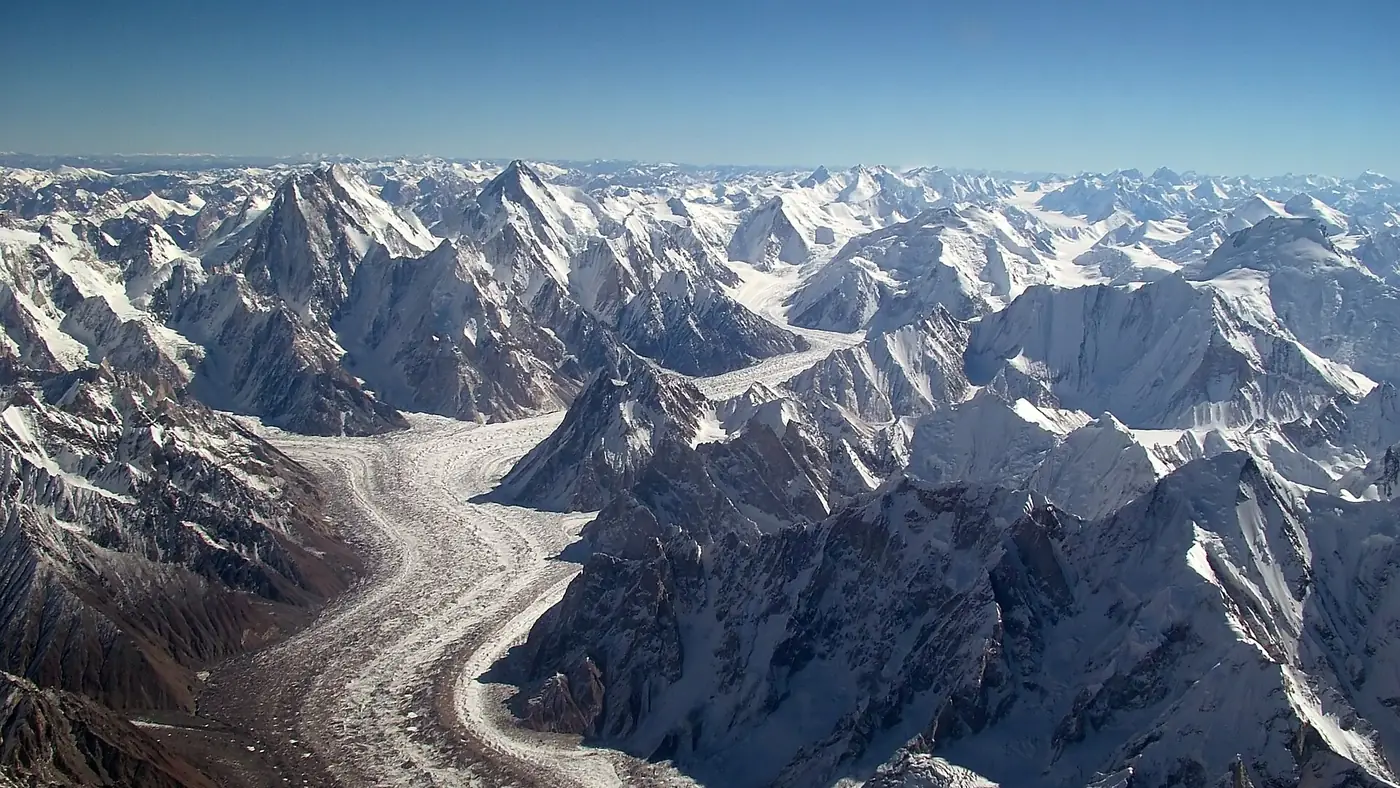

Pakistan has five of the world's fourteen eight-thousanders, and all five are in Gilgit-Baltistan: K2 (8,611 metres), Nanga Parbat (8,126), Gasherbrum I (8,080), Broad Peak (8,051) and Gasherbrum II (8,035). Four of these 8000 meter peaks stand together around the upper Baltoro glacier in the Karakoram; Nanga Parbat stands alone at the western end of the Himalaya. Only Nanga Parbat can be seen from a road. The other four need a trek of about a week from Askole.
This guide takes each peak in turn, with its height, its first ascent and its first winter ascent, and then explains where each can be seen and how much effort that takes.
| Peak | Height | World rank | First ascent | First winter ascent |
|---|---|---|---|---|
| K2 | 8,611 m | 2nd | 31 July 1954 | 16 January 2021 |
| Nanga Parbat | 8,126 m | 9th | 3 July 1953 | 26 February 2016 |
| Gasherbrum I | 8,080 m | 11th | 5 July 1958 | 9 March 2012 |
| Broad Peak | 8,051 m | 12th | 9 June 1957 | 5 March 2013 |
| Gasherbrum II | 8,035 m | 13th | 7 July 1956 | 2 February 2011 |
Heights differ by a few metres between surveys: you will also see 8,125 m for Nanga Parbat, 8,047 m for Broad Peak and 8,034 m for Gasherbrum II.
Where are Pakistan's 8,000-metre peaks?
They fall into two groups, almost 200 km apart as the crow flies.
The Baltoro four. K2, Broad Peak and Gasherbrum I and II stand on or near the border with China at the head of the Baltoro glacier, inside the Central Karakoram National Park. Few places on earth have so many of the highest mountains this close together. The nearest village is Askole, at the end of the jeep road from Skardu, and none of the four can be seen from it.
Nanga Parbat. The odd one out, south of the great bend of the Indus in Diamer and Astore. It belongs to the Himalaya rather than the Karakoram, and it rises so far above its surroundings that it can be seen from the Karakoram Highway, from Babusar Top and from the Deosai plateau on clear days.
K2, 8,611 metres
The second-highest mountain in the world and the highest in Pakistan, first climbed by Lino Lacedelli and Achille Compagnoni of an Italian expedition in 1954. It is steeper and more dangerous than Everest, and it was the last eight-thousander to be climbed in winter, by ten Nepali climbers in January 2021. Our guide to K2 itself tells the full story, including the part played by the Hunza porter Amir Mehdi.
Nanga Parbat, 8,126 metres
The ninth-highest mountain in the world, and the only one of the five you can see without trekking. Thirty-one people died on it before the Austrian Hermann Buhl reached the top alone in 1953, which is how it became known as the Killer Mountain. The first winter ascent, in 2016, was made by Ali Sadpara of Skardu with Alex Txikon and Simone Moro. Its three faces and its history are covered in our guide to Nanga Parbat.
Gasherbrum I, 8,080 metres
Also called Hidden Peak, a name the British explorer Martin Conway gave it in 1892 because it stays out of sight behind its neighbours for most of the way up the Baltoro. The survey of 1856 had simply called it K5. Gasherbrum itself comes from Balti words usually translated as "beautiful mountain".
It was first climbed on 5 July 1958 by Pete Schoening and Andy Kauffman of an American expedition led by Nicholas Clinch, which included two Pakistani army officers, Captain Mohammad Akram and Captain S.T.H. Rizvi. The Poles Adam Bielecki and Janusz Gołąb made the first winter ascent on 9 March 2012, without supplementary oxygen.
Broad Peak, 8,051 metres
Broad Peak stands about 8 km from K2, and its name describes it exactly: a summit ridge more than 1.5 km long. Conway named it in 1892, after the Breithorn in the Alps. From Concordia it stands beside K2 across the head of the valley.
Four Austrians, Marcus Schmuck, Fritz Wintersteller, Kurt Diemberger and Hermann Buhl, made the first ascent on 9 June 1957, without supplementary oxygen or high-altitude porters, a remarkable style for the time. The first winter ascent, on 5 March 2013, was a Polish success that turned to tragedy: Maciej Berbeka and Tomasz Kowalski died on the way down.
On 30 July 2026 an avalanche between the second and third camps, at about 6,600 metres, killed ten climbers from four teams, among them the Nepali mountaineer Nirmal Purja and the Pakistani guide Sohail Sakhi. It is the deadliest single accident in the mountain's history.
Gasherbrum II, 8,035 metres
The lowest of the five, first surveyed as K4. Three Austrians, Fritz Moravec, Josef Larch and Hans Willenpart, reached the summit on 7 July 1956 after an avalanche had buried one of their camps. The first winter ascent, on 2 February 2011, was by Simone Moro, Denis Urubko and Cory Richards, without supplementary oxygen.
Gasherbrum II is usually counted among the more accessible eight-thousanders, though "accessible" here still means a remote, high and serious expedition.
Where can you see them?
From least to most effort:
- Nanga Parbat from the road. The Nanga Parbat View Point at Talechi on the Karakoram Highway, Babusar Top and Sheosar Lake on Deosai all give distant views on a clear morning.
- Nanga Parbat close up. Fairy Meadows, reached by jeep from Raikot Bridge and a walk of a few hours, faces the Rakhiot side of the mountain. Fit walkers carry on to Beyal and the base camp; see our Nanga Parbat base camp trek guide. On the Astore side, Tarishing looks up at the Rupal face.
- K2 and Broad Peak from Concordia. About a week's walk from Askole up the Baltoro glacier, Concordia puts K2 at the head of the valley with Broad Peak beside it and the Gasherbrum group to the east. A long day on takes you past Broad Peak base camp to K2 base camp at about 5,000 metres. Our K2 base camp trek guide goes through it stage by stage.
- All four Baltoro peaks from the Gondogoro La. On a clear morning the top of this 5,585-metre pass looks back over K2, Broad Peak and Gasherbrum I and II together. It is a night climb on fixed ropes, and our Gondogoro La guide explains the skills and gear it needs.
Flights between Islamabad and Skardu or Gilgit also pass close to Nanga Parbat on clear mornings.
When are they climbed, and when can you see them?
Expeditions arrive from June, and most summit bids come in July and early August. That is also the only realistic season for trekking to Concordia, since the upper Baltoro is snowbound for most of the year.
Seasons vary enormously. In 2025 there were 42 summits of K2, 25 of Nanga Parbat and 17 of Gasherbrum I, but none on Broad Peak or Gasherbrum II. In 2026 heavy July snow, the Broad Peak avalanche and unusual heat in early August left only a handful of summits on the Baltoro peaks and none on K2.
For viewing, mornings are clearest, cloud usually builds by the afternoon, and autumn has the sharpest air. That matters most for Nanga Parbat, which is often hidden in July and August.
Which should you try to see?
If you have a week and a car, see Nanga Parbat: stop at Talechi on the Karakoram Highway, or better, spend two nights at Fairy Meadows. It is the only eight-thousander most Pakistanis will ever see, and from the meadow it fills the sky.
If you are a fit, experienced trekker with three weeks, the Baltoro gives you K2, Broad Peak and the Gasherbrums, and Concordia is one of the great mountain views on earth. It is a serious trek, not a holiday walk, and it needs an operator, porters and a guide.
If you can't trek that far, don't expect to glimpse K2 or the Gasherbrums from Skardu. Rakaposhi, Masherbrum and the other 7,000-metre giants beside the Karakoram Highway and the Hushe road are the alternative, and our planning page is the place to start if you want help fitting one of these views into a trip.
Frequently asked questions
How many 8,000-metre peaks are there in Pakistan?
Five: K2, Nanga Parbat, Gasherbrum I, Broad Peak and Gasherbrum II. All of them are in Gilgit-Baltistan, and four stand around the upper Baltoro glacier.
Which is the highest mountain in Pakistan?
K2, at 8,611 metres, the second-highest in the world after Everest. It stands on the border with China at the head of the Godwin-Austen glacier.
Can you see any 8,000-metre peak from a road in Pakistan?
Only Nanga Parbat. It can be seen from the Karakoram Highway at Talechi, from Babusar Top and from Deosai on clear days. The other four are hidden from every road and village.
Where can you see four 8,000-metre peaks at once?
From the top of the Gondogoro La, a 5,585-metre pass between Concordia and Hushe, where K2, Broad Peak and Gasherbrum I and II are all in view on a clear morning.
Why is Gasherbrum I called Hidden Peak?
Because it stays hidden behind other peaks for most of the approach up the Baltoro glacier. Martin Conway gave it the name in 1892.
Which 8,000-metre peak in Pakistan was climbed first?
Nanga Parbat, by Hermann Buhl on 3 July 1953, a year before K2. Gasherbrum II followed in 1956, Broad Peak in 1957 and Gasherbrum I in 1958.