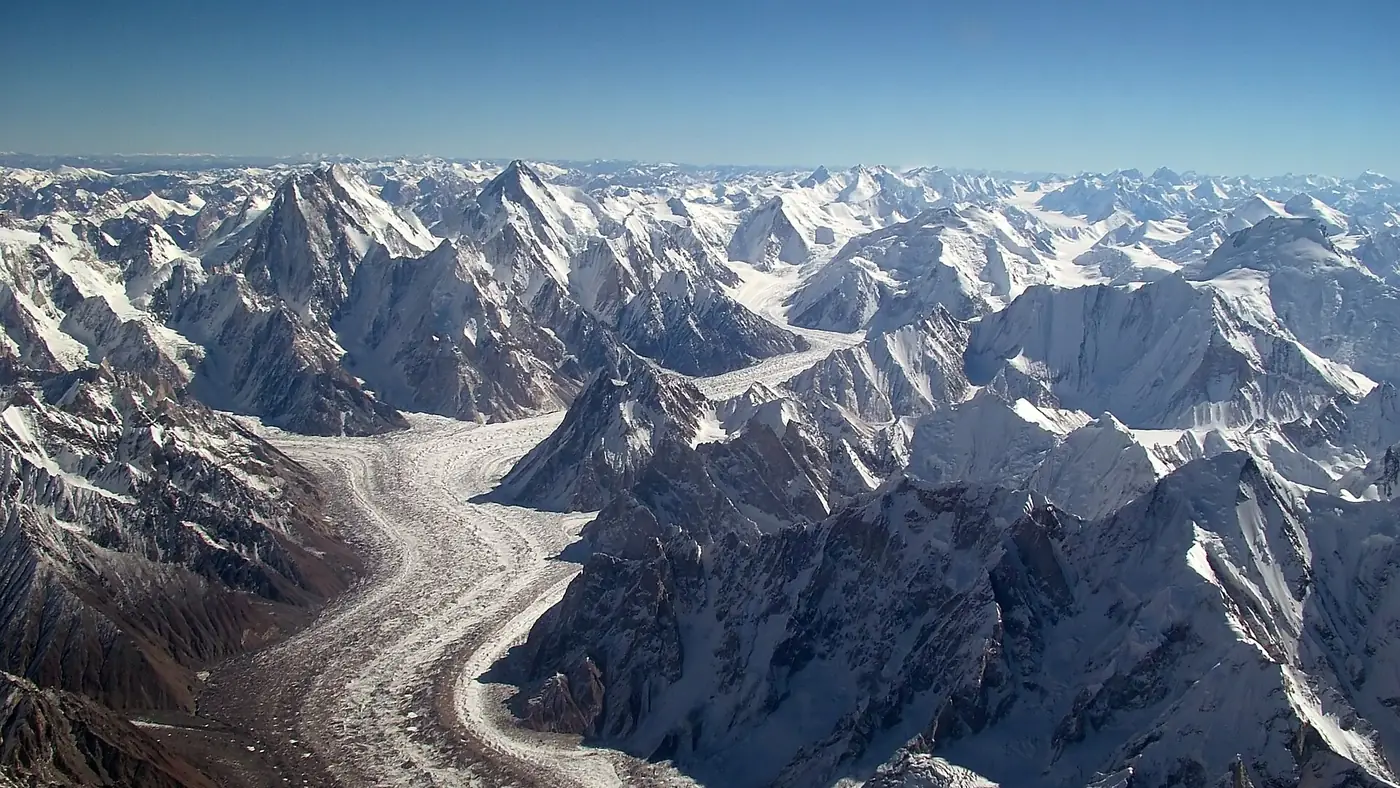
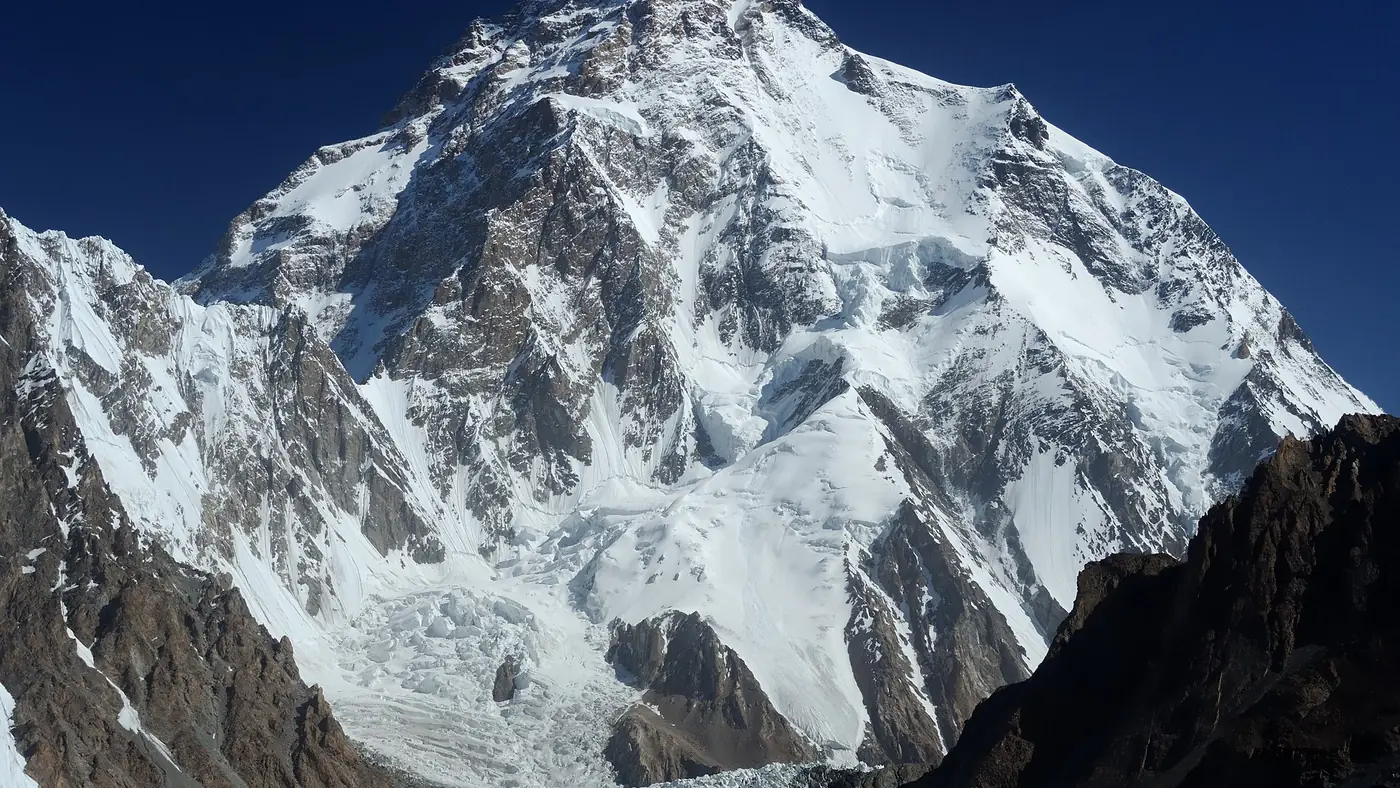
K2 is the second-highest mountain on earth and the highest point in Pakistan, at 8,611 metres. It stands on the border between Gilgit-Baltistan and China's Xinjiang, at the head of the Baltoro glacier in the Karakoram. Italians first climbed it on 31 July 1954, and it was the last of the world's 8,000-metre peaks to be climbed in winter, on 16 January 2021. Climbers call it the Savage Mountain: until 2021, roughly one person died on it for every four who reached the top.
This guide covers the mountain itself: its height, its name, the story of its first ascents and why it is feared. If you want to go and see it, our K2 base camp trek guide covers the walk in.
| At a glance | |
|---|---|
| Height | 8,611 m (28,251 ft) |
| Rank | 2nd highest in the world, 1st in Pakistan |
| Location | Pakistan–China border, at the head of the Godwin-Austen glacier |
| Range | Karakoram |
| Other names | Chhogori; Mount Godwin-Austen |
| First ascent | 31 July 1954, Lino Lacedelli and Achille Compagnoni (Italy) |
| First winter ascent | 16 January 2021, ten Nepali climbers |
| Standard route | The Abruzzi Spur, on the Pakistani side |
| Nearest view | Concordia, about a week's walk from Askole |
How high is K2, and where is it?
K2's summit is 8,611 metres above sea level, about 240 metres lower than Everest. It is the highest mountain in the Karakoram and the most prominent peak in the range.
The mountain sits on the watershed between Pakistan and China. Its southern side, which almost every expedition climbs, feeds the Godwin-Austen glacier, which flows down to meet the Baltoro at Concordia. The northern side falls into Xinjiang and sees far fewer expeditions.
It is also well hidden. No road, village or town in Pakistan has a view of K2; even Askole, the last village on the approach, sees nothing of it. Four of the world's fourteen 8,000-metre peaks stand within a few days' walk of each other here, and our guide to the 8,000-metre peaks of Pakistan covers the others.
Why is it called K2?
The name is a surveyor's label that stuck. In 1856 Thomas Montgomerie of the Great Trigonometrical Survey of India looked north from Mount Haramukh in Kashmir, some 210 km away, and numbered the Karakoram peaks he could see: K1, K2, K3 and so on. K1 turned out to be Masherbrum. Most of the others later took local names, but K2 never had one that everyone agreed on.
The Balti name is Chhogori, from words meaning "big mountain". It appears on some maps but never replaced K2. Mount Godwin-Austen, after Henry Godwin-Austen, an early British surveyor of the region, is rarely used for the mountain but survives in the name of the glacier below it.
The early attempts
For half a century, K2 beat everyone who tried it:
- 1902. Oscar Eckenstein and Aleister Crowley led the first serious attempt, on the northeast ridge.
- 1909. An Italian expedition led by the Duke of the Abruzzi reached about 6,250 metres on the south-east spur. It has been called the Abruzzi Spur ever since, and it is still the normal route.
- 1939. Fritz Wiessner's American expedition came within about 200 metres of the summit, then fell apart. Dudley Wolfe and three Sherpas, Pasang Kikuli, Pasang Kitar and Pintso, disappeared high on the mountain.
- 1953. Charles Houston's American team was pinned by a storm at about 7,800 metres for ten days, and Art Gilkey fell seriously ill. He was lost during the retreat. The Gilkey Memorial, a stone cairn near base camp, now carries plaques for many of the climbers who have died on K2.
It was a member of that 1953 team, George Bell, who gave the mountain its nickname: "It's a savage mountain that tries to kill you."
The first ascent in 1954
A large Italian expedition led by the geologist Ardito Desio finally reached the top on 31 July 1954, when Lino Lacedelli and Achille Compagnoni stood on the summit.
The climb is remembered as much for the night before. Walter Bonatti and Amir Mehdi, a high-altitude porter from Hunza, carried oxygen bottles up to the summit pair's final camp. The camp had been moved higher than agreed, and in the dark they could not reach it. They survived the night in the open at about 8,100 metres, one of the highest bivouacs anyone had lived through. Mehdi, whose boots were reportedly too small, lost all his toes to frostbite.
The row over that night lasted fifty years, until the Italian Alpine Club accepted Bonatti's account in 2008.
Pakistanis on K2
The mountain's history is increasingly a Pakistani one:
- 1977. On the second ascent, by a Japanese expedition, Ashraf Aman became the first Pakistani to reach the summit.
- 2008. Two Pakistani high-altitude porters, Jehan Baig and Meherban Karim, were among the eleven people who died when falling ice cut the fixed ropes in the Bottleneck on 1 and 2 August.
- 2021. Muhammad Ali Sadpara of Skardu, who had made the first winter ascent of Nanga Parbat in 2016, disappeared high on K2 on 5 February with John Snorri and Juan Pablo Mohr. His son Sajid turned back that day when his oxygen regulator failed, and in July he found the three climbers' bodies.
- 2022. On 22 July, Samina Baig became the first Pakistani woman to summit K2, followed the same day by Naila Kiani.
- 2025. Iftikhar Hussain Sadpara, from Skardu, was killed by rockfall on the lower mountain on 18 July while working for climbing teams.
The first winter ascent, 2021
For decades, climbing K2 in winter was the biggest prize left in Himalayan mountaineering. Winter storms, jet-stream winds and extreme cold had defeated every earlier winter expedition.
On the evening of 16 January 2021, ten Nepali climbers reached the summit together, among them Nirmal Purja, who climbed without supplementary oxygen, and Mingma Gyalje Sherpa. K2 was the last of the fourteen 8,000-metre peaks to be climbed in winter. The same season cost the lives of Ali Sadpara and his companions a few weeks later.
Purja himself died on 30 July 2026, when an avalanche on neighbouring Broad Peak killed ten climbers, among them the Pakistani guide Sohail Sakhi.
Why is K2 so feared?
K2 is lower than Everest, but it is a much harder and more dangerous climb:
- It is steeper. There is no easy side. Even the normal route on the Abruzzi Spur involves long stretches of steep rock and ice.
- The weather is worse. K2 lies further north than Everest, storms arrive fast and last for days, and expeditions often wait weeks for a few days of calm.
- The Bottleneck. Above 8,000 metres the route climbs a steep gully beneath a hanging wall of ice. Climbers pass under it on the way up and again on the way down, when they are most exhausted. In 2008 part of that ice collapsed and eleven people died.
- Rockfall. Hotter summers have loosened the lower slopes. The 2025 season had 42 summits and two deaths, both from falling rock.
- Rescue is hard. High on the mountain, a sick or injured climber has to be brought down by other climbers.
Commercial expeditions, fixed ropes and bottled oxygen have made K2 far more climbable than it was, and a record number of people reached the summit on 22 July 2022. But the mountain still decides. In 2026, a season of heavy July snow, the Broad Peak avalanche and unusual heat in early August, nobody reached the top at all.
Can you see K2?
Only by walking in. The classic view is from Concordia, where the Baltoro meets the Godwin-Austen glacier, about a week's walk from Askole. Fit trekkers continue to K2 base camp at about 5,000 metres, and some cross the Gondogoro La on the way out, from where K2 rises above a sea of peaks; our guide to crossing the Gondogoro La explains what that involves.
For the big peaks you can see from a car, including Nanga Parbat and Rakaposhi, see our guide to the highest peaks in Gilgit-Baltistan.
Is a K2 trip for you?
For most people, K2 is a mountain to read about, and perhaps to see once. The trek to Concordia takes about two weeks from Skardu, in a short July and August season. It suits experienced, fit trekkers, not first-timers.
If you can't give it two weeks, Skardu, Shigar and Deosai put you among big peaks by road; our Skardu destination page shows what is within reach. If the trek is your goal, send us your dates through our planning page and we can help you work out the season and the time you need.
Frequently asked questions
How high is K2?
K2 is 8,611 metres (28,251 feet) high, the second-highest mountain in the world after Everest and the highest in Pakistan.
Who first climbed K2?
The Italians Lino Lacedelli and Achille Compagnoni, on 31 July 1954, on an expedition led by Ardito Desio. Walter Bonatti and the Hunza porter Amir Mehdi carried their oxygen high on the mountain and survived a night in the open at about 8,100 metres.
Who was the first Pakistani to climb K2?
Ashraf Aman, on the second ascent by a Japanese expedition in 1977. Samina Baig became the first Pakistani woman to reach the summit, on 22 July 2022.
Why is K2 more dangerous than Everest?
It is steeper, its weather is harsher and less predictable, and the normal route passes under a hanging ice cliff in the Bottleneck above 8,000 metres. Before 2021 about one climber died for every four who reached the summit.
When was K2 first climbed in winter?
On 16 January 2021, by ten Nepali climbers including Nirmal Purja and Mingma Gyalje Sherpa. It was the last 8,000-metre peak to be climbed in winter.
Can you see K2 from Skardu?
No. K2 can't be seen from Skardu or from any other town or road in Pakistan. The nearest good view is from Concordia on the Baltoro glacier, about a week's trek from Askole.