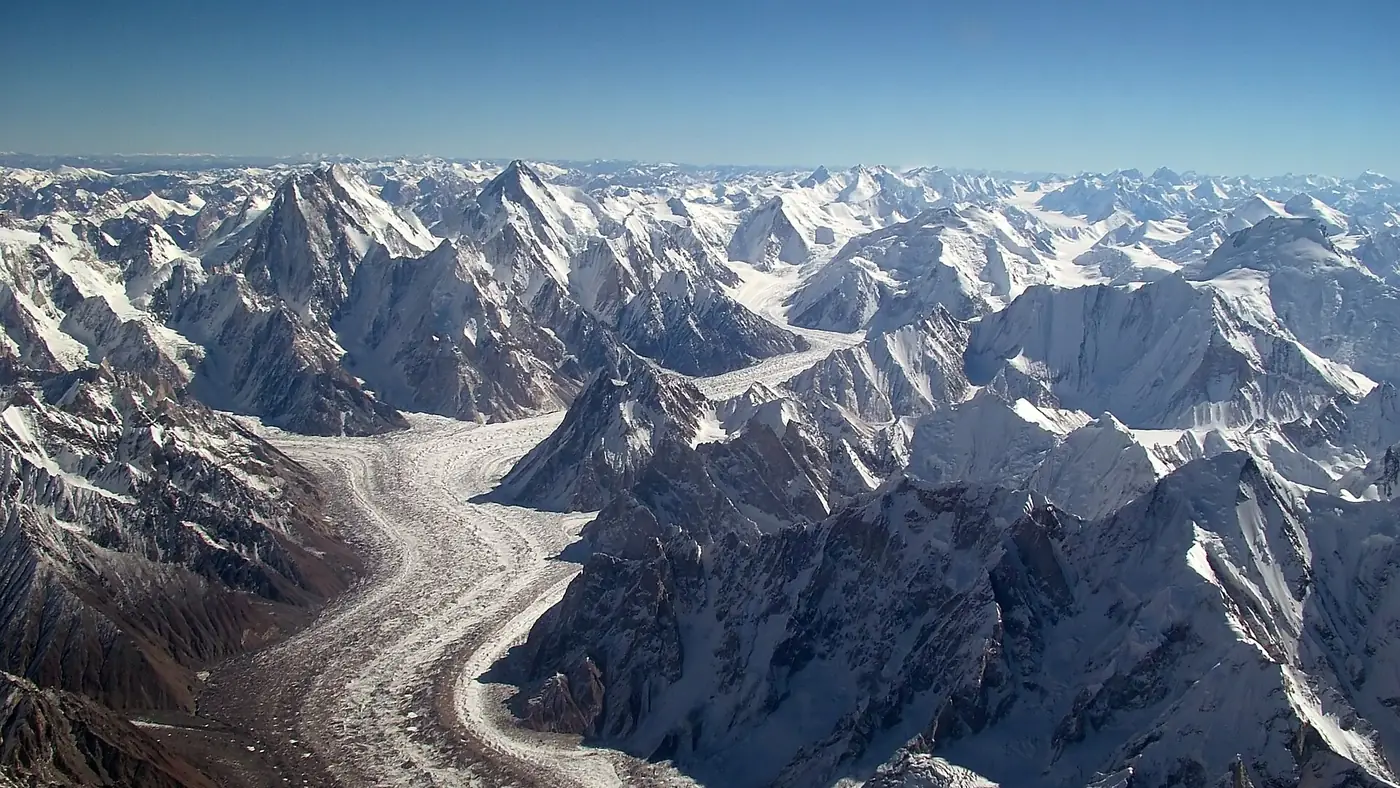
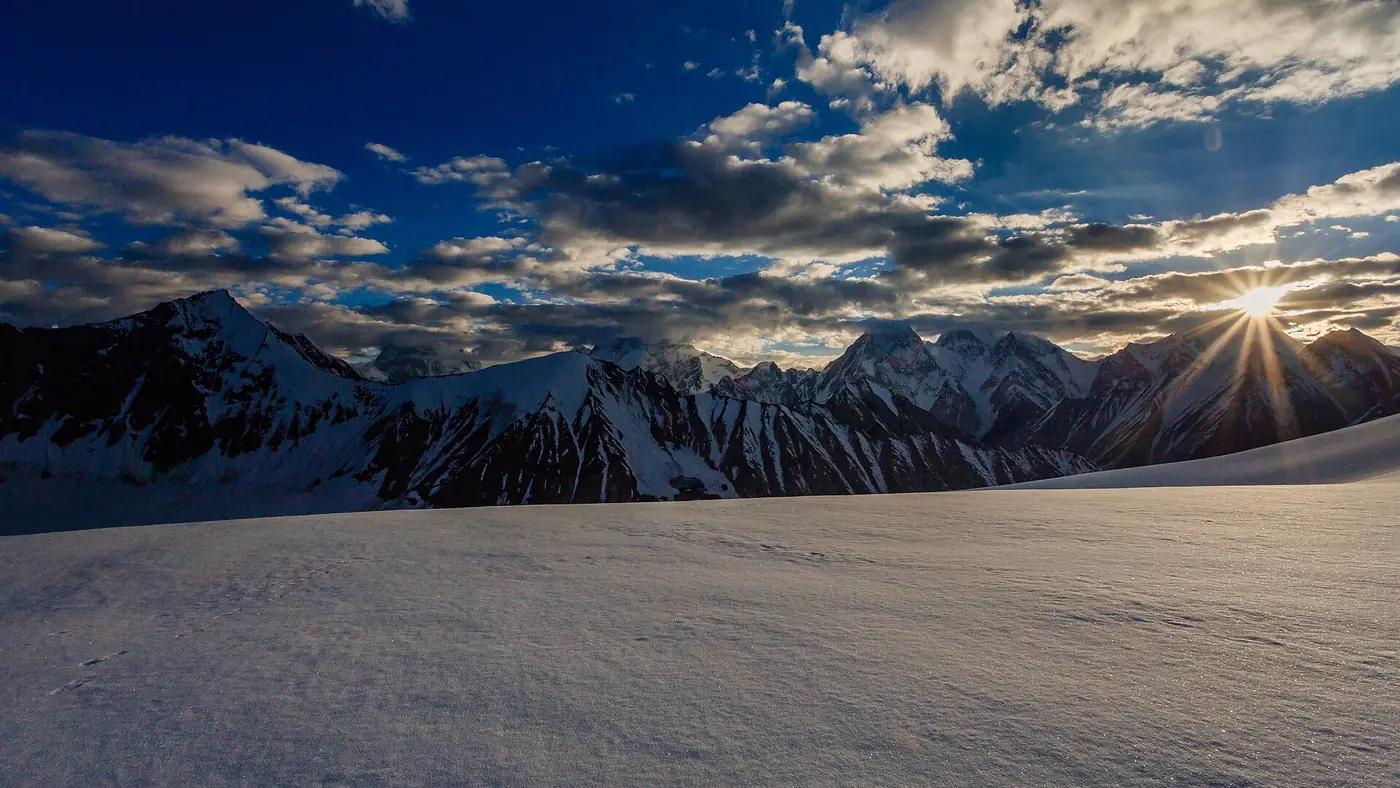
The Gondogoro La trek is the K2 base camp trek with a different way out: instead of walking back down the Baltoro glacier, you cross the Gondogoro La, a pass of about 5,585 metres, from near Concordia down to Hushe. The crossing starts around midnight from Ali Camp, climbs snow slopes on fixed ropes, and comes down steep ground on the far side, usually ten to twelve hours in all. It is normally possible only from about late June to the end of August, and it suits fit trekkers who have already been high and are comfortable in a harness and crampons.
This guide covers the Concordia to Hushe section: how the crossing day works, who maintains the ropes, the season, and what fitness and kit it demands. The walk in from Askole to Concordia is the same as on the standard trek, and our K2 base camp trek guide goes through it stage by stage.
| At a glance | |
|---|---|
| The pass | About 5,585 m; published figures range from 5,560 to 5,650 m |
| Route | Askole, Baltoro glacier, Concordia, Ali Camp, the pass, Khuspang, Saicho, Hushe |
| Last camp before the pass | Ali Camp, about 4,900 to 5,000 m |
| First camp after it | Khuspang, about 4,600 to 4,700 m |
| Crossing day | Start around midnight; 10 to 12 hours |
| Season for the crossing | About late June to the end of August |
| Skardu to Skardu | About 14 to 16 days with spare days |
| Difficulty | Strenuous and semi-technical: fixed ropes, crampons, harness |
What is the Gondogoro La trek?
The Gondogoro La links the Vigne glacier, a side arm of the upper Baltoro, with the Gondogoro glacier, which drains south into the Hushe valley. A trekking route over it was opened in 1986, and it turned the K2 trek from an out-and-back walk into a loop.
You don't repeat days of Baltoro moraine on the way out, and on a clear morning the top of the pass looks back at K2, Broad Peak, the Gasherbrums and Masherbrum, and forward to Laila Peak and the Hushe valley. The price is one very serious day: everything before Ali Camp is trekking, while the pass itself is closer to basic mountaineering.
Concordia to Hushe, stage by stage
Most groups cross from the Concordia side, after a week or more on the Baltoro has acclimatised them. A typical sequence after the K2 base camp day:
- Concordia to Ali Camp, about 7 hours. South-east up the upper Baltoro past Mitre Peak, then onto the Vigne glacier to Ali Camp at about 4,900 to 5,000 metres. It is a cold, exposed camp on the glacier. Groups eat early and try to sleep by late afternoon.
- The crossing, Ali Camp to Khuspang, 10 to 12 hours. A start at around 11 pm to midnight, the climb to the pass by first light, and the descent to Khuspang at about 4,600 to 4,700 metres. The next section explains it in detail.
- Khuspang to Saicho, about 7 to 8 hours. Down the Gondogoro glacier with Masherbrum across the valley, to Saicho (also spelt Shaicho or Shaisho), a grassy campsite at about 3,400 metres and the first green ground since the Baltoro.
- Saicho to Hushe, about 3 hours. An easy walk along the river and through fields into Hushe village, at a little over 3,000 metres.
- Hushe to Skardu, about 6 hours by jeep, down the valley to Khaplu and along the Shyok.
Our guide to the Hushe valley covers the village, its guesthouses and the jeep road out.
What is the crossing actually like?
The crossing is timed around the sun. Once it warms the Hushe side of the pass, stones start coming loose on the descent, so the aim is to be at the top at dawn and off the steep ground before mid-morning.
The climb
From Ali Camp the route crosses the glacier in the dark for about an hour to the point where crampons go on. Above that it climbs snow slopes of increasing steepness, the upper parts at around 45 to 50 degrees, with fixed ropes on the steep sections. You clip a jumar (a rope clamp) or a safety sling to the line and move up it steadily. Most groups take four to five hours from camp to the top, and few stay there long.
The descent
The Hushe side is the more dangerous half. It starts on snow at up to about 50 degrees, usually descended by a series of abseils (rappels) on fixed ropes, then turns into loose rock and scree where the rope becomes a handrail. By August much of the snow has gone, the ground underneath is looser, and rockfall is the main hazard. A helmet is not optional here. Most groups reach Khuspang, tired, around the middle of the day.
The fixed ropes and the Hushe rescue team
At the start of each season a team from Hushe village fixes ropes on both sides of the pass. Through the summer they maintain them, stay at Ali Camp and Khuspang, and help groups across. They take the ropes down in the last days of August.
Every group pays the team a fee for the ropes and their support, set by group size. It changes from year to year, so your operator should confirm it and include it in the price.
Treat the pass as possible rather than guaranteed. In 2007 a surge of the glacier steepened the route and opened a deep crevasse, and trekking groups could not cross at all.
When can you cross the Gondogoro La?
The window is short:
- Late June to mid-July. The earliest crossings. More snow on the slopes makes the ground more stable, but new snowfall can close the pass for days.
- Mid-July to mid-August. The main season. The ropes are in, the rescue team is present and the weather is at its most settled.
- Late August. Possible, but the snow cover has thinned, crevasses are more open and rockfall on the Hushe side is worse. The rescue team leaves around the end of the month.
- September onwards. Not a realistic plan for a trekking group.
Even in season, groups sometimes wait out bad weather at Ali Camp or turn back, so build in a spare day. For how this fits the wider trekking calendar, see our month-by-month trekking season guide.
What fitness and experience do you need?
You don't need to be a climber, but you need more than walking fitness:
- Stamina for a 10 to 12 hour day starting at midnight, after about ten days of trekking.
- Previous high-altitude trekking. A trek above 4,500 metres, in Pakistan or Nepal, where you know how your body reacts.
- Basic rope and crampon skills. Walking in crampons, using a jumar on a fixed line and abseiling. If they are new to you, get some instruction before the trek and practise with your guide at Concordia.
- A head for steep ground in the dark and on loose rock.
Altitude matters more here than on the standard trek: Ali Camp is usually the highest night, and the pass is higher than K2 base camp. Anyone struggling at Concordia should not be going higher. Our guide to altitude sickness in Gilgit-Baltistan covers the warning signs.
What gear does the crossing need?
On top of normal K2 trek kit, each person needs:
- A climbing harness, with two slings and locking carabiners
- A jumar or other rope clamp for the fixed lines
- Crampons that fit your boots, and stiff enough boots to take them
- An ice axe
- A helmet, for the rockfall on the Hushe side
- A head torch with spare batteries, for the night start
- Warm gloves and a spare pair; the pre-dawn hours are the coldest of the trek
A good operator checks everyone's technical kit before the trek and can usually arrange rental of anything missing. Try it all on before you reach the glacier.
Permits, guides and porters
The Gondogoro La lies in the restricted zone of the Karakoram. Pakistani and foreign trekkers need a trekking permit arranged in advance through a registered operator, and pay the Central Karakoram National Park fee. The rules and fees were revised in 2025, so confirm what applies before you commit. Nobody should attempt the pass without a guide who has crossed it before.
Should you cross it, or go back down the Baltoro?
Cross it if you are fit, have been above 5,000 metres before without trouble, and are comfortable on a rope. The loop is the more rewarding trek, and the view from the top is one of the great ones.
Go back the way you came if anyone in the group has struggled with altitude, if you have no experience with crampons or ropes, or if your dates fall in late August or September. Walking out via the Baltoro takes longer but is far less risky, and it still gives you Concordia and K2.
Decide at Concordia, not at home. Plan for the crossing, but let the conditions, the rescue team's advice and how everyone feels make the final call. If you would like help planning the trek, the season or an itinerary with enough spare days, send us your dates through our trip planning page.
Frequently asked questions
How high is the Gondogoro La?
About 5,585 metres. Published figures vary between roughly 5,560 and 5,650 metres, depending on the survey.
How long does it take to cross the Gondogoro La?
Usually 10 to 12 hours from Ali Camp to Khuspang, starting around midnight. The climb to the top takes four to five hours, and the steep descent most of the morning.
Is the Gondogoro La technical?
It is semi-technical. You need crampons, a harness and a helmet, and you climb and abseil on fixed ropes on slopes of up to about 50 degrees. No climbing experience is required, but some practice on ropes helps.
When is the best time to cross the Gondogoro La?
From mid-July to mid-August, when the ropes are fixed, the rescue team is at the pass and the weather is most settled. Late June and late August are possible but carry more risk.
Can you do the Gondogoro La trek without the K2 base camp trek?
Some groups approach from Hushe, but the usual plan is to cross from the Concordia side at the end of the Baltoro trek, after a week or more of acclimatisation.
What happens if the pass is closed?
You walk back down the Baltoro glacier to Askole, which usually adds a day or two and means the jeep collects you there instead of Hushe. A good plan allows for this.