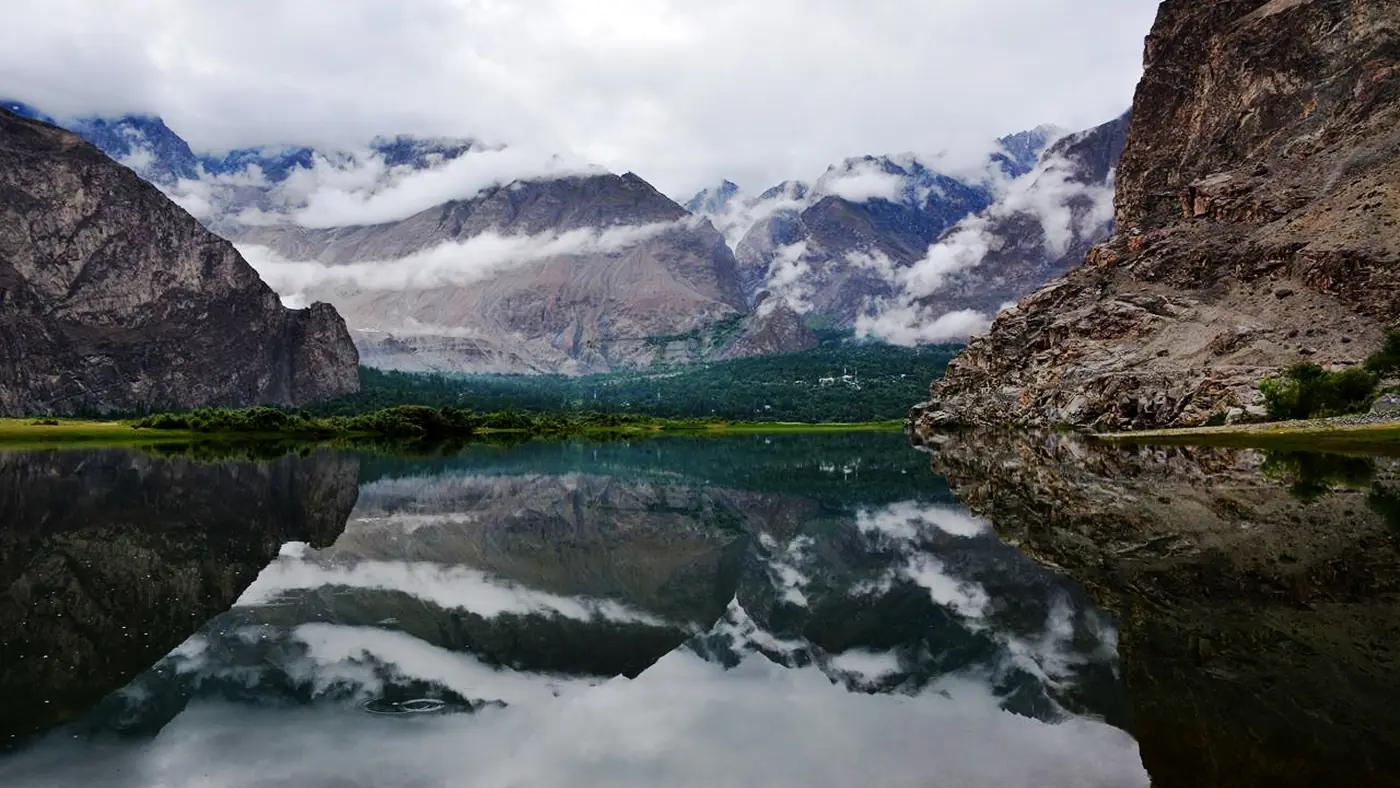
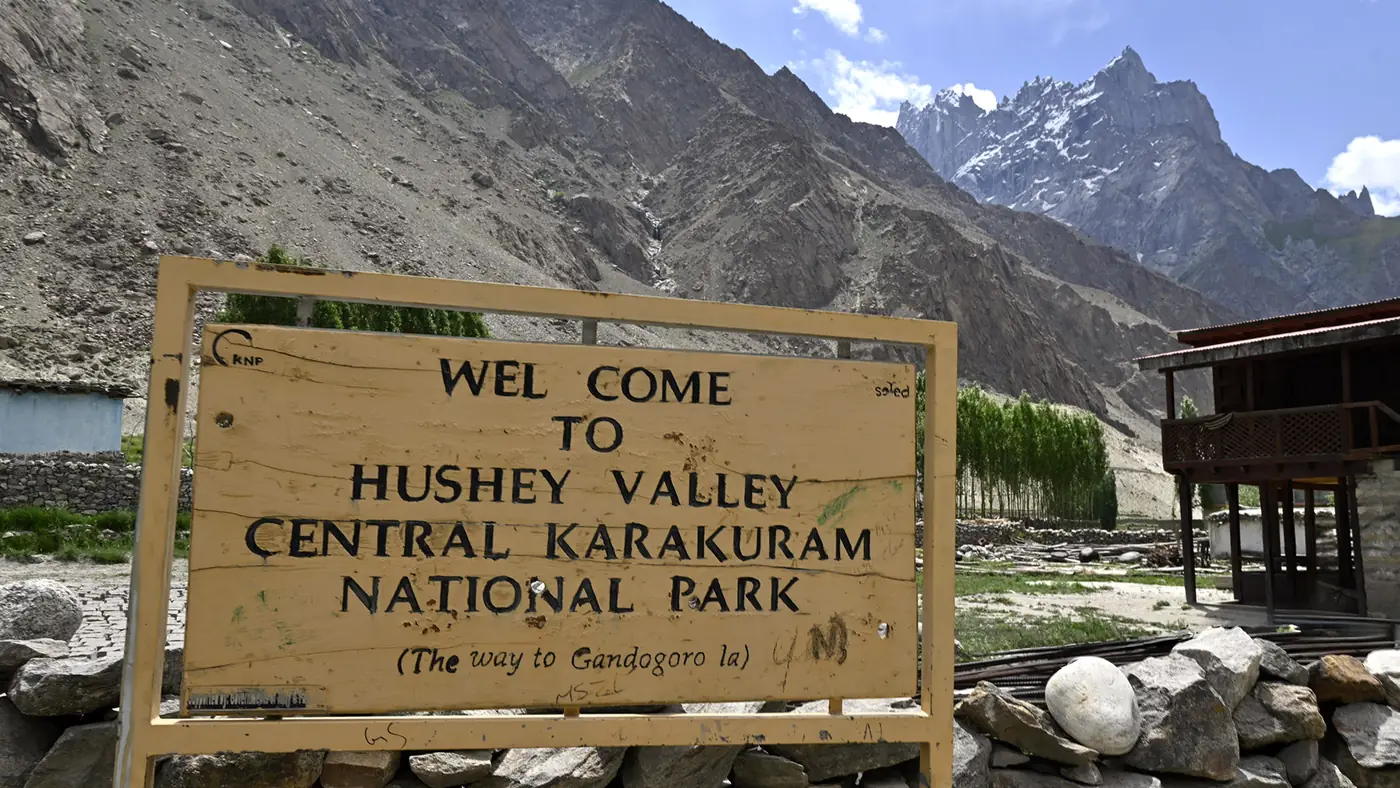
The Hushe valley runs north from the Shyok river opposite Khaplu to the foot of Masherbrum, at 7,821 metres one of the great peaks of the Karakoram. A jeep road climbs it from Khaplu in about two and a half to three hours, through Saling, Machulu and Kande, to Hushe village, a little over 3,000 metres up. Hushe is the last village in the valley and the starting point for treks to Masherbrum base camp, the Charakusa glacier and the Gondogoro La.
Most visitors come for one of two reasons: to see Masherbrum close up without a long trek, or to start or finish a trek. This guide covers the jeep road, where to stay, what the valley is like for non-trekkers, and what trekkers need to arrange.
| At a glance | |
|---|---|
| Where | Ghanche district, north of Khaplu across the Shyok |
| Hushe village | A little over 3,000 m; the last village in the valley |
| From Khaplu | About 2.5 to 3 hours by jeep |
| From Skardu | About 6 hours via Khaplu, without long stops |
| Road | Paved for the first part, then a narrow, rough track |
| Vehicle | A jeep or high-clearance 4x4 |
| Best months | June to September |
| Stay | Basic guesthouses, homestays and campsites |
| Signal | Very limited in the upper valley |
Where is the Hushe valley?
Hushe is the valley of the Hushe river, which rises in the glaciers below Masherbrum and flows south to join the Shyok near Khaplu. Its head reaches the Masherbrum range, which separates it from the Baltoro glacier and K2 to the north.
The valley is a long, narrow corridor of villages, orchards and fields that gets steadily higher, colder and emptier as you go north. Masherbrum's south face stands at the head of it, and the peaks around its side valleys, K6, K7 and Laila among them, draw climbers from around the world.
The jeep road from Khaplu
The road leaves Khaplu, crosses the Shyok on the bridge at Saling, about 15 to 20 minutes away, and turns north up the Hushe river.
- Saling. The village at the mouth of the valley, with orchards and fish farms. Beyond Saling the road narrows, and before long the tarmac gives way to track.
- Machulu. Roughly halfway, one of the biggest villages in the valley, with terraced apricot orchards and an old wooden mosque.
- Kande. One of the last villages before Hushe. Beyond it the track gets rougher and steeper.
- Hushe. The end of the road, 30 to 45 minutes beyond Kande, with Masherbrum filling the head of the valley on a clear day.
The track is single-lane for long stretches, with drops to the river and occasional rockfall. It is not a road for a sedan or for someone who hasn't driven mountain tracks before. Hire a jeep with a local driver in Khaplu. Your hotel can arrange one; agree the price, the waiting time and the return time before you leave. After heavy rain, the drive takes longer.
What is there to do in Hushe?
For non-trekkers, the valley is mostly about the mountains and the quiet.
- See Masherbrum. The south face is visible from the upper part of the road and from the village itself. Clear mornings give the best view; cloud often builds by the afternoon.
- Walk beyond the village. An hour or two's walk up the valley above Hushe brings you closer to the glaciers and the mountain. Stay on obvious paths, don't cross glacier streams, and turn back in good time. Anything longer than a day walk needs the permits described below.
- Village life. Hushe men have worked as porters and cooks for expeditions since the 1960s, and many families still do. The village is small, traditional and conservative. Dress modestly, and ask before photographing people, particularly women.
- Machulu and Saling on the way. Machulu's orchards and wooden mosque are worth a stop; so is the river at Saling. Our guide to places to visit in Khaplu covers both.
Hushe is at a little over 3,000 metres. Most people notice only mild breathlessness, but if you have come straight from Islamabad by air, a night in Skardu or Khaplu first makes the day more comfortable.
Where to stay in Hushe
There are no hotels in Hushe in the usual sense. Accommodation is a couple of basic guesthouses, homestays with local families, and campsites used by trekking groups.
- Expect simple rooms, shared bathrooms, and little or no hot water.
- Power is limited, so bring a power bank and a head torch.
- Food is what the guesthouse cooks: dal, rice, roti, local vegetables and tea. Bring snacks.
- Mobile signal is very limited, and there is little or no internet.
- Bring cash. There are no card machines or ATMs in the valley.
If you want comfort, stay in Khaplu and make Hushe a long day out. Our guide to hotels in Khaplu covers the options there, from the palace to simple guesthouses.
Treks from Hushe: what you need to arrange
Hushe is one of the main trekking bases in the Karakoram. The best-known routes are:
- Masherbrum base camp, a moderate trek of a few days up the main valley.
- The Charakusa glacier, for the granite walls around K6 and K7.
- Gondogoro La, at 5,585 metres, the pass that links Hushe with Concordia and the Baltoro. Most people cross it from the Concordia side and come down to Hushe at the end of the K2 base camp trek.
These are serious undertakings. Multi-day treks above the village enter the Central Karakoram National Park and need its permit. The Gondogoro La lies in the restricted zone, where Pakistani and foreign trekkers alike need a trekking permit arranged in advance through a registered operator, and it needs an experienced guide with ropes and crampons. Porters are hired in Hushe at rates set by the village's porters' association.
Our K2 base camp trek guide explains how the Gondogoro La fits into that route, and what the permits and porters involve.
When to go
June to September is the season. The road is at its most reliable, the trekking routes are open, and Hushe village is busy with expedition teams, especially in July and August.
May and October are possible for a jeep trip to the village, with snow still low in May and cold nights in October, but the high routes are closed or close to it. From November the valley is cold and quiet, and the road can close with snow.
If you would like Hushe built into a longer Baltistan trip, with the jeep, a night in Khaplu and a spare day for the Skardu flight arranged around your dates, send us the details through our trip planning page.
Is the Hushe valley worth it?
For mountain lovers, yes. Few places in Pakistan put you this close to a 7,800-metre peak by road, and the valley has none of the crowds of Skardu or Hunza.
For most families, probably not. Five or six hours of rough jeep track, there and back, is a long day with small children, and the reward is a view and a village rather than a lake or a resort. Older travellers who dislike rough roads should think carefully too.
The balance: with a night in Khaplu and a clear forecast, a day to Hushe is one of the most rewarding outings in Baltistan. On a short Skardu trip, stay on the valley floor, and see the palace and the Chaqchan Mosque in Khaplu instead.
Frequently asked questions
How do you get to the Hushe valley?
By jeep from Khaplu, which is about three hours from Skardu. The jeep road to Hushe village takes another two and a half to three hours via Saling, Machulu and Kande.
Can a car go to Hushe valley?
A car can manage the paved first stretch across the river to Saling, but the track beyond is rough, narrow and steep. Hire a jeep with a local driver in Khaplu for the rest.
What is the altitude of Hushe village?
A little over 3,000 metres. Sources give figures between about 3,050 and 3,200 metres.
Can you see Masherbrum from Hushe?
Yes, on a clear day. Masherbrum's south face, at 7,821 metres, stands at the head of the valley and is visible from the upper road and the village.
Do I need a permit to visit Hushe?
No special permit is needed to drive to the village as a visitor; carry your CNIC, or passport if you are a foreign national, and ask in Khaplu in case rules have changed. Multi-day treks above the village need a national park permit, and the Gondogoro La needs a restricted-zone trekking permit arranged through a registered operator.
Is there a hotel in Hushe?
No hotels as such, but there are a couple of basic guesthouses, homestays and campsites. For proper hotels, stay in Khaplu.