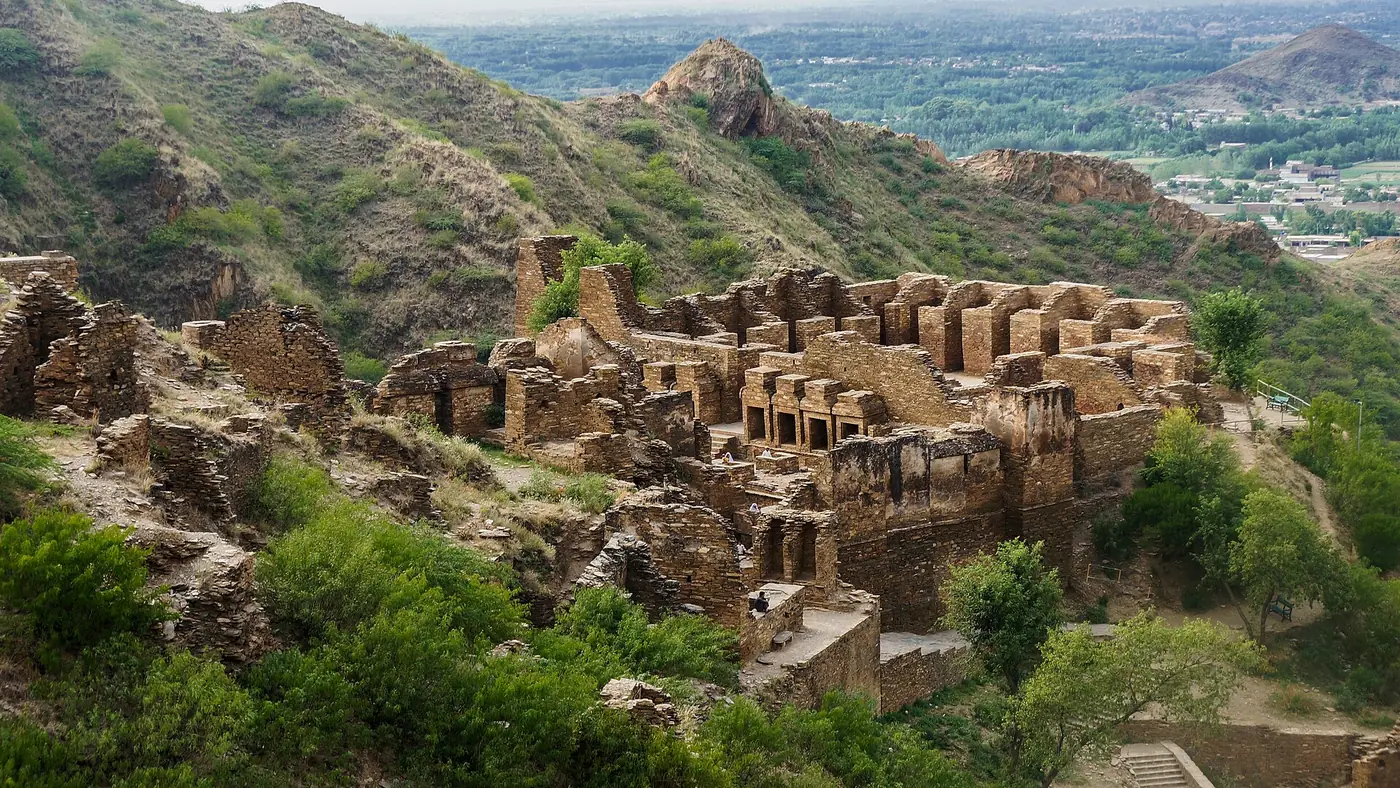
Takht-i-Bahi is a Buddhist monastery on a hilltop about 15 km north of Mardan, and one of the most complete monastic ruins in all of Gandhara. It has been a UNESCO World Heritage Site since 1980. It is about 70 km from Peshawar and 170 km from Islamabad. You buy a ticket at the foot of the hill and climb about 150 metres of steps. Allow two hours for the climb and the ruins, and go between October and March, early in the day.
Below: getting there, the ticket, timing, what each court was for, and safety, which matters in Mardan right now.
| At a glance | |
|---|---|
| Where | Hilltop about 2 km from Takht Bhai bazaar, 15 km north of Mardan |
| The climb | Up to about 150 m above the plain, on steps |
| From Peshawar | About 70 km, 1.5 to 2 hours |
| From Islamabad | About 170 km by the M-1 and N-45, 2.5 to 3 hours |
| Time on site | About 2 hours with the climb; 3 for a slow visit |
| Ticket | Bought at the gate, in cash; foreign visitors pay more |
| Best months | October to March |
How do you get to Takht-i-Bahi?
The ruins stand above the town of Takht Bhai, on the N-45 between Mardan and the Malakand pass.
- From Peshawar: the shorter way, about 70 km, runs out on the Northern Bypass, through Charsadda district and along the Rajjar–Takht Bhai road. Plan on one and a half to two hours.
- From Islamabad: take the M-1 towards Peshawar, leave at the N-45 interchange near Risalpur and drive north through Mardan. It is about 170 km, two and a half to three hours in normal traffic.
- From Mardan: 15 to 18 km north on the N-45, about half an hour.
The site is about 2 km from Takht Bhai bazaar. With a car you can drive to the ticket gate at the foot of the hill. Without one, chingchi rickshaws in the bazaar will take you; agree the fare, and whether they will wait, before you set off.
Tickets and opening hours
Tickets are sold at the gate at the bottom of the hill. The fee is small for Pakistani visitors and higher for foreign nationals, and it has changed over the years. The provincial archaeology department doesn't publish a current rate online, so carry cash and pay what is posted at the gate.
Opening hours aren't published online either. Treat it as a morning visit: arrive by nine or ten, and don't count on being let in late in the afternoon. The site is run by the Directorate General of Archaeology and Museums, Khyber Pakhtunkhwa, and police are posted by the ruins.
How long do you need, and how hard is the climb?
Most people need about two hours: 15 to 20 minutes for the climb at an easy pace and an hour and a half among the courts. With a real interest in Buddhist art, three hours goes quickly. Add Sahr-i-Bahlol, the ruined town on the plain below, and it becomes a full day; our Gandhara day trip from Peshawar sets out the timings.
From the gate a stone stairway climbs the tree-covered hillside. It is a real climb for older parents or anyone with knee trouble, so take it slowly. At the top the courts sit at different levels along the ridge, joined by more steps and passageways, some of them roofed. There is almost no shade, and the stone underfoot is uneven.
What each court was for
The monastery grew over several centuries, which is why the courts sit at different levels and differ in style. All of it is local stone, laid with lime and mud mortar in the patterned masonry typical of Gandhara.
The Court of Many Stupas
A crowded court of small votive stupas, the kind of monument a pilgrim or donor paid for as an act of merit. They stand close together because they were added one at a time over the centuries, wherever there was room, rather than laid out to a plan.
The Main Stupa Court
This was the ritual heart of the monastery. The main stupa stood in the middle of an open court, and monks and pilgrims walked around it clockwise as an act of worship. Only its square base survives. On three sides the court is lined with tall niches, like small chapels, which once held large figures of the Buddha and bodhisattvas in stone and stucco. Most of those sculptures are now in the Peshawar Museum and in collections abroad.
The monastery
North of the stupa courts is the monastery proper, where the monks lived: small cells around an open courtyard, each big enough for sleeping, study and meditation and not much more. Beside it are the kitchen, a dining hall and a water tank. This is the part that shows most clearly how a community of monks actually lived.
The assembly hall
A large hall near the monastery, thought to be where the whole community gathered for recitation, teaching and ritual, and to settle the business of running the monastery. The federal archaeology department calls it the conference hall.
The low-level chambers
The most atmospheric part of the site. Steps lead down into corridors lined with small, dark cells with low openings. They date from the last phase of the monastery, and they may have been used for meditation in the dark, or simply for storing grain; scholars aren't sure. A phone torch helps.
The Court of Three Stupas
On the west side is a court with the bases of three stupas. When H. Hargreaves of the Archaeological Survey of India cleared it in 1910–11, stucco friezes of seated and standing Buddhas were still in place on the bases, some with traces of red paint, and the heads and feet of large figures lay at the foot of the wall.
A short history
The monastery was founded in the 1st century AD and was in use until about the 7th century, through the Indo-Parthian, Kushan and later periods. A British officer, H.W. Bellew, published a description and plan of it in 1864, and the Archaeological Survey of India excavated it from 1907, first under D.B. Spooner and then under Hargreaves.
Spooner alone recorded 472 sculptures, which went to the Peshawar Museum, so its Gandhara galleries hold much of what once stood in these niches. Our guide to places to visit in Peshawar covers the museum.
When to go and what to bring
October to March is the season, with mild, clear days that make the climb pleasant. From May to September the Peshawar valley is very hot and the ruins have almost no shade; if you must go then, be at the gate early and off the hill by late morning.
Bring:
- Water, a hat and sunscreen
- Shoes with grip
- A torch, or a charged phone, for the low-level chambers
- Cash for the ticket and rickshaws
- Your CNIC; foreign visitors, a passport with visa
Dress modestly, as anywhere in rural Khyber Pakhtunkhwa. Buddhist pilgrims from Sri Lanka, Nepal, Thailand and elsewhere still come here to pray, so give any group at worship some space.
Is it safe to visit Takht-i-Bahi?
Pakistani visitors do go, and the site is guarded, but police in the area have been attacked repeatedly.
- Recent incidents. In July 2024 gunmen attacked the police post by the ruins, killing a constable. On 15 September 2026 a militant threw a grenade at the Sahr-i-Bahlol police post, a few kilometres away, injuring three officers before he was killed. The targets were police, not visitors, but both were close by.
- Foreign government advice. The UK government's travel advice, updated on 22 September 2026, advises against all but essential travel to Mardan district, and against all travel on the N-45 from the north of the Mardan ring road, which is the road to Takht Bhai, and to Peshawar and Charsadda. Overseas visitors' own governments may say not to go, and ignoring that advice can void travel insurance.
If you go, check the local news and ask the police in Mardan or Takht Bhai about the situation the day before. Travel in daylight, and on a first visit go with someone who knows the area.
Is Takht-i-Bahi worth it?
For anyone interested in history, Buddhism or architecture, yes. At Taxila the monasteries are scattered across a valley; here the whole plan of a working monastery survives in one place, on a hill with a long view. If you have already seen Taxila's heritage sites, this is the natural next step.
It suits less well anyone who can't manage the steps or can only go in summer, and it is not a trip to make without checking the security situation. For more of the district, see our guide to places to visit in Mardan. To fit Takht-i-Bahi into a longer trip, start with your dates.
Frequently asked questions
How old is Takht-i-Bahi?
It was founded in the 1st century AD and was in use until about the 7th century. The inscription of the Indo-Parthian king Gondophares often linked with it was in fact found at Shahbaz Garhi nearby, so the dating rests on the architecture and finds.
How much is the Takht-i-Bahi ticket?
There is a small fee for Pakistani visitors and a higher one for foreign nationals, paid in cash at the gate. Rates have changed over the years, so pay what is posted on the day.
How long does it take to see Takht-i-Bahi?
About two hours, including 15 to 20 minutes to climb the steps. Allow three if you want to look closely at every court.
Why is Takht-i-Bahi a World Heritage Site?
It is one of the most complete Buddhist monasteries in Gandhara, with its shrine courts, living quarters and assembly hall all surviving. UNESCO listed it in 1980 with the fortified town of Sahr-i-Bahlol nearby.
Is Takht-i-Bahi safe to visit?
The site is guarded and Pakistani visitors do go, but police nearby were attacked in 2024 and 2026, and the UK advises against all travel on the road north of Mardan. Check local news and police advice first, and travel in daylight.