The best places to visit in Mardan are its ancient sites: the hilltop monastery of Takht-i-Bahi, a UNESCO World Heritage Site; the quieter hilltop monastery of Jamal Garhi; the rock edicts of the emperor Ashoka at Shahbaz Garhi; and, for fit walkers, the Kashmir Smast caves in the hills beyond Katlang. Add the Mardan Museum and a chapli kebab in Takht Bhai, and you have a full day or two, best between October and March.
Mardan lies on the plain north of the Kabul River, about 60 km from Peshawar and 140 km from Islamabad, in what was the heart of Buddhist Gandhara. This guide takes the sites one by one, then covers how to fit them together and the security situation, which you should read before planning.
| Place | Where | Time to allow |
|---|---|---|
| Takht-i-Bahi | 15 km north of Mardan | About 2 hours, with the climb |
| Sahr-i-Bahlol | A few km from Takht-i-Bahi | 30 minutes |
| Jamal Garhi | 13 km north, on the Katlang road | 1 to 1.5 hours |
| Shahbaz Garhi edicts | 12 km east, on the Swabi road | 30 to 45 minutes |
| Mardan Museum | Mardan city | About an hour |
| Kashmir Smast | Hills north-east of Katlang | A full day on foot, with local guides |
| Best months | October to March |
Takht-i-Bahi and Sahr-i-Bahlol
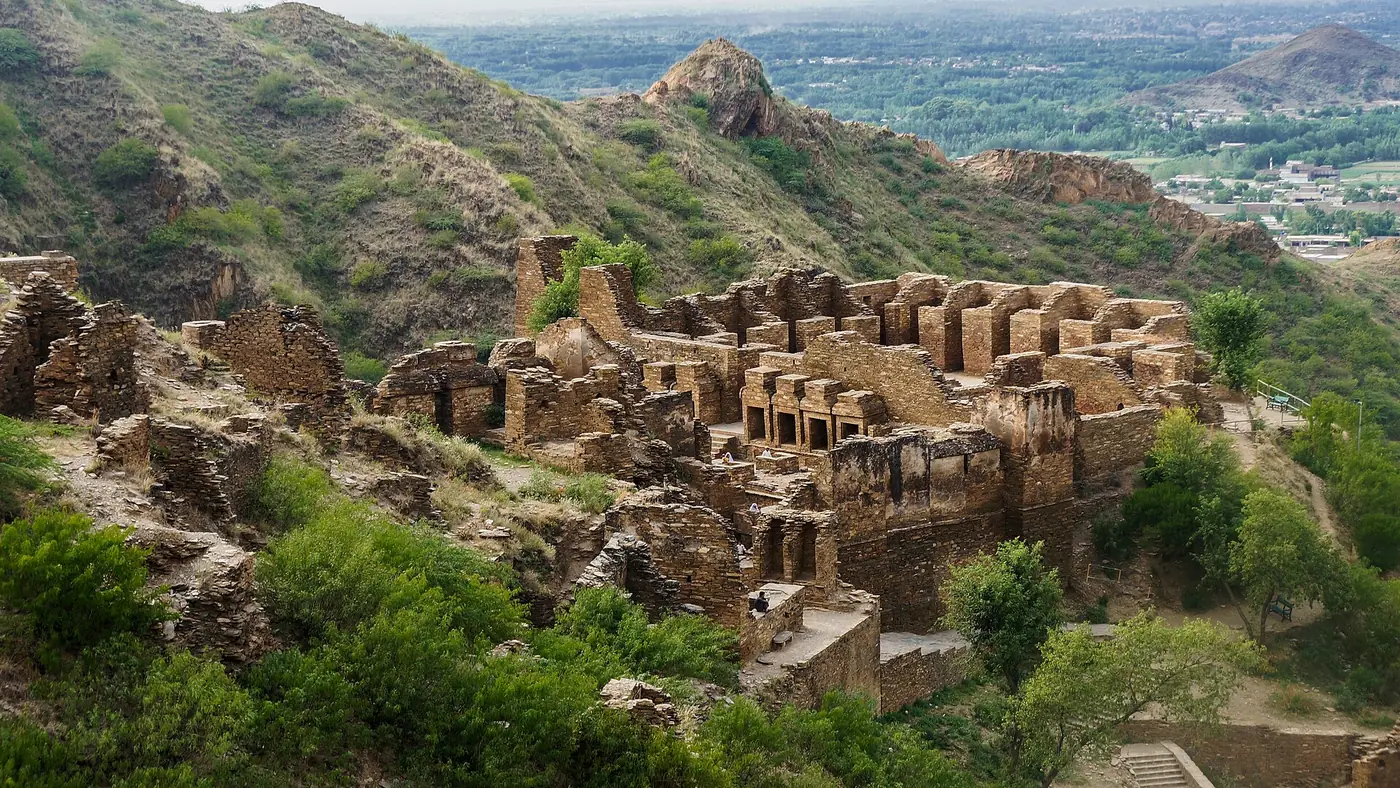
Takht-i-Bahi is the reason most people come. It is a Buddhist monastery on a hilltop above the town of Takht Bhai, founded in the 1st century AD and in use until about the 7th, and it is one of the most complete monastic complexes in Gandhara: shrine courts crowded with stupas, monks' cells, a kitchen, an assembly hall and dark meditation chambers, reached by about 150 metres of steps. Our Takht-i-Bahi guide covers the ticket, the climb and what each court was for.
Sahr-i-Bahlol, a few kilometres away on the plain, was a small fortified town of the Kushan period, listed by UNESCO with Takht-i-Bahi in 1980. A modern village now sits on its mound, and what you see are stretches of the old defensive wall. Its excavations produced some of the finest Gandharan sculpture, much of it now in the Peshawar Museum. Give it half an hour on the way to or from the monastery.
Jamal Garhi: the quieter hilltop monastery
Jamal Garhi stands on the western end of Paja hill, about 13 km from Mardan on the road to Katlang. It was a Buddhist monastery from about the 1st to the 5th century AD, and like Takht-i-Bahi it is reached on foot up the hill.
The site has two parts: a stupa area, built around a circular main stupa ringed by small chapels, with a court of votive stupas beside it; and a monastery with rows of monks' cells and a water tank. A Kharosthi inscription found here is dated to the equivalent of AD 275.
Alexander Cunningham identified the ruins in 1848, and 19th-century diggers carried off much of the sculpture, now in the British Museum, the Indian Museum in Kolkata and the Peshawar Museum. The site is barer than Takht-i-Bahi as a result, but much quieter, with a fine view across the Mardan plain. Allow an hour to an hour and a half, including the walk up.
Shahbaz Garhi: the Ashokan rock edicts
At Shahbaz Garhi, about 12 km from Mardan on the Swabi road, two large boulders carry fourteen major rock edicts of Ashoka, the Mauryan emperor, carved in the 3rd century BC. They are written in Kharosthi, the script of ancient Gandhara, and are among the oldest deciphered writing in South Asia.
The edicts set out Ashoka's idea of dhamma, or right conduct: care for people and animals, tolerance between sects, and the duties of officials. The thirteenth is the most famous, because in it Ashoka describes his remorse at the killing that came with his conquest of Kalinga. The boulders stand under protective shelters, with boards giving translations, and the site has been on UNESCO's tentative list for World Heritage status since 2004.
It is a short stop, 30 to 45 minutes, and easy to combine with the museum in Mardan or with a drive on to Swabi.
Kashmir Smast: the cave temple in the hills
Kashmir Smast is the least visited of Mardan's sites and the hardest to reach: a group of large natural limestone caves high in the hills north-east of Katlang, towards the Buner boundary. The main cave has chambers up to about 30 metres high, with ruined shrines, a water tank and monastic buildings in and around it.
It was an important Hindu, Shaivite centre from roughly the 2nd to the 10th century AD, and large numbers of coins, seals and copper-plate inscriptions have come out of it, many taken by illegal diggers before archaeologists began systematic work in the early 2000s. The name comes from a local legend that one of its tunnels leads to Kashmir.
There is no road. The caves are reached on foot from villages below the ridge, and the old stepped approach has collapsed in places. Go only with local people who know the path, start early and allow a full day. It is for fit walkers with a real interest in archaeology, not a family outing.
Mardan town: the museum and the kebabs
The Mardan Museum, opened in the early 1990s and run by the provincial archaeology department, is small but good. Its Gandhara gallery holds more than 250 sculptures, many from Takht-i-Bahi, Jamal Garhi and Sahr-i-Bahlol, alongside ethnological and Islamic galleries. Allow about an hour, and confirm opening times with the Directorate General of Archaeology and Museums first.
Mardan was the home of the Corps of Guides, a famous frontier regiment, from 1851, and the Guides' Memorial, built in 1892, commemorates the Guides killed defending the British Residency in Kabul in 1879. Mardan is still an army town and access to the memorial isn't guaranteed, so ask locally rather than planning around it.
Then eat. Takht Bhai's bazaar is known across the province for chapli kebab, and a plate after the monastery climb is part of the day. Our guide to Peshawar's famous food has more on what to order.
How to fit Mardan into one or two days
With a car, the main sites fit into one full day:
- Takht-i-Bahi, arriving by 9 am, before the day warms up.
- Sahr-i-Bahlol, on the way back down to the plain.
- Lunch in Takht Bhai.
- Jamal Garhi in the early afternoon, or Shahbaz Garhi and the Mardan Museum if you would rather not climb again.
A second day covers whichever you missed, or carries on east to Swabi. Kashmir Smast needs a day of its own.
Mardan is an hour to an hour and a half from Peshawar, and two to two and a half hours from Islamabad by the M-1. The sites are too far apart to walk between, so use your own car, a car with a driver, or a rickshaw from Mardan or Takht Bhai for the nearer ones, agreeing the route and fare first. From Peshawar, our Gandhara day trip sets out timings for Takht-i-Bahi and Sahr-i-Bahlol.
Go between October and March. From May to September the Peshawar valley is very hot, and the hilltop sites have almost no shade.
Is it safe to visit Mardan?
Mardan is Khyber Pakhtunkhwa's second city, and Pakistani visitors do travel to its sites. But police in the district have been attacked. On 15 September 2026 a militant threw a grenade at the Sahr-i-Bahlol police post near Takht Bhai, injuring three officers before he was killed, and in July 2024 a policeman was killed in an attack on the post by the Takht-i-Bahi ruins.
The UK government's travel advice, updated on 22 September 2026, advises against all but essential travel to Mardan and Swabi, against all travel on the N-45 north of the Mardan ring road, which is the road to Takht Bhai, and against all travel to neighbouring Peshawar, Charsadda and Buner. If you are visiting from overseas, check your own government's advice as well; going against it can invalidate your insurance.
If you go, check local news and ask the police about the situation the day before, keep to daylight, and don't attempt Kashmir Smast without local people who can advise you on the day.
Who Mardan suits
Mardan suits travellers interested in history, Buddhism and early writing, and it makes a good winter trip when the mountains are closed. If you have seen the sites at Taxila, Mardan shows another side of Gandhara: better-preserved hilltop monasteries, and the Ashokan edicts.
It suits less well anyone looking for scenery or an easy break: the sites are ruins on hot hillsides with basic facilities, and the security picture means planning carefully. For help fitting Mardan into a longer trip, send us your dates.
Frequently asked questions
What is Mardan famous for?
Its Gandharan Buddhist sites, above all the Takht-i-Bahi monastery, a UNESCO World Heritage Site; the Ashokan rock edicts at Shahbaz Garhi; and the chapli kebab of Takht Bhai.
Can you see Mardan's sites in one day?
Yes, with a car. Takht-i-Bahi, Sahr-i-Bahlol and either Jamal Garhi or Shahbaz Garhi and the museum fit into one full day. Kashmir Smast needs a separate day.
What is written on the Shahbaz Garhi rocks?
Fourteen major rock edicts of the emperor Ashoka, carved in the 3rd century BC in the Kharosthi script. They set out his moral teaching, and the thirteenth records his remorse over the conquest of Kalinga.
Can tourists visit Kashmir Smast?
Yes, but only on foot. The caves are high on a ridge north-east of Katlang with no road, so go with local people who know the path and allow a full day.
When is the best time to visit Mardan?
October to March, when the days are mild. From May to September the plain is very hot and the hilltop sites have little shade.