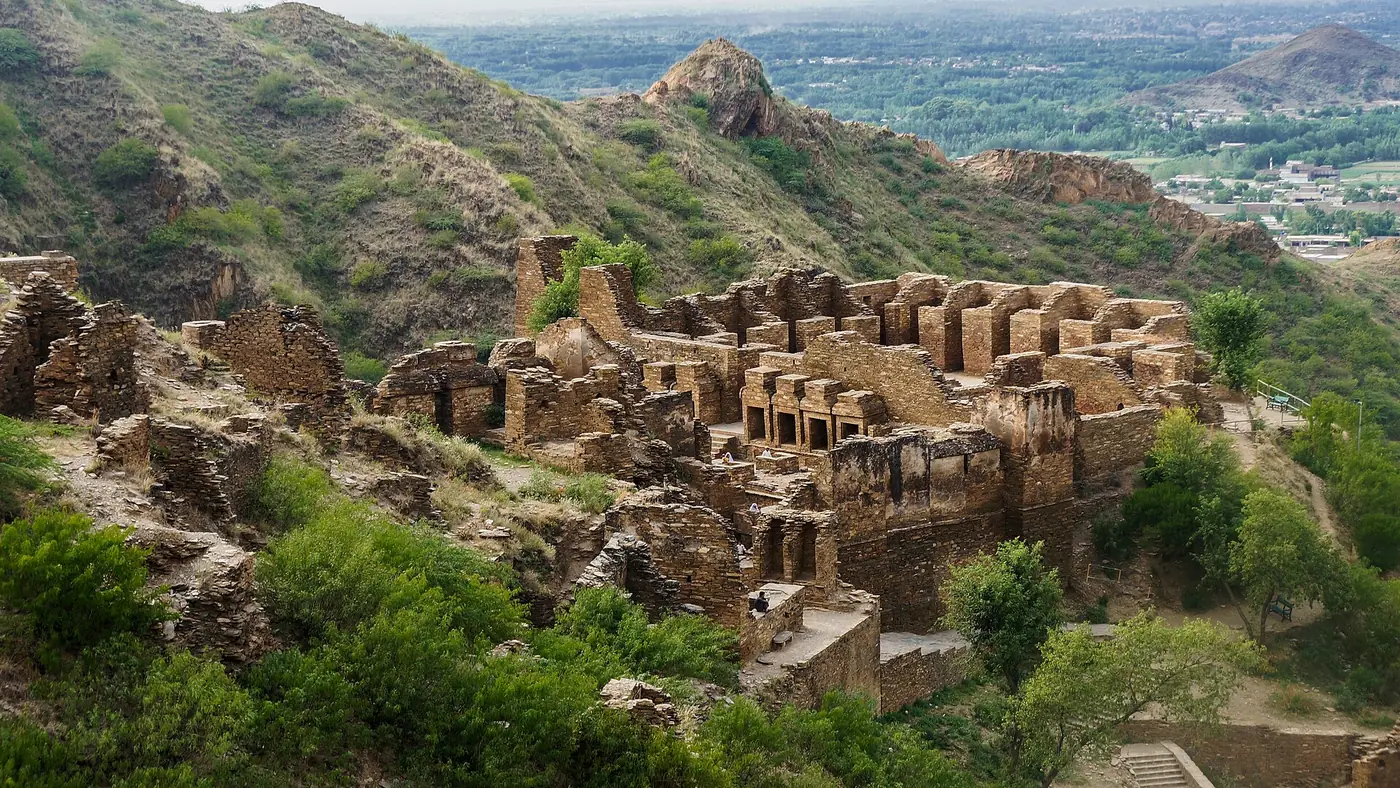
The Shahbaz Garhi rock edicts are fourteen inscriptions of the Mauryan emperor Ashoka, cut into two large boulders in the 3rd century BC, about 12 km from Mardan. Written in the Kharoshthi script, they are among the earliest surviving examples of writing in the subcontinent, and among the very few Ashokan edicts anywhere carved in that script rather than Brahmi. The site is a short, easy stop, protected under shelters with translation boards, and worth 30 to 45 minutes.
This guide covers what the edicts say, their history, and how to fit them into a Mardan trip.
| At a glance | |
|---|---|
| What it is | Fourteen major rock edicts of Ashoka, carved on two boulders |
| Date | 3rd century BC (Ashoka's reign, 272 to 231 BC) |
| Script | Kharoshthi |
| Where | Shahbaz Garhi village, about 12 km east of Mardan on the Swabi road |
| Time needed | 30 to 45 minutes |
| UNESCO status | On the tentative World Heritage list since 2004 |
What the edicts say
Ashoka's major rock edicts, of which there are fourteen standard texts, set out his idea of dhamma, or right conduct: care for people and animals, restraint in hunting and slaughter, tolerance between religious sects, and the duties expected of his officials. The thirteenth edict is the most quoted, because in it Ashoka records his remorse at the killing and suffering caused by his conquest of Kalinga, a turning point often cited as the moment his policy shifted from conquest towards a stated ethic of non-violence.
At Shahbaz Garhi, the fourteen edicts are spread across two boulders rather than one continuous rock face, cut in the Kharoshthi script used in ancient Gandhara. Kharoshthi developed from contact with the Achaemenid Persian administration, which had used Aramaic script in the region before Ashoka's time, and it reads right to left, unlike the Brahmi script used for most of Ashoka's other rock edicts across the subcontinent. Shahbaz Garhi and the Mansehra edicts, north-east of here, are the only two places where Ashoka's major rock edicts survive in Kharoshthi.
Why Ashoka chose this spot
Shahbaz Garhi sits at what was the junction of three ancient routes: one from Kabul to Pushkalavati, the old capital near present-day Charsadda; one south towards Taxila via Hund on the Indus; and one north through Buner towards Swat. Placing a set of edicts here meant they would be read by travellers, traders and officials moving along all three routes, in a region that was already a going concern of Gandharan Buddhist life, with its own stupas and monasteries in Ashoka's time.
Visiting the site
The boulders stand under protective shelters built to shield the carved surfaces from weather, with boards nearby giving translations of the Kharoshthi text into more accessible languages. There is no long walk and no ticket booth to speak of; this is a roadside stop rather than a walled monument, and 30 to 45 minutes is enough to read the boards and see both rock faces.
Shahbaz Garhi lies about 12 km from Mardan on the road towards Swabi, a drive of 20 to 25 minutes. It combines easily with the Mardan Museum, which holds Gandharan sculpture from the wider district, or with a longer day that also takes in Takht-i-Bahi and Sahr-i-Bahlol. If you are continuing east, it also sits on the way towards Swabi's own sites, including the Hund Museum on the Indus.
Our places to visit in Mardan guide sets out how to combine Shahbaz Garhi with the district's other Gandharan sites in a single day, and our Hund Museum guide covers the museum on the Indus if you are carrying on towards Swabi.
Who this stop suits
Shahbaz Garhi suits anyone with even a passing interest in early Indian history or the history of writing: this is some of the oldest deciphered text in South Asia, and the thirteenth edict's account of Ashoka's remorse is a genuinely striking thing to read on the stone itself rather than in a book. It is also an easy add-on, since it needs so little time and sits directly on the road between Mardan and Swabi.
It suits less well anyone expecting a dramatic monument. This is two boulders under a shelter, not a temple or a fort, and without some prior interest in the edicts' content, the visit can feel thin. Read a summary of what the edicts say before you go, so you know what you are looking at.
Is it safe to visit?
Mardan district has seen periodic militant activity in recent years, including attacks on police posts near Takht Bhai in 2024 and September 2026. Pakistani visitors continue to travel to Shahbaz Garhi and Mardan's other Gandhara sites, but the UK government's travel advice, updated 22 September 2026, advises against all but essential travel to Mardan district. If you visit, check current local news and the police situation before setting out and keep the trip to daylight hours. Overseas visitors should check their own government's advice too, since travelling against it can affect travel insurance.
Frequently asked questions
What is written on the Shahbaz Garhi rocks?
Fourteen major rock edicts of the emperor Ashoka, carved in the 3rd century BC in the Kharoshthi script, setting out his ideas of right conduct, tolerance between religions, and his remorse over the conquest of Kalinga.
How old are the Shahbaz Garhi edicts?
They date to Ashoka's reign, 272 to 231 BC, making them among the oldest deciphered inscriptions in South Asia.
Why is Shahbaz Garhi written in a different script from other Ashokan edicts?
Most of Ashoka's rock edicts use the Brahmi script. Shahbaz Garhi and the Mansehra edicts, in what is now Khyber Pakhtunkhwa, are the only sites where his major rock edicts survive in Kharoshthi, the script used in ancient Gandhara.
How far is Shahbaz Garhi from Mardan?
About 12 km, on the road towards Swabi, roughly 20 to 25 minutes by car.
How much time should I allow at Shahbaz Garhi?
30 to 45 minutes is enough to see both boulders and read the translation boards. It works well as a short stop on a longer day around Mardan or on the way to Swabi.