
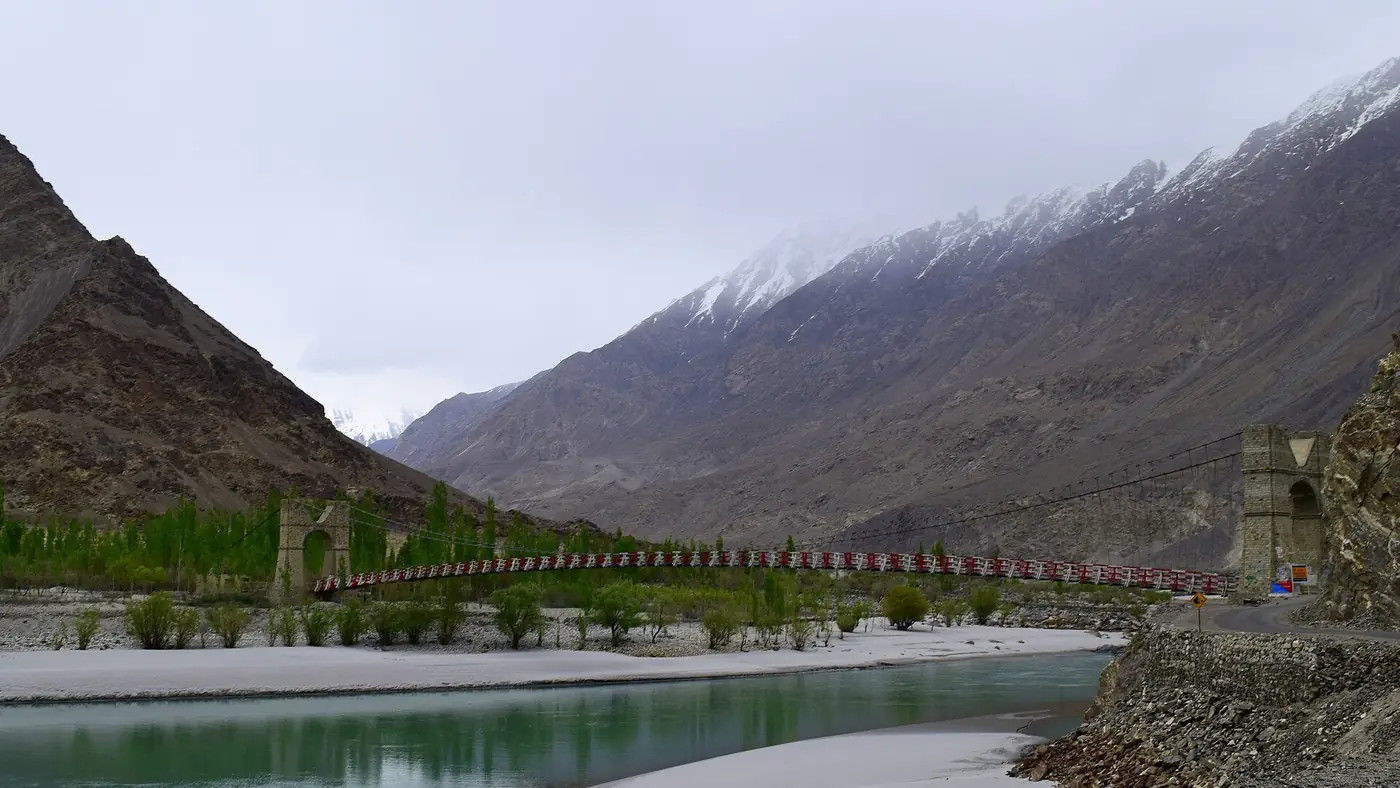

The places to visit in Shigar valley, an hour north of Skardu, are Shigar Fort, the restored seventeenth-century palace of the local rajas; the Amburiq mosque, one of the oldest in Baltistan; the Sarfaranga cold desert and Blind Lake at the mouth of the valley; and, further up, the Basha valley, with the hot springs at Chutron and the village of Arandu beneath a great glacier. The first four fit into one easy day from Skardu. The Basha valley needs a jeep and a longer day, or a night away.
This guide goes through each place, how long it takes and how to put them together, from a half-day visit to a two-day trip.
| Place | What it is | From Skardu | Time needed |
|---|---|---|---|
| Shigar Fort | 17th-century palace, now a heritage hotel and museum | About 1 hour | 1 to 2 hours |
| Amburiq mosque | One of Baltistan's oldest mosques, with a small museum | About 1 hour | 30 minutes |
| Shigar village and orchards | Lanes, water channels, fruit trees | About 1 hour | An hour or more |
| Sarfaranga cold desert | High-altitude dunes where the rivers meet | 20 to 40 minutes | 1 to 2 hours |
| Blind Lake (Zharba Tso) | A still lake with no visible inflow or outflow | About 30 minutes, plus a walk | 1 to 2 hours |
| Basha valley: Chutron and Arandu | Hot springs, and a village at a glacier's foot | Several hours by jeep | A long day, or a night |
Shigar Fort
Shigar Fort, Fong Khar in Balti, "the palace on the rock", is the reason most people come. It was built in the seventeenth century by the Amacha rajas who ruled Shigar, on a huge boulder at the edge of the village. The Aga Khan Cultural Service Pakistan restored it between 1999 and 2004, and the work won a UNESCO Asia-Pacific Award of Excellence in 2006.
Today it is a Serena heritage hotel. Day visitors pay an entry fee to see the museum in the old audience hall, with its carved woodwork, and the Mughal-style garden with its square pavilion. Our Shigar Fort guide covers the history, tickets and what the museum shows.
The Amburiq mosque
About ten minutes from the fort, the Amburiq mosque is a small building with a single spire. Local tradition says it was founded by Sayed Ali Hamdani, the Sufi teacher credited with bringing Islam to Baltistan, and it is traditionally dated to the fourteenth century. It is said to be the first mosque built in the Shigar valley.
By the 1990s it was badly damaged. It was restored between 1998 and 2000 by the Aga Khan Cultural Service Pakistan with Norwegian funding, and in 2005 the work won a UNESCO Asia-Pacific Award of Merit. The mixture of Kashmiri and Tibetan building, with Islamic purpose, is the thing to notice.
A small museum inside explains the building's history. It is also a place of prayer, so dress modestly, take your shoes off where others do, and avoid prayer times.
Shigar village, its old mosques and gardens
Shigar is a farming town, and the lanes behind the fort are worth an hour on their own: stone houses, irrigation channels, and apricot, walnut and other fruit trees. The same conservation programme that restored the fort also repaired water and sanitation in the old quarters of the village and restored its historic mosques.
- The Khilingrong mosque, about four centuries old, was conserved by the Aga Khan Trust for Culture and recognised by UNESCO in 2012. It is still a place where the neighbourhood gathers.
- Hushupi garden, about 15 minutes from the fort, is an old orchard garden of fruit trees and walking paths, and one of the excursions Serena offers its guests.
- The orchards in season. Blossom usually comes from late March to mid-April, and the poplars and orchards turn gold in the second half of October. Both are the best times to walk here.
Be respectful when walking through the village. These are people's homes and fields: ask before photographing anyone, especially women, and keep to the paths.
Sarfaranga cold desert
On the way into the valley, just after the road from Skardu crosses the Indus, you pass the Sarfaranga desert. It is a stretch of dunes at about 2,300 metres, spread between the Indus and the Shigar river, with snow peaks all round, and it is quieter than Katpana near the airport.
Walk the dunes in the last hour before sunset, or arrange a jeep or quad-bike ride on the sand. Since 2017 it has also hosted an annual cold desert jeep rally, usually in the autumn. Our Sarfaranga desert guide covers the rides, the light and camping.
Blind Lake
Blind Lake, locally Zharba Tso, is a narrow lake about 1.4 km long on the edge of the Sarfaranga desert, between the two rivers. No stream visibly flows into or out of it, which is where the name comes from. It is about half an hour from Skardu, down a rough side track off the Shigar road and a short walk, and on most days you will have it nearly to yourself.
It makes a quiet stop on the way back from Shigar, before sunset at the dunes. Our Blind Lake guide covers the track, the name and camping by the water.
The Basha valley: Chutron and Arandu
Above Shigar town the valley divides. One branch, the Braldu, comes down from the Baltoro glacier past Askole. The other, the Basha, comes down from Arandu and the Chogo Lungma glacier. Together they form the Shigar river.
Chutron is the main village of the Basha valley that visitors head for, because of its hot springs. The name itself means "hot water" in Balti, from chu, water, and trun, hot, as the British surveyor Henry Godwin-Austen noted in the 1860s, when he measured the spring at about 43 °C.
Arandu is the last village up the Basha valley, at the foot of the Chogo Lungma glacier, the first of the great Karakoram glaciers to be recorded by outsiders, in 1835. Godwin-Austen was struck by the sight of farming going on so close to so large a glacier. From Skardu it is roughly four hours by jeep, so it is a long day out or better with a night in the valley.
A few things to know before going up the Basha valley:
- Take a jeep with a local driver. The road beyond Shigar is rougher than the main road, and landslides and floods can close it after heavy rain.
- Start early. It is a long way for a day, and you don't want to drive back in the dark.
- Don't enter glacier caves in summer. The ice caves near Arandu are visited with local guides in the depth of winter, when the meltwater stops. In the melt season they can collapse without warning.
- Go prepared. Facilities are limited, so carry cash, water, snacks and warm clothes.
The road to Askole and K2
The Braldu branch of the valley leads to Askole, the last village and the starting point for the trek to K2 base camp and Concordia. It is about six hours by jeep from Skardu on a rough road. It is a trekking road rather than a sightseeing drive, and not worth doing unless you are going on to walk. Our K2 base camp trek guide covers that journey.
How to plan your time in Shigar
- Half a day: Shigar Fort and the Amburiq mosque, back in Skardu for lunch.
- One full day: the fort, the mosque and the village in the morning; Blind Lake in the afternoon; the Sarfaranga dunes at sunset. Our Skardu to Shigar guide sets out the timings.
- Two days: the above, a night in Shigar at the fort or a guesthouse, and the Basha valley the next day for Chutron.
Our Skardu and Deosai trip gives a day to Shigar, with the fort, the Amburiq mosque and the orchards behind the village, as part of a week in Baltistan from PKR 90,000 per person.
Is Shigar valley worth visiting?
Yes, on almost any trip to Skardu. It is close, it needs no jeep for the main sights, and it shows old Baltistan better than anywhere else near the town. It is also a good choice when Deosai is closed, when the weather is poor at altitude, or when you are travelling with older parents or small children, because the main sights sit no higher than Skardu itself.
It is quiet rather than thrilling. If your group wants adventure, spend less time in the village and more on the dunes, or go up the Basha valley. And if you have only two days in Skardu, see the fort and the dunes and leave the rest for another trip.
Frequently asked questions
What is Shigar valley famous for?
Shigar Fort, the restored palace of its rajas, the centuries-old Amburiq mosque, and its orchards. It is also the gateway to Askole and the K2 base camp trek.
How far is Shigar from Skardu?
About 30 km, or 45 minutes to an hour by car on a paved road.
How many days do you need for Shigar valley?
One full day covers the fort, the Amburiq mosque, Blind Lake and the Sarfaranga dunes. Add a second day and a night if you want the Basha valley.
Can you visit Shigar valley in a normal car?
Yes, for the fort, the mosque, the village and the edge of the dunes. For the Blind Lake track and the Basha valley, use a jeep with a local driver.
Where are the hot springs in Shigar?
At Chutron, in the Basha valley above Shigar town. The village's name means "hot water" in Balti.
What is the best time to visit Shigar valley?
Late March to mid-April for blossom, May to September for green fields, and the second half of October for autumn colour. The road is open all year.