
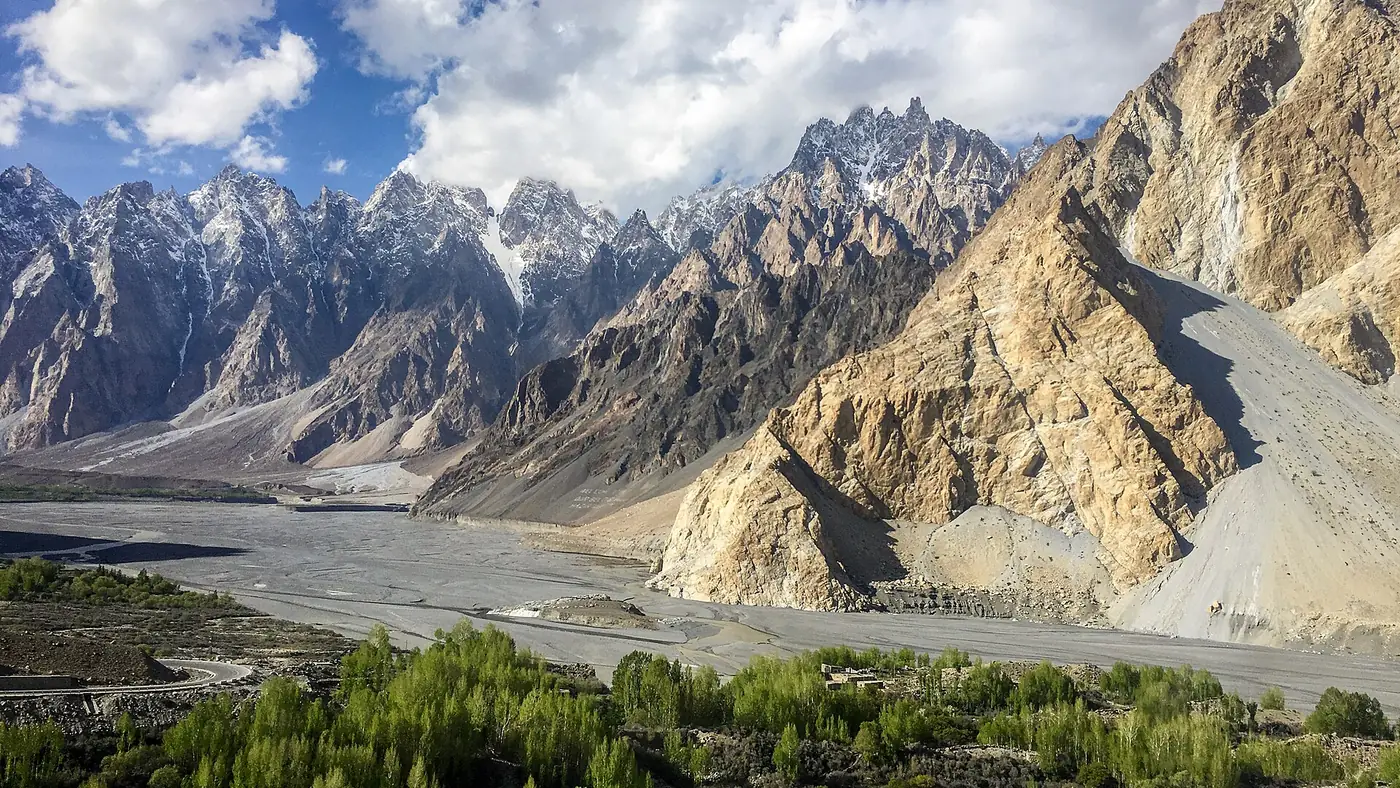

June is the month the northern areas open up. The Babusar Pass has usually reopened by the start of the month or soon after, Deosai and the Fairy Meadows track open during it, and the Khunjerab Pass and Shandur are already running. The valleys are warm to hot by day and cool at night, snow still lies on the high ground, and the crowds build week by week as schools close in the plains. For most trips, June in the northern areas is one of the two best months of the year, alongside September.
This guide covers what June is really like: the weather at different heights, what "open" means for a pass that was under snow three weeks earlier, the first weather warnings of the summer, and how the school holidays, Eid and Muharram fall across the month.
| At a glance | June |
|---|---|
| Gilgit | Hot: afternoons around 34 to 36 °C |
| Skardu | Warm days around 29 °C, cool nights |
| Karimabad, Hunza | Mid to high 20s by day, cool evenings |
| Fairy Meadows | Days around 14 °C, nights around 6 °C |
| Babusar Pass | Reopened 25 May in 2026; daylight only, with closures in early June |
| Deosai | Usually opens early to mid-June |
| Khunjerab Pass | Open for visitors |
| Shandur polo festival | 11 to 13 June in 2026 |
| Crowds | Rising all month; Punjab schools closed from 22 May in 2026 |
What is the weather like in June?
June is warm and settled in most of the north, but the range between places is wide, and people who pack for one temperature get caught out.
- The low valleys are hot. Gilgit, at about 1,500 metres, averages 34 to 36 °C in the afternoon through the summer, and Chilas, lower down the Indus, is hotter still. The Kohistan stretch of the Karakoram Highway can be as hot as Lahore.
- The main towns are pleasant. Skardu averages around 29 °C by day in June, and Karimabad a few degrees less, with nights cool enough for a light jacket. Naran and Kalam are cooler again.
- The high places are cold. At Fairy Meadows, June nights average around 6 °C. Deosai, at over 4,000 metres, can be near freezing in the early morning, and the top of the Khunjerab Pass is cold and windy whatever the valley feels like.
Rain is light in most of Gilgit-Baltistan in June; the monsoon usually reaches the mountains in July. That makes June one of the clearest months for views and flights, but it does not mean trouble-free weather, as the section on rivers below explains. For the full year, see our guide to the seasons.
Is Babusar open in June?
In most recent years, yes, but the first weeks after it opens are not the road in the July photographs.
The pass reopened on 25 May in 2026 and in the fourth week of May in 2025; in 2023 and 2024 it stayed shut until about 10 to 12 June. Even after the opening, June can bring short closures. In 2026 the road was shut again from 31 May to 2 June and then until 6 June so that crews could finish clearing snow and widen the carriageway.
What early June on Babusar means in practice:
- Snow walls and single-lane sections near Gittidas and the top, with traffic run one way at a time.
- Daylight-only crossings. The police have stopped traffic in the evening in recent seasons, because the road freezes after dark.
- A cold top. At 4,173 metres there is still snow beside the road, and it feels like winter in the wind.
- Long queues at weekends and holidays on a road that is not yet at full width.
If your trip depends on the pass, plan on the Karakoram Highway until the second half of June and treat Babusar as a bonus. Our guide to whether Babusar Top is open or closed has the opening dates year by year.
Snow on the high ground: what else opens in June
June is the month when the high places move from closed to open, often in the middle of your holiday.
Deosai
The plateau averages 4,114 metres and opens only once the drifts on the track have been cleared: in an average year that is early to mid-June, in a light year late May, and after a heavy winter later. Early in the season the track is soft and muddy where meltwater runs across it, and the lakes may still be partly frozen. The wildflowers come later, in July. Our guide on whether Deosai is open or closed explains how to check.
Fairy Meadows
The jeep track from Raikot Bridge is usually open for the season by June, and the meadow turns green. Snow still lies on the higher paths towards Beyal and the viewpoint in the first half of the month, so the walk beyond the meadow can be wet and slippery.
Saif-ul-Malook and the Kaghan lakes
By June the ice has gone from Saif-ul-Malook and the meadows around it are green, with snow still on the slopes above. It is one of the best months for the lake, particularly early on a weekday. Lulusar, on the road to Babusar, follows a week or two behind.
Khunjerab and Shandur
The Khunjerab Pass is open for visitors in June, though the top can still close for a day after fresh snow. The Shandur Pass between Gilgit and Chitral is open for the summer, and the polo festival on its plateau was held from 11 to 13 June in 2026; our Shandur Polo Festival guide covers the event.
Rivers, glaciers and the first weather warnings
June's weather risk comes from heat rather than rain. Hot spells melt glaciers and snowfields fast, the rivers run high and grey, and glacial lakes can burst.
The official warnings start early. In May 2026 the Gilgit-Baltistan tourism department issued an advisory about heavy rain, landslides, flash floods and glacial lake outburst floods, and in June the authorities warned that a long heatwave had raised the flood risk in glacier zones including Shishper in Hunza. On 17 June 2026, heavy rain brought landslides and mudflows that blocked sections of the Karakoram Highway in Diamer and the Skardu road for a day or two.
Not every hold-up is the weather. On 20 and 21 June 2026, road blockades at Chilas left some travellers stuck on the highway for well over a day.
What to do about it:
- Check the road on the morning you travel, not the week before. Our guide to Karakoram Highway road status lists where to look.
- Keep a spare day, even in June.
- Stay away from riverbanks and stream crossings in the afternoon, when meltwater peaks.
- Finish each day's driving in daylight, and don't stop under loose slopes to take photographs.
School holidays, Eid and Muharram
June is when the northern areas fill up. In 2026 Punjab closed its schools from 22 May to 23 August, and Sindh from 1 June to 31 July, so families from both provinces were on the road for the whole month.
Three things decide how busy a particular June is:
- Where Eid ul Adha falls. It was on 27 May in 2026, so the first week of June carried the tail of the Eid rush, on a Babusar road that had only just opened. In 2027 it is expected in mid-May, so June should start calmer.
- Muharram. The 9th and 10th of Muharram are public holidays, and they fell on 25 and 26 June in 2026; in 2027 they come around the middle of June. Mobile and internet services are often suspended in sensitive districts on those days, and processions run through several northern towns. Plan to stay put rather than drive.
- Weekends. Naran, Swat and the Galiyat fill every weekend once schools close. Midweek is noticeably quieter.
Book hotels in Hunza, Skardu and Naran before you book anything else, and book summer flights to Gilgit and Skardu as early as you can; the small number of seats goes quickly.
Early June or late June?
The month divides roughly in two.
The first half of June is quieter in a year when Eid falls in mid-May, the air is clear and the green is fresh. The trade-offs are that Babusar may still be on restricted hours or closed for clearing, Deosai may not have opened, and there is snow on the higher walks.
The second half of June has everything open, longer settled spells and the best chance of crossing Babusar without drama. It is also busier, hotter in the low valleys, and, in 2026 and 2027, includes the Muharram holidays.
If Deosai or a Babusar crossing is the point of the trip, aim for the last ten days of June. If the point is Hunza, Skardu town or the Kaghan valley, any week works.
A sensible June plan
A route that suits June well is to go up the Karakoram Highway and come back over Babusar. Going north early in the month, you are not relying on the pass; coming back a week or more later, it is far more likely to be open and running normally. The same logic works for Skardu: fly in, spend the first days on the valley floor and around Shigar, and leave Deosai for the end of the trip, when it is more likely to be open.
Our Skardu and Deosai trip puts the plateau in the middle of the week for the same reason, with a spare day at the end for the weather.
Who is June right for?
June suits almost everyone: families on school holidays, first-time visitors, anyone who wants every road open without the full weight of the monsoon. It is especially good for Hunza, the Kaghan valley, Saif-ul-Malook and Skardu town.
It suits less well if your heart is set on Deosai in flower (go in July), if you want the quietest roads (go in September), or if you are relying on Babusar in the first week of the month. And if you are flexible, avoid the Eid and Muharram holidays, which bring the heaviest traffic of the season.
Frequently asked questions
Is June a good time to visit the northern areas?
Yes. The main valleys are warm and clear, the high passes are opening, and the monsoon usually has not arrived. It is busier than May, so book rooms early.
Is Babusar Top open in June?
Usually, yes. It reopened on 25 May in 2026, but closed again for several days in early June for snow clearing. Expect daylight-only crossings and single-lane stretches in the first weeks.
Is Deosai open in June?
It usually opens in early to mid-June once the track is cleared, and can open later after a heavy winter. Late June is safer if the plateau is essential to your trip.
Is there snow in the northern areas in June?
Yes, on the high ground: around Babusar Top, beside the Deosai track, on the walks above Fairy Meadows and at the Khunjerab Pass. The valleys where people stay are free of snow.
How hot is Gilgit in June?
Hot. Afternoons average 34 to 36 °C, and Chilas on the way is hotter still. Hunza and Skardu are more comfortable, and nights everywhere above 2,000 metres are cool.
Is June crowded in the northern areas?
Increasingly so as the month goes on, because schools in Punjab and Sindh are closed. Weekends, Eid and the Muharram holidays are the busiest times; midweek is calmer.