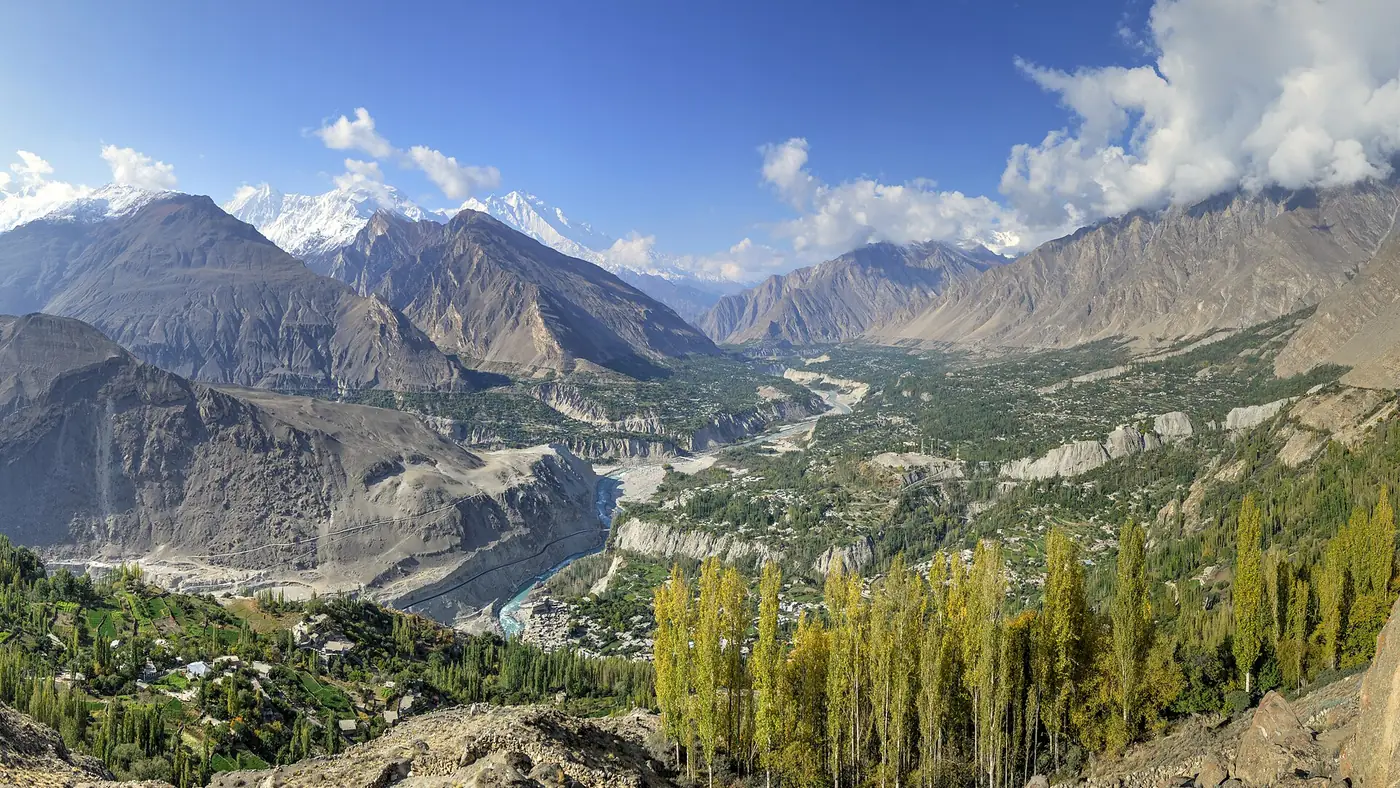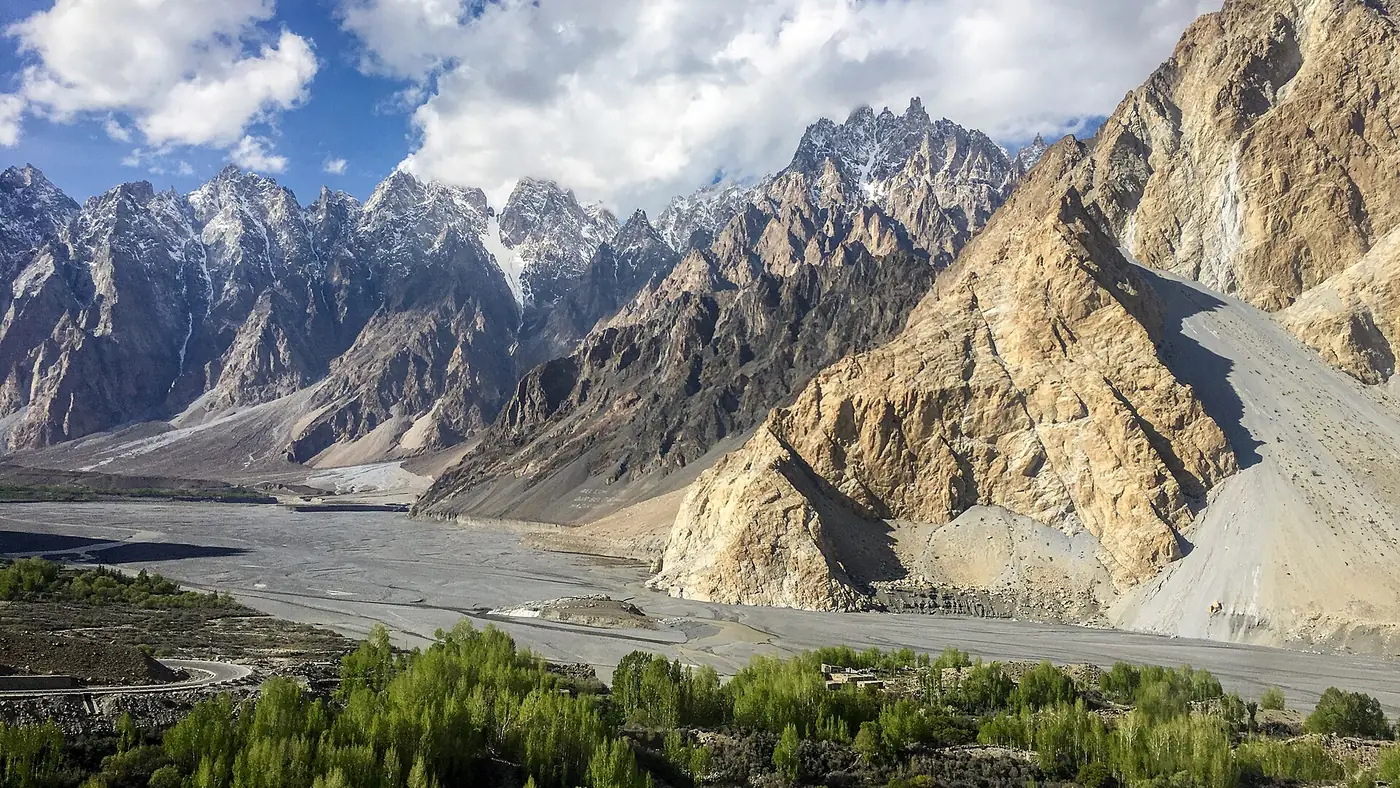
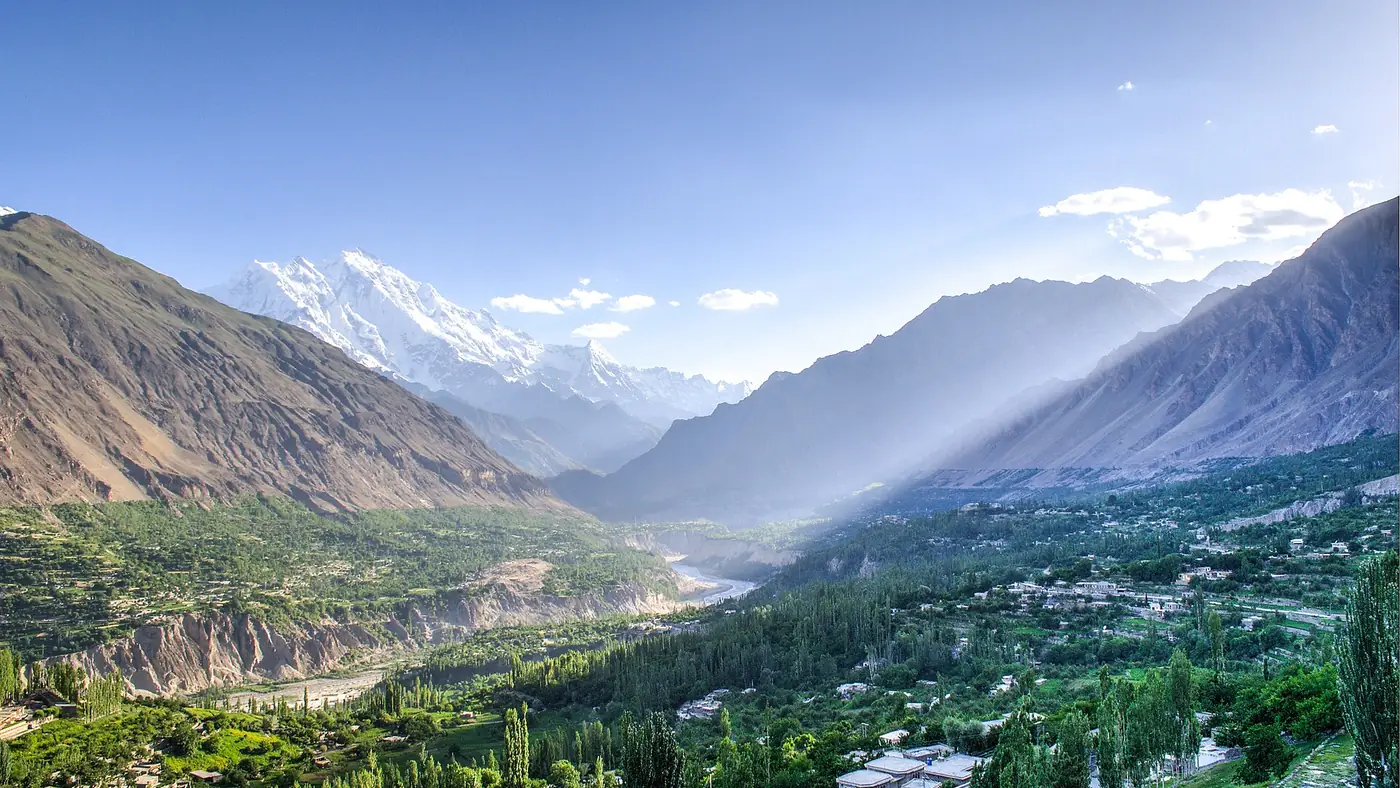
The history of Hunza is the story of a small mountain state that stayed independent for centuries. Its hereditary rulers, the Mirs, governed from Altit and later Baltit, paid a token tribute to China, and grew rich partly by raiding the caravans that crossed the passes to Central Asia. The British conquered Hunza in 1891 and kept the Mirs on as rulers. In November 1947 Hunza joined Pakistan, and in 1974 the state was abolished.
This guide runs through that story in order, from the rock carvings beside the Karakoram Highway to the Attabad landslide of 2010, and ends with where to see each part of it on a visit.
| Date | What happened |
|---|---|
| 1st millennium AD | Travellers carve inscriptions on the Sacred Rock near Ganish |
| About 1760 | Hunza starts sending tribute to Qing China |
| Early 19th century | Mir Silum Khan becomes Ismaili |
| 1889 | Francis Younghusband meets Mir Safdar Ali Khan |
| December 1891 | A British force takes Nilt and reaches Baltit |
| 1945 | The Mirs move out of Baltit Fort |
| 3 November 1947 | Hunza accedes to Pakistan |
| September 1974 | Hunza state abolished |
| 1979 and 1986 | Karakoram Highway completed, then opened to the public |
| January 2010 | Attabad landslide dams the Hunza river |
| 2015 | Attabad tunnels open; Hunza becomes a district of its own |
Before the Mirs: rock carvings and the Silk Road
Long before there was a state, Hunza was a corridor. For most of history the way from Gilgit to Kashgar ran up the valley to the Mintaka and Kilik passes; the Karakoram Highway, planned in the 1960s, went over the Khunjerab instead.
The clearest trace of early travellers is the Sacred Rock of Hunza, a group of boulders between the river and the highway, a few minutes from Ganish. They carry carvings of ibex and horsemen and inscriptions in Kharoshthi, Brahmi, Sogdian, Bactrian, Chinese and Tibetan scripts, mostly from the first millennium AD, some naming kings of the Kushan empire. Buddhism was followed in these valleys before Islam arrived.
Ganish, on the highway below Karimabad, is usually described as the oldest settlement in Hunza. Its old village keeps a watchtower and carved wooden mosques, and its restoration won UNESCO Asia-Pacific heritage awards in 2002 and 2009.
Who were the Mirs of Hunza?
Local tradition says Hunza and Nagar, the state across the river, were once one kingdom, split between twin brothers who fought from birth: Girkis took the Hunza bank and Moghlot the Nagar bank. The two states stayed rivals, and often at war, for centuries.
Hunza's ruling family came to be called the Ayasho. Its rulers were first titled Thum and later took the Persian title Mir, and they claimed descent from Alexander the Great.
Their first seat was Altit Fort, on its cliff above the river, whose oldest tower is commonly dated to around 900 to 1,100 years ago. The capital later moved up to Baltit Fort, above what is now Karimabad. In the 16th century Mir Ayasho II married Shah Khatun, a princess from Skardu, and craftsmen from Baltistan rebuilt Baltit, which is why it shows Tibetan influence. Our guides to Baltit Fort and Altit Fort cover both buildings.
The people of central Hunza, the Burusho, speak Burushaski, a language with no known relatives, which our Burushaski language guide explains. Upper Hunza, or Gojal, speaks Wakhi.
How did Hunza become Ismaili?
In the early 19th century, missionaries from Badakhshan brought Ismaili teaching to the valley. Mir Silum Khan, who ruled until the 1820s, is remembered as Hunza's first Ismaili ruler, though he is said to have kept his faith quiet for political reasons. Over the following decades most of the valley became Ismaili, as it remains. A minority of families, notably in Ganish, are Twelver Shia, as is most of Nagar.
The link with the Ismaili imams, the Aga Khans, has shaped modern Hunza as much as any government. Karimabad is named after Prince Karim Aga Khan, Aga Khan IV, who led the community from 1957 until his death in February 2025. His son Rahim is now Aga Khan V.
China, the caravans and the Great Game
From about 1760 Hunza recognised the Qing emperor as overlord and sent a small annual tribute of gold dust, receiving silk and other gifts in return. The tribute continued until the late 1930s.
Hunza also lived by raiding. Its men crossed the Shimshal Pass to attack caravans on the trade route between Leh and Yarkand, carrying off goods and captives. By the 1880s this made Hunza a problem for British India, just as Britain and Russia were competing for influence in the Pamirs.
In 1888 the Russian officer Bronislav Grombchevsky visited Hunza. The next year the British sent Francis Younghusband north from Leh with a small Gurkha escort, and he went on to tell Mir Safdar Ali Khan to stop the raids and keep away from the Russians.
The war of 1891
The British tightened their hold on Gilgit, reinforced the fort at Chalt on the edge of Hunza and Nagar, and began building roads towards both states. In December 1891 a force of about 1,000 men under Colonel Algernon Durand, largely Gurkha and Kashmiri troops with mountain guns, marched on them.
The main fighting was at Nilt, a fort on the Nagar side of the river, and three Victoria Crosses were awarded for the campaign. By the end of December the British were in Baltit. Safdar Ali Khan did not wait for them: he fled over the passes into China.
In 1892 the British installed Mohammad Nazim Khan as Mir. Hunza became a princely state under British protection, running its own internal affairs, with a British political agent in Gilgit watching its borders.
From princely state to Pakistan
Nazim Khan ruled until 1938. He was followed by Mohammad Ghazan Khan II and then, in 1945, by Mohammad Jamal Khan, the last ruling Mir. That year the royal family left Baltit Fort for a new palace lower down the hill.
On 3 November 1947 Mir Jamal Khan sent a telegram to Muhammad Ali Jinnah acceding Hunza to Pakistan. For another quarter-century the Mir still ran Hunza as a state within Pakistan. In September 1974 Prime Minister Zulfikar Ali Bhutto abolished Hunza and Nagar as states, and they were absorbed into the Northern Areas, now Gilgit-Baltistan.
The title of Mir survives as a ceremonial one. The current Mir, Ghazanfar Ali Khan, son of Jamal Khan, has been an elected politician and served as Governor of Gilgit-Baltistan from 2015 to 2018.
Modern Hunza: the road, the Aga Khan and the lake
The Karakoram Highway changed Hunza more than anything since 1891. Completed in 1979 and opened to the public in 1986, it cost the lives of roughly 810 Pakistani and 200 Chinese workers. It put Hunza on the main road to China, and tourism followed.
Much of the development came through the community. The Aga Khan Rural Support Programme, set up in 1982, worked with village organisations on irrigation channels, bridges and savings, and the Aga Khan Trust for Culture restored Baltit Fort (reopened in 1996) and Altit Fort (2007). In a Gilgit-Baltistan government survey published in 2026, Hunza came top of the region's districts on almost every measure of health and education.
On 4 January 2010 a huge landslide at Attabad killed 20 people and dammed the Hunza river. The lake drowned Ayeenabad, flooded parts of Shishkat and Gulmit, displaced about 6,000 people and cut upper Hunza off by road. Boats carried people and goods across it for more than five years, until a new stretch of highway with five tunnels opened in September 2015. Our guide to Attabad Lake covers the lake today. The same year Hunza became a district of its own, separate from Nagar, with Aliabad as its centre.
Where to see Hunza's history on a visit
Most of the story can be seen in a day or two around Karimabad:
- Baltit Fort, the palace of the Mirs until 1945, now a museum with guided tours.
- Altit Fort and its village, the older seat of the Mirs.
- Ganish, with its watchtower and old mosques, best walked with a local guide.
- The Sacred Rock, a short drive from Ganish.
- The Attabad tunnels and lake, the latest chapter, on the drive up to Gojal.
If history is a big part of why you are going, give Karimabad two nights rather than one. The fort tours are short, but the villages around them are what make sense of the story, and they need a slow walk with someone local. For deeper reading, Haji Qudratullah Beg's history of the old state, first published in 1980, came out in English in 2026.
Our Gilgit and Hunza page shows how the sites fit together, and our Gilgit, Hunza and Khunjerab tour gives a full day to Baltit, Altit and old Karimabad.
Frequently asked questions
Who ruled Hunza?
Hereditary rulers called Mirs ruled Hunza for centuries, first from Altit Fort and later from Baltit Fort. The last ruling Mir, Mohammad Jamal Khan, reigned from 1945 until the state was abolished in 1974.
When did Hunza join Pakistan?
On 3 November 1947, when Mir Mohammad Jamal Khan sent a telegram to Muhammad Ali Jinnah acceding the state to Pakistan. Hunza kept its Mir and its own administration until 1974.
Was Hunza on the Silk Road?
Yes. Routes from Gilgit to Kashgar ran through Hunza and over the Mintaka and Kilik passes, and inscriptions on the Sacred Rock near Ganish record travellers from the first millennium AD.
Why is Karimabad called Karimabad?
It is named after Prince Karim Aga Khan, the Ismaili imam. The old capital was Baltit, and the name Karimabad came with the new town that grew below the fort after the Mirs moved down.
Is there still a Mir of Hunza?
Only as a ceremonial title, held by Mir Ghazanfar Ali Khan, son of the last ruling Mir.
When did the British take Hunza?
In December 1891, after a short campaign under Colonel Algernon Durand. Mir Safdar Ali Khan fled to China, and the British installed Mohammad Nazim Khan as Mir in 1892.