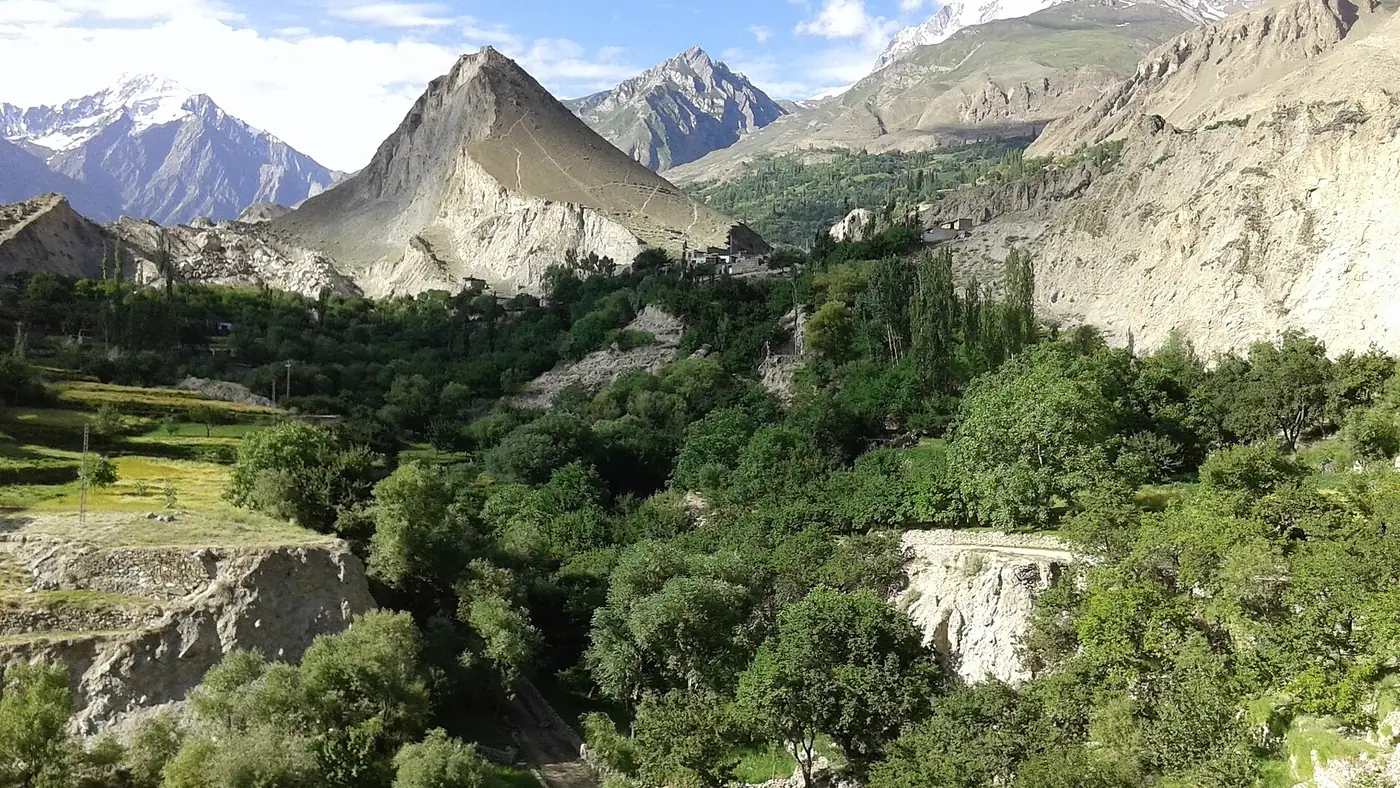
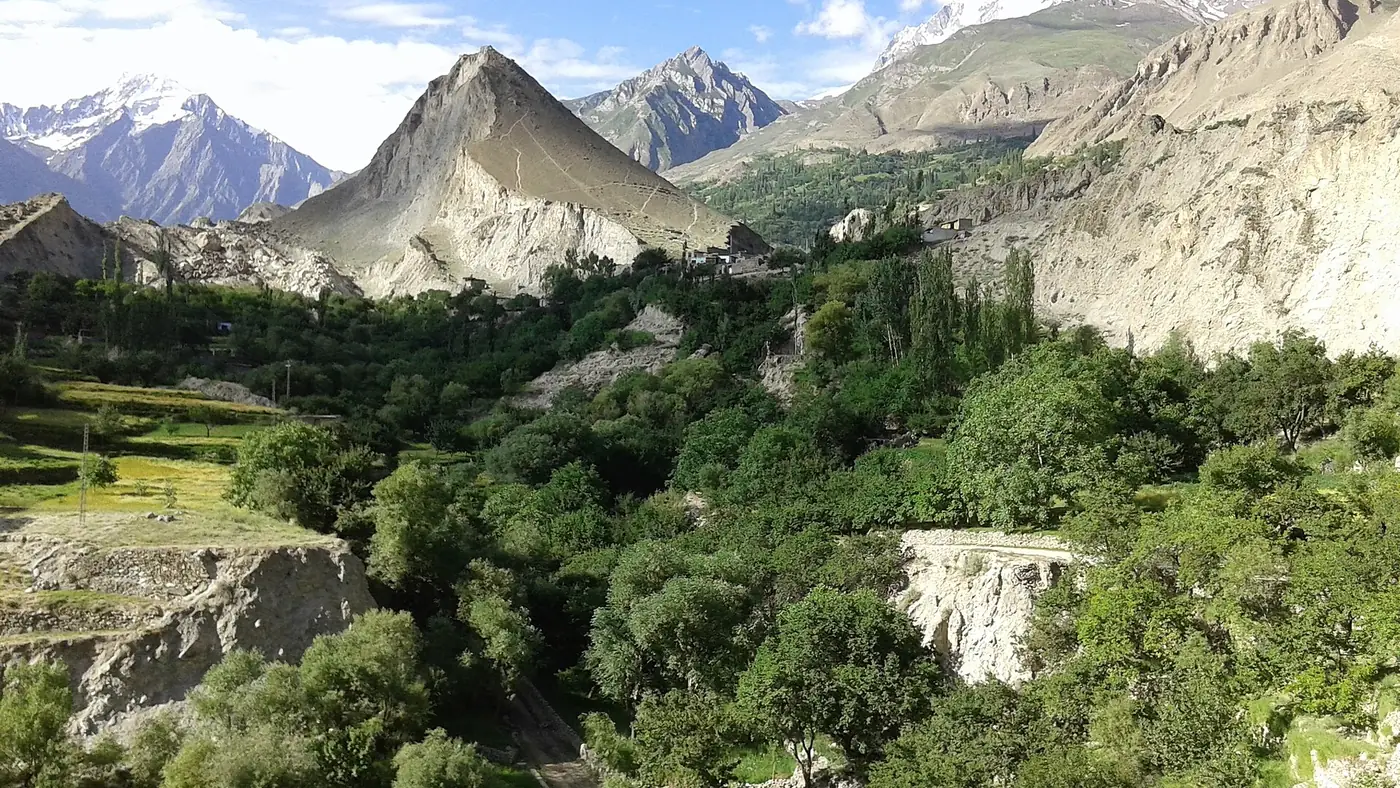
Golden Peak, known formally as Spantik, is a 7,027-metre mountain on the edge of Nagar district, at the head of the glaciers above Hopper. Its English name comes from a huge pillar of pale rock on the north-west face that turns gold in the evening light, a sight visitors staying around Hopper and upper Nagar can see without climbing anything.
This guide covers the mountain's height and setting, the story behind the Golden Peak name, its climbing history, and where in Nagar to see the glow for yourself.
| At a glance | |
|---|---|
| Height | 7,027 m |
| Range | Spantik-Sosbun subrange, Karakoram |
| Location | Head of the Bualtar and Chogolungma glaciers, on the edge of Nagar |
| Local (Burushaski) name | Ghenish Chhish, "Golden Peak" |
| Balti name | Spantik, from spang (grass) and tik (place) |
| First ascent | 1955, southeast ridge, from the Baltistan side |
| Famous route | The Golden Pillar, northwest face, first climbed 1987 |
| Best viewpoint | Hopper valley, at sunset |
Where is Golden Peak?
Spantik stands in the Spantik-Sosbun subrange of the Karakoram, at the head of the glacier system that Nagar and Baltistan share. Its northern side rises above the Bualtar glacier, the same ice that forms the well-known viewpoint at Hopper, while its southern side drops towards the Chogolungma glacier in the Arandu area of Shigar district, Baltistan.
That places it on the boundary between the two regions rather than inside a single valley. For a visitor based in Hunza, it counts as one of the peaks of Nagar because the approach, and the view most people get of it, comes from the Hopper side. Our guide to places to visit in Nagar valley covers Hopper and the rest of the district.
Why is it called Golden Peak?
The name is not a marketing phrase. On the mountain's north-west face is a huge, smooth pillar, made of pale, creamy rock rather than the dark granite typical of the surrounding peaks, and in the low sun of evening it turns a deep gold. Climbers who first described the route up it named it the Golden Pillar, and the name stuck to the whole mountain.
In Burushaski, the language of Nagar and Hunza, the peak is called Ghenish Chhish, which also means Golden Peak. Its other name, Spantik, is Balti, thought to come from spang (a grassy slope) and tik (a place), describing the green ground on its south-eastern approach.
Climbing history
Spantik was first climbed in 1955, by the German mountaineers Reiner Diepen, Eduard Reinhardt and Jochen Tietze, who reached the summit by the south-east ridge, approaching from the Chogolungma glacier on the Baltistan side. That route remains the normal way up the mountain and the one used on most guided expeditions today.
The climb that made the mountain famous came much later, from the Nagar side:
- 1987. The British climbers Mick Fowler and Victor Saunders made the first ascent of the Golden Pillar on the north-west face, climbing it in alpine style over several days with no fixed ropes or support. Their account of the route, written up for the American Alpine Club, is one of the best-known pieces of Karakoram climbing literature and is why the mountain is now widely known as Golden Peak.
- 2000. The Golden Pillar saw its second ascent, more than a decade after Fowler and Saunders first climbed it.
- 2009. A Korean team opened a further new alpine-style line on the north-west face.
Spantik still sees far fewer expeditions than Pakistan's 8,000-metre peaks, and the south-east ridge, though technically the easier route, is still a serious high-altitude climb requiring a permit and an experienced team.
Where to see the glow from Nagar
You do not need to be a climber to see what gives the mountain its name. From the villages of Hopper, at the head of the Bualtar glacier, Spantik and its golden pillar are part of the skyline, and on a clear evening the face lights up as the sun drops. Our guide to Hopper valley covers the drive there from Karimabad and the glacier viewpoint at the end of the road.
Trekkers on the route to Rush Lake, which climbs from Hopper across the Bualtar and Barpu glaciers, get a closer and longer look at the mountain over several days, from angles the roadside viewpoint does not offer.
A few points for anyone hoping to catch the light:
- Go in the evening, in the hour or so before sunset. The gold colour is strongest in direct, low sun and disappears once the mountain falls into shadow.
- Clear weather matters more than the exact date. Cloud on the high peaks is common in Nagar on summer afternoons, so a still, dry evening gives the best chance.
- September and October tend to bring the clearest air after the summer haze has settled, though the mountain can show its colour at any time from May to October when the road to Hopper is open.
Is it worth the trip?
For most visitors, yes, as part of a stop in Hopper rather than a special journey of its own. Golden Peak is not visible from the Karakoram Highway or from Karimabad, so seeing it means making the drive up into Nagar. Anyone already planning a half-day at the Hopper glacier viewpoint gets the mountain, and its evening colour, as part of the same outing at no extra cost in time.
If your schedule in Hunza is tight and you have to choose one Nagar outing, the Hopper glacier itself, described in our Hopper valley guide, is the better use of a short afternoon; the sight of Golden Peak simply adds to it if you can stay until the light turns.
Frequently asked questions
How tall is Golden Peak (Spantik)?
Spantik is 7,027 metres high, part of the Spantik-Sosbun subrange of the Karakoram, on the edge of Nagar district near the border with Baltistan.
Why is Spantik called Golden Peak?
A large pillar of pale rock on its north-west face turns gold in the evening sun. Climbers named the route up it the Golden Pillar after first climbing it in 1987, and the mountain is now widely known by the same name.
Who first climbed Spantik?
Three German climbers, Reiner Diepen, Eduard Reinhardt and Jochen Tietze, made the first ascent in 1955 by the south-east ridge, approaching from the Baltistan side.
Where can you see Golden Peak from Nagar?
From the Hopper valley, at the head of the Bualtar glacier. The mountain and its golden pillar are visible from the villages there on a clear evening, best in the hour before sunset.
Do you need to be a climber to see it?
No. The mountain is visible from the Hopper glacier viewpoint, which any visitor can reach by road from Karimabad in under an hour. Only the Golden Pillar route itself needs mountaineering experience.