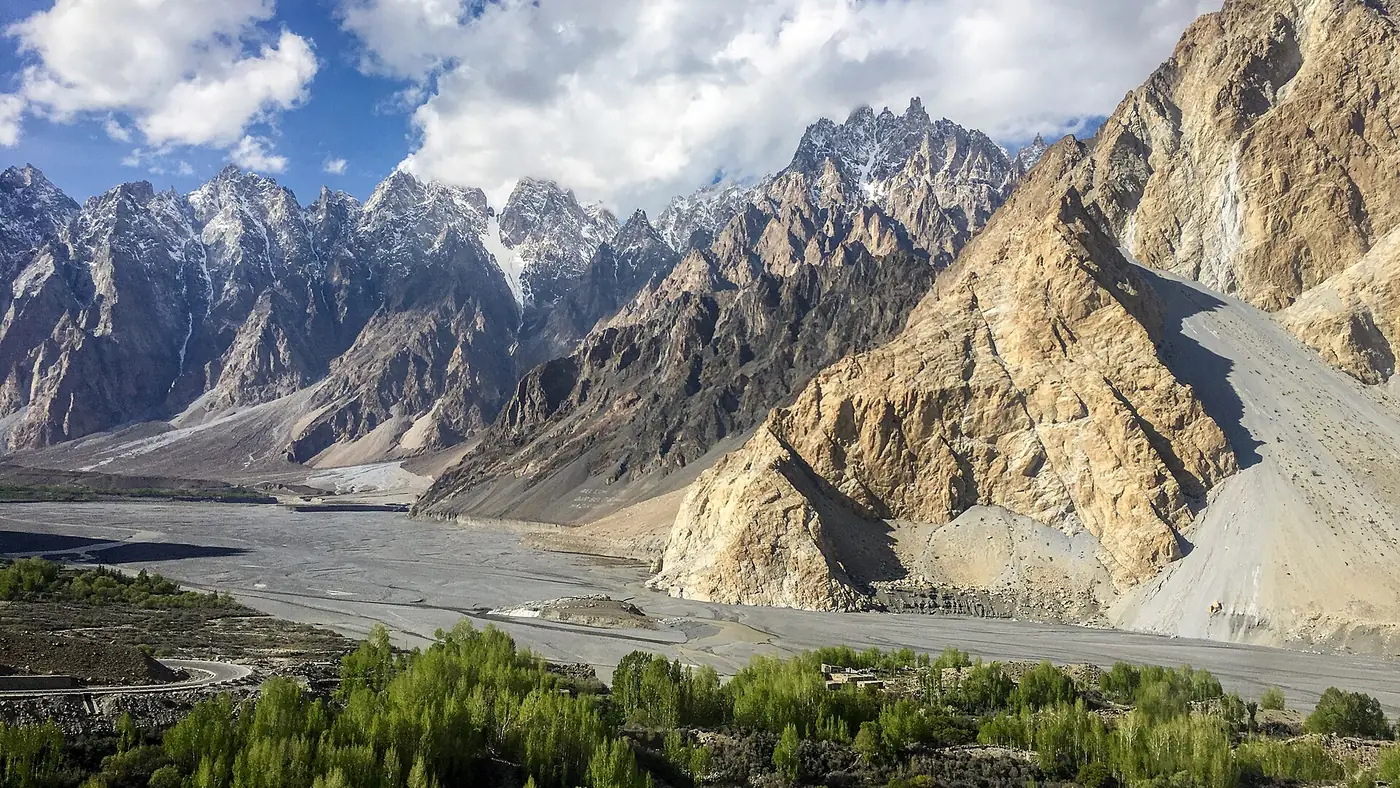
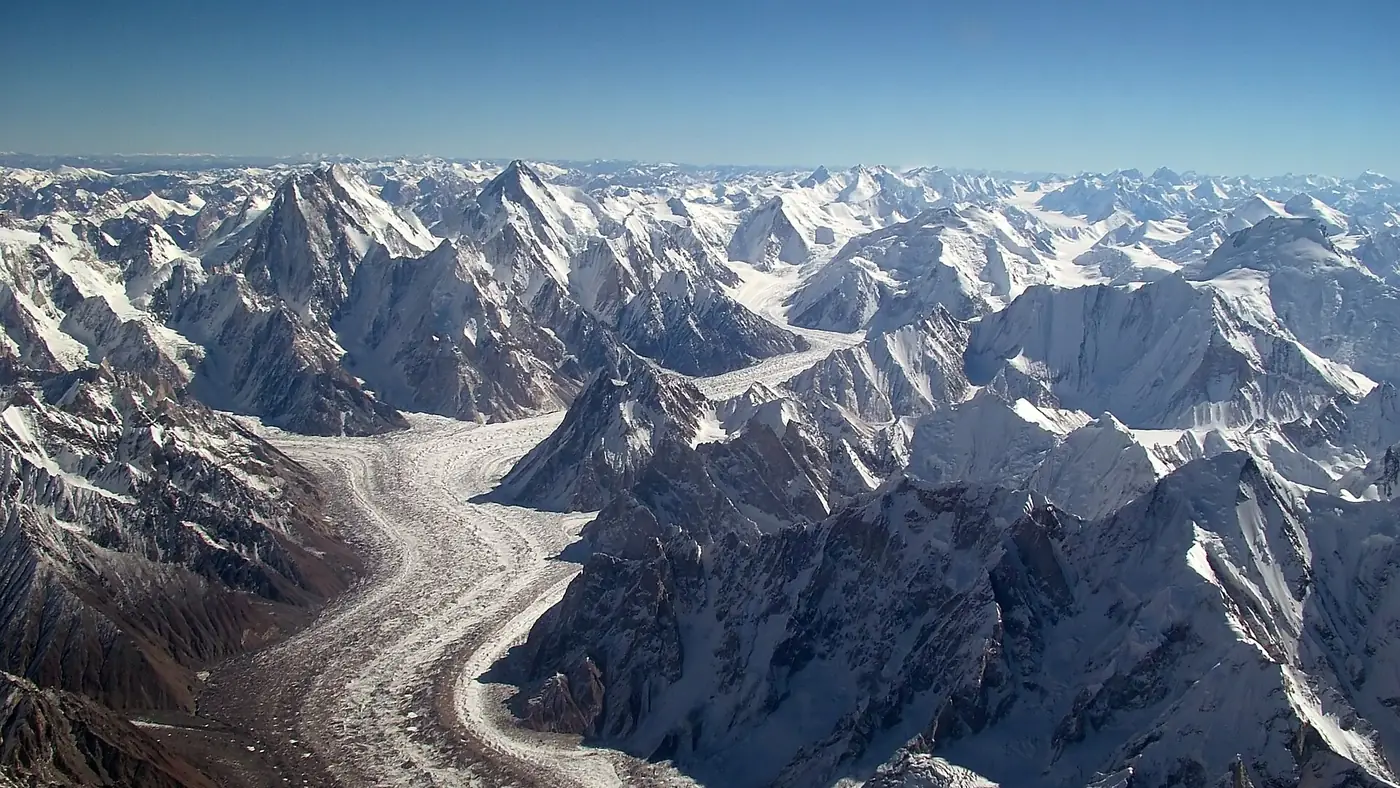
Gasherbrum I and II are two of the five Gasherbrum peaks in the Karakoram, and the two that reach above 8,000 metres: Gasherbrum I at 8,080 metres and Gasherbrum II at 8,035 metres. Both stand at the head of the Baltoro glacier, near K2 and Broad Peak, and both are visible from Concordia, the trekkers' viewpoint reached on foot from Askole.
This page covers what the Gasherbrum peaks are, their climbing history, and how far a trekker, rather than a climber, can actually get toward them.
| At a glance | |
|---|---|
| Gasherbrum I height | 8,080 m, 11th-highest mountain on earth |
| Gasherbrum II height | 8,035 m, 13th-highest mountain on earth |
| Range | Karakoram, Gilgit-Baltistan |
| First ascent, GI | 1958, American expedition |
| First ascent, GII | 1956, Austrian expedition |
| Seen from | Concordia, and the base camp walk beyond it |
| Climbing season | June–August |
What are the Gasherbrum peaks?
Gasherbrum is a cluster of five summits at the head of the Baltoro glacier in Baltistan, straddling the Pakistan–China border. Only two are above 8,000 metres and belong to the "eight-thousander" list that draws expeditions from around the world: Gasherbrum I, also known as Hidden Peak, at 8,080 metres, and Gasherbrum II at 8,035 metres. The other three summits in the group, Gasherbrum III, IV and V, are lower but still major Karakoram peaks in their own right, with Gasherbrum IV's sharp rock face one of the most photographed mountains on the Baltoro.
The name Hidden Peak, given to Gasherbrum I by the explorer William Martin Conway, describes how the mountain sits tucked behind the other summits in the group and stays out of sight from much of the approach, unlike K2, which dominates the skyline from far off.
Climbing history
Gasherbrum II was climbed first, on 7 July 1956, by an Austrian expedition whose members Fritz Moravec, Josef Larch and Hans Willenpart reached the summit. Gasherbrum I followed two years later, on 5 July 1958, when Pete Schoening and Andy Kauffman summited as part of an American expedition led by Nicholas Clinch.
Both peaks are now regularly attempted each summer, and Gasherbrum II in particular has a reputation as one of the more approachable 8,000-metre climbs, which is why it is often climbed alongside Broad Peak in the same season by expeditions using a shared base camp area near Concordia.
How trekkers see the Gasherbrums
The Gasherbrum group is one of the mountains you see from Concordia, the glacier junction reached by walking the Baltoro glacier from Askole. From Concordia, the Gasherbrums sit to the east, across the Godwin-Austen glacier from K2, and on a clear day the whole group, along with Broad Peak and Chogolisa, is visible from the same spot.
Beyond Concordia, a further walk of five to six hours up the South Gasherbrum glacier reaches the Gasherbrum base camp itself, at around 5,000 metres. This is the route climbing expeditions take, and it is possible in principle for a strong trekker to walk there and back, but it adds a serious extra day to what is already a long trip, and it is not part of the standard K2 base camp trek itinerary most operators run. Anyone wanting to see the Gasherbrums up close rather than from Concordia should plan for it specifically and go with an experienced local guide, not add it as an afterthought.
When to go
The Baltoro glacier and Concordia are open to trekkers from about July to early September, the same short window that applies to the whole route from Askole. Climbing expeditions on the Gasherbrums use much the same season, June to August, with base camp set up in June and summit attempts through July and into August depending on conditions. Outside this window the glacier route is not realistically walkable.
Is a Gasherbrum base camp extension worth it?
For most trekkers, no. The view from Concordia already takes in the full Gasherbrum group, K2 and Broad Peak in one place, and that is what the standard K2 base camp trek and Gondogoro La trek are built around. Pushing on to Gasherbrum base camp itself adds distance, altitude and cost for a view that is only marginally closer, and it makes sense mainly for climbers preparing an attempt on the mountain, or for very experienced trekkers with time to spare and a guide who knows the ground. For everyone else, Concordia is the goal.
Frequently asked questions
How tall are Gasherbrum I and II?
Gasherbrum I is 8,080 metres, the eleventh-highest mountain on earth. Gasherbrum II is 8,035 metres, the thirteenth-highest.
Why is Gasherbrum I called Hidden Peak?
Explorer William Martin Conway named it Hidden Peak because it sits behind other summits in the Gasherbrum group and is not visible from far away, unlike K2.
Who first climbed Gasherbrum I and II?
Gasherbrum II was first climbed on 7 July 1956 by an Austrian team. Gasherbrum I followed on 5 July 1958, climbed by Pete Schoening and Andy Kauffman on an American expedition.
Can trekkers reach Gasherbrum base camp?
Only with a dedicated extension beyond Concordia, adding five to six hours each way up the South Gasherbrum glacier to about 5,000 metres. Most trekkers see the Gasherbrums from Concordia itself rather than walking to their base camp.
When can you see the Gasherbrum peaks?
The trekking season to Concordia runs from about July to early September. The Gasherbrums, like the rest of the Baltoro route, are inaccessible outside these summer months.