Ganish village is the old fortified settlement beside the Karakoram Highway just below Karimabad, thought to be the oldest in Hunza and at least a thousand years old. Its four carved wooden mosques, restored by the villagers themselves, won a UNESCO Asia-Pacific heritage award in 2002, and the lanes, watchtowers and village pond around them make one of the best short walks in the valley. Allow about an hour, go with a guide from the village, and remember that this is a place where people live, not a museum.
Most visitors drive straight past it on the way up to Karimabad. This guide covers what you are looking at, how a visit works, when to go, and the etiquette that keeps Ganish open to visitors.
| At a glance | |
|---|---|
| Where | Beside the KKH below Karimabad, near the bridge to Nagar |
| Altitude | About 2,240 m |
| From Karimabad | About 5 minutes by car, or a steep walk down |
| From Aliabad | About 7 km along the highway |
| Time needed | About an hour for the guided walk |
| Awards | UNESCO Asia-Pacific heritage awards in 2002 and 2009 |
| Community | Mainly Twelver Shia |
| Visiting | With a guide from the village; a small fee is usually charged |
| Avoid | Muharram, especially the first ten days |
Where is Ganish, and how do you get there?
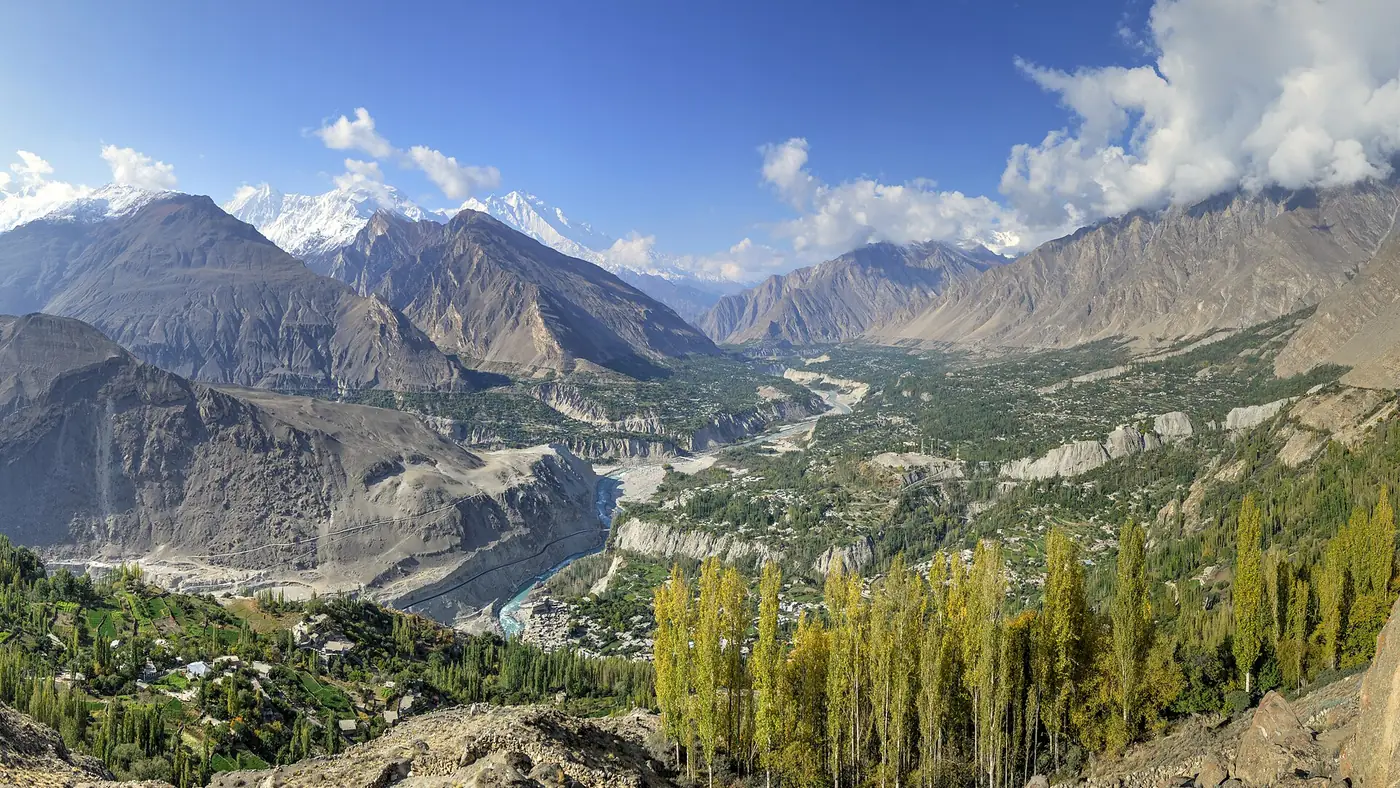
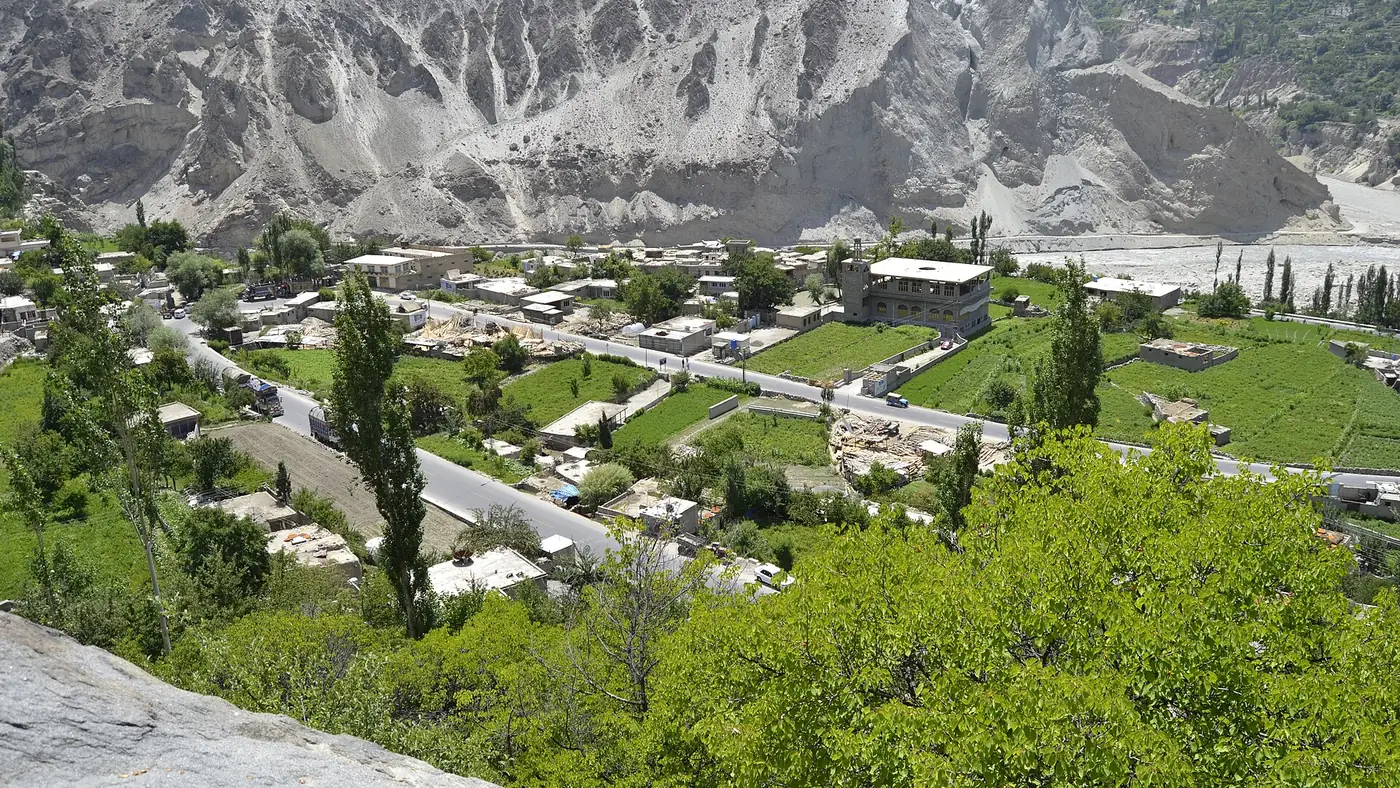
Ganish sits on a shelf of land above the Hunza river, where the Karakoram Highway swings down in a long S-bend towards the bridge that crosses to Nagar. The road up to Karimabad leaves the highway here, so every car heading to the hotels and Baltit Fort passes the edge of the village.
From Karimabad it is about five minutes by car, or a steep walk down the hill road and back up again. From Aliabad, the market town further down the valley, it is about 7 km. There is no car park as such, so pull well off the highway where local drivers park and walk in; the old settlement is a knot of narrow lanes that no vehicle can enter.
Ganish is a short drive from the Karimabad hotels, so it fits into any day there. Our guide to things to do in Karimabad shows how it sits alongside Baltit, Altit and the viewpoints above the town.
Why Ganish matters
Ganish is described as the first settlement on the old Silk Road route through Hunza, a stopping place for traders long before the highway existed. Its core is a khun, a fortified village: houses packed tightly together inside a defensive wall, with watchtowers at the corners and lanes too narrow and winding for an attacker to move through easily. The towers date from the long rivalry between Hunza and Nagar, whose villages face Ganish across the river.
In the late 1990s the villagers set about saving what was left, with technical help from the Aga Khan Cultural Service, and the result is the clearest picture in the valley of how a Hunza village looked when Baltit Fort was still a royal palace. About five minutes' drive away, between the highway and the river, the Haldeikish rocks carry inscriptions left by Silk Road travellers in the first millennium AD.
The four mosques and the 2002 award
At the heart of the old village is the jataq, the public square where the community met for meetings, ceremonies and festivals. Around it stand four small wooden mosques, each built by one of the village's family groups and named after it: Yarikutz, Rupikutz, Kuyokutz and Mamorukutz. They are thought to date from the sixteenth and seventeenth centuries, and the carving on their pillars, doors and ceilings is some of the finest in Hunza.
By the 1990s the mosques were close to collapse. Physical work on the restoration ran from April 1998 to January 2000, at a cost of about US$13,000, funded by the Norwegian embassy, with the villagers doing the work and the Aga Khan Cultural Service providing the professional guidance. The same effort paved the lanes, stabilised houses and improved drainage and sanitation.
In 2002 the project won an Award of Distinction in the UNESCO Asia-Pacific Heritage Awards, chosen from 142 entries from 37 countries. The jury praised a restoration "initiated and undertaken by the villagers" that had kept the historic patina of the buildings while bringing the square back to life.
Watchtowers, the pond and the Ali Gohar House
Beyond the mosques, a guided walk usually takes in:
- The watchtowers. The timber-and-stone towers that once guarded the village, the tallest about 40 feet high, used for keeping watch over the surrounding land, especially at night.
- The pharee, the village pond. A tank fed by meltwater channels, rebuilt as part of the restoration, in front of the mosques. It was the village's water store, and on a still day it reflects the carved fronts behind it.
- The gates and lanes. Covered passages and narrow alleys that twist between the houses, part of the old defences.
- The Ali Gohar House. A house built by a village noble, or trangpha, and later the home of the Hunza state's principal envoy to Kashgar. It is the most richly decorated old dwelling in Ganish, with carved columns, door surrounds and ventilators. It was restored in 2007, again with Norwegian funding, and won a second UNESCO Asia-Pacific award for Ganish in 2009.
Near the entrance to the settlement stands a newer imambargah, the community's hall for religious gatherings, which also houses a library and a dispensary.
How a visit works
See Ganish with a guide from the village. A local guide explains the mosques, the towers and the families who built them; without one you will miss most of what is there and may walk into places you should not.
- Arrive at the edge of the old village and ask for a guide. Hotels in Karimabad can also tell you who to contact.
- Agree the fee before you start. A modest charge covers the walk. It has changed over the years and can differ for Pakistani and foreign visitors, so ask rather than assume.
- Walk the circuit through the lanes to the jataq, the mosques and the pond, then out past the towers, in about an hour at an easy pace.
The lanes are uneven, with a few steps. Pushchairs will struggle, and anyone unsteady on their feet should take it slowly.
Walking-tour etiquette
Ganish is a living village of families, not a heritage park, and visitors are welcome because they behave accordingly. Keep to these and you will be treated as a guest:
- Dress modestly. Shoulders and knees covered for everyone. Women may want a scarf to hand near the mosques.
- Ask before entering a mosque, and follow what your guide says about shoes and where you may stand. Don't go in during prayers.
- Ask before photographing anyone, and don't photograph women without permission. Don't point a camera into open doorways or courtyards.
- Keep your voice down and your group small. The lanes are narrow and sound carries straight into people's homes.
- Don't climb on walls or towers, or touch the carved woodwork.
- Don't fly a drone over the village.
- Take your litter with you. There are no bins in the lanes.
When is the best time to visit?
Time of day. Morning or late afternoon, when the light comes low across the carved woodwork and the lanes are cool. In summer the stone lanes hold the midday heat, and Friday midday prayers are best avoided.
Season. Ganish can be visited all year, but two windows stand out:
- Late March to mid-April, when apricot blossom hangs over the old walls; our guide to the Hunza blossom season has the timing by village.
- The last week of October to early November, when the poplars and apricot trees around the village turn gold and orange. Our Hunza in autumn guide covers where the colour comes first.
Is Ganish worth visiting?
Yes, for almost anyone spending a day or more in Karimabad. It takes an hour, costs little, and shows you something the forts can't: the ordinary village life that surrounded them.
It is less rewarding if you rush it. Without a guide, Ganish is a few lanes and a pond, and the point of the place is lost. If you are short of time, do Baltit Fort and Ganish on the same morning, and leave Altit for another day; our Baltit Fort guide covers the tour times. For how Ganish fits into the wider valley, see our Gilgit and Hunza page.
Frequently asked questions
How old is Ganish village?
Ganish is at least a thousand years old and is thought to be the oldest settlement in Hunza. Its four wooden mosques are believed to date from the sixteenth and seventeenth centuries.
Is there an entry fee for Ganish?
A small fee is usually charged, and it normally includes a guide from the village. The amount has changed over the years, so ask before you start the walk.
How far is Ganish from Karimabad?
About five minutes by car down the hill road from Karimabad, beside the Karakoram Highway. It is about 7 km from Aliabad.
What award did Ganish win?
The restoration of its four mosques won an Award of Distinction in the 2002 UNESCO Asia-Pacific Heritage Awards. The restored Ali Gohar House brought a second UNESCO award in 2009.
Can visitors go inside the Ganish mosques?
Sometimes, with your guide's permission and outside prayer times. Follow the guide's lead on shoes and where you may stand, and don't go in during Muharram gatherings.