
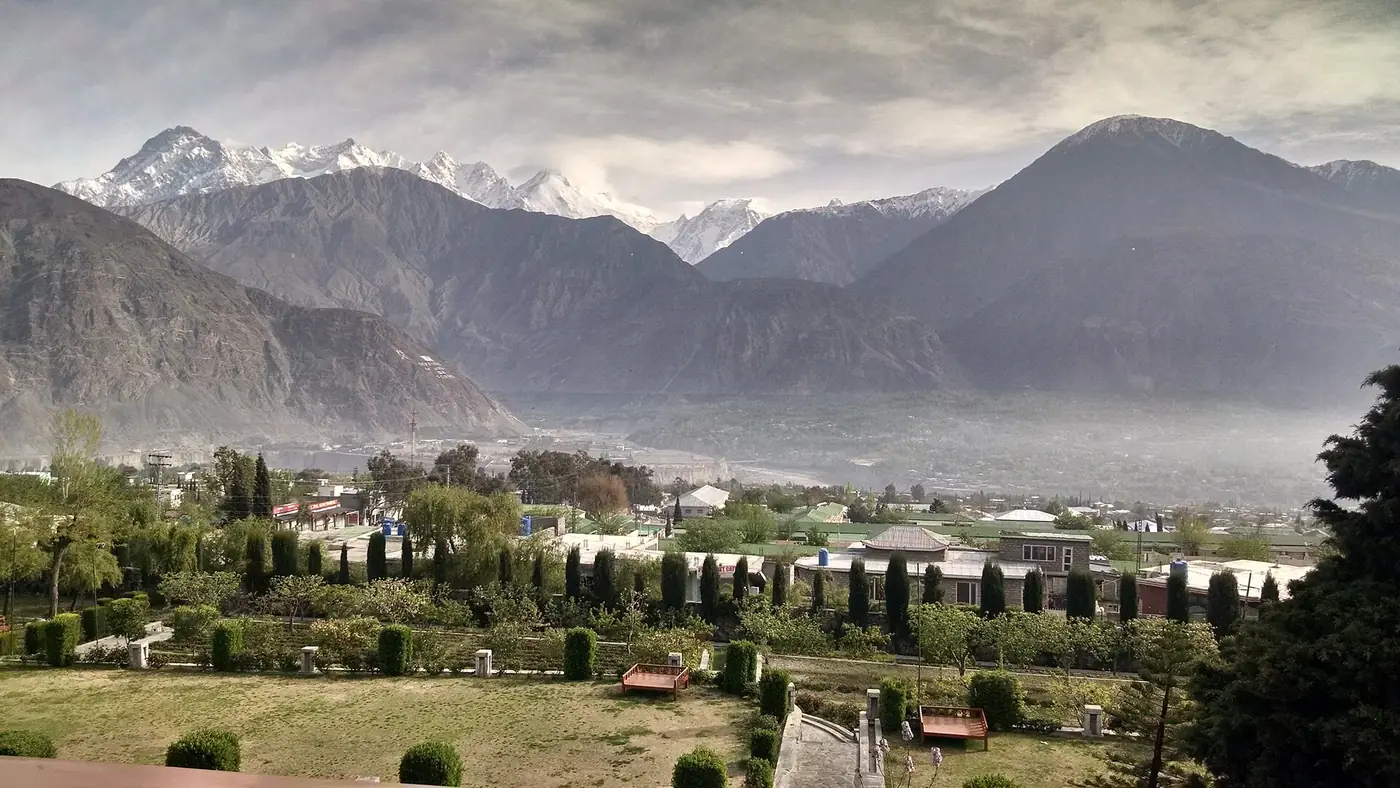

Chinar Bagh is a riverside park on River View Road in Gilgit, named for its chinar (plane) trees and best known for the Yadgar-e-Shuhada, a memorial to the Gilgit Scouts who died fighting Dogra rule in 1947. It is a short, quiet stop rather than a headline attraction: a walk beside the Gilgit river, a monument with real local meaning, and a place the city gathers every 1 November for Gilgit-Baltistan's liberation day.
This guide covers what the park and memorial are, the history behind them, and how to work a visit into a day in Gilgit.
| At a glance | |
|---|---|
| Location | River View Road, Chinar Bagh, Gilgit |
| What it is | A riverside park with a martyrs' memorial |
| Commemorates | Gilgit Scouts who died in the 1947 uprising against Dogra rule |
| Built | Early 1960s; rebuilt and reinaugurated in 2017 |
| Annual event | Liberation Day ceremonies, held here each 1 November |
| Entry | Free |
| Time needed | 20 to 30 minutes |
What is at Chinar Bagh
The park sits beside the Gilgit river, shaded by chinar trees that give it its name, with paths, lawns and benches. It functions as a public green space for the city rather than a tourist site in its own right, which is part of the appeal: an easy, unhurried place to walk after the heat and traffic of the bazaars.
At its centre stands the Yadgar-e-Shuhada, a monument to the martyrs of the Gilgit Scouts. The memorial was first built in the early 1960s. The Gilgit-Baltistan government dismantled and rebuilt it in 2017, and it was reinaugurated on 1 November that year, coinciding with the 70th anniversary of the uprising it commemorates.
The history behind the memorial
In November 1947, weeks after the partition of British India, the Gilgit Scouts, a locally raised paramilitary force then under a British commanding officer, rose against the Dogra governor administering the region on behalf of the Maharaja of Jammu and Kashmir. The uprising ended Dogra rule in Gilgit within days and led to the region's accession to Pakistan. The Gilgit Scouts who died in that action are the "martyrs" the Yadgar-e-Shuhada honours.
The date, 1 November, is now marked across Gilgit-Baltistan as Liberation Day, and Chinar Bagh is where the main official ceremony is usually held: the flag is raised at the memorial, and the region's governor, chief minister and senior military officers typically attend. Outside that day, the park is simply a place to sit by the river.
Visiting the park and memorial
Treat Chinar Bagh as a short, restful stop rather than a sightseeing highlight:
- Walk the riverside paths under the chinar trees, especially in the cooler part of the day.
- Read the memorial respectfully. It marks real deaths and is treated seriously by the city, even outside the annual ceremony.
- Combine it with the bazaars nearby, since the park is close to central Gilgit and easy to fold into a walk around the city. Our places to visit in Gilgit city guide covers the rest of a day here.
- If your visit falls on or near 1 November, expect the park to be busier than usual, with a ceremony and a larger crowd than on an ordinary day.
There is no fee and no fixed opening hours in the way a museum has them; it is a public park, open through daylight hours. Most visitors see it on the way through Gilgit at the start or end of a longer trip; our guide to Gilgit and Hunza covers the region beyond the city.
Is it worth the stop?
On its own, no: Chinar Bagh will not be the reason anyone plans a trip to Gilgit. As part of a morning or afternoon already spent in the city, seeing the Kargah Buddha or walking the bazaars, it costs almost nothing to add and gives real context to what 1 November means locally. If your time in Gilgit is limited to a single overnight transit stop, it is easy to skip without missing much. Our overview of what Gilgit is famous for sets the memorial in the wider picture of the city's history.
Frequently asked questions
What is Chinar Bagh in Gilgit?
A riverside public park on River View Road, named for its chinar trees, and home to the Yadgar-e-Shuhada memorial to the 1947 martyrs of the Gilgit Scouts.
Who does the Yadgar-e-Shuhada memorial commemorate?
The Gilgit Scouts who died in the November 1947 uprising against Dogra rule, an event that led to the region's accession to Pakistan.
Is there an entry fee for Chinar Bagh?
No. It is a public park with free access.
When is the main ceremony held at the memorial?
Each year on 1 November, marked across Gilgit-Baltistan as Liberation Day, with an official flag-raising and ceremony usually held at the memorial.
How much time should I set aside for Chinar Bagh?
Twenty to thirty minutes is enough for most visitors, longer if you want to sit by the river or your visit coincides with the annual ceremony.