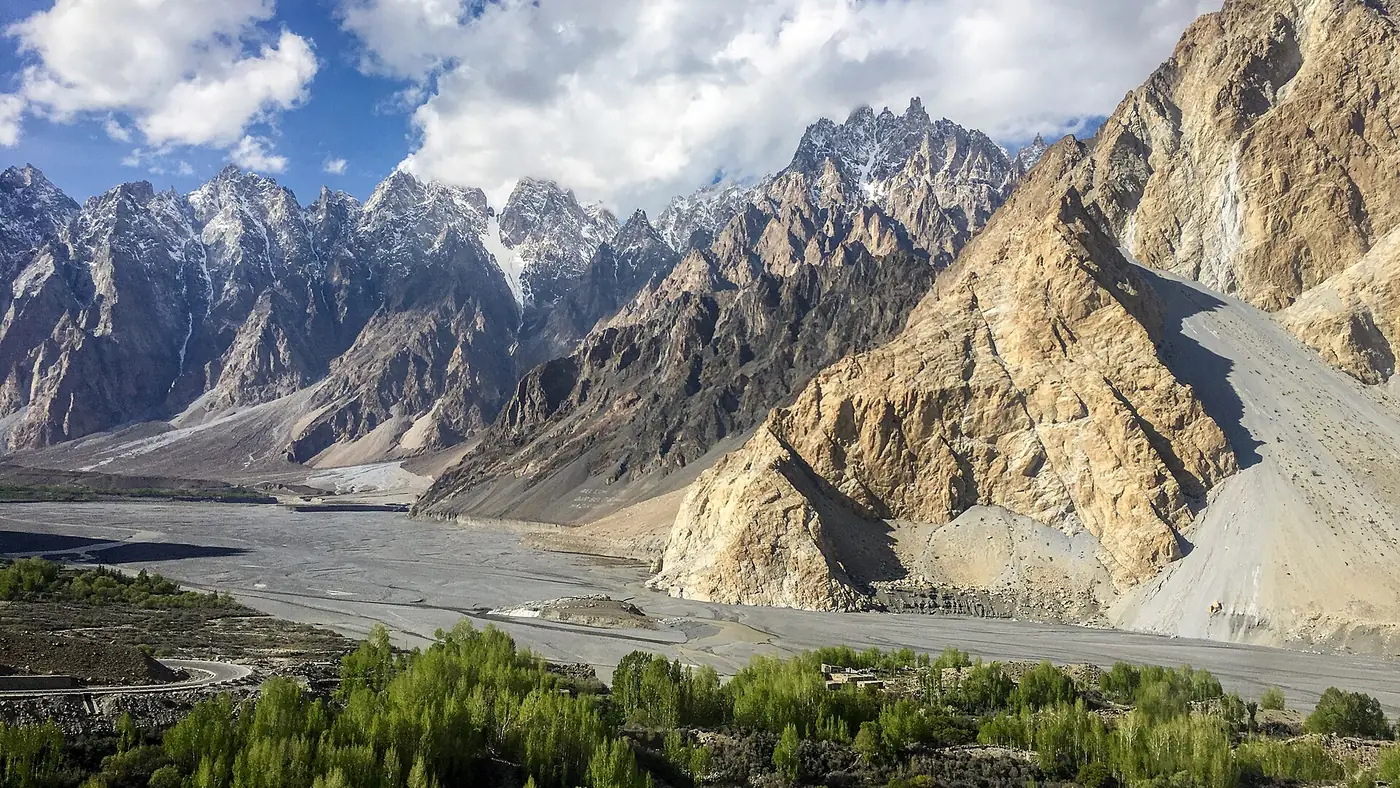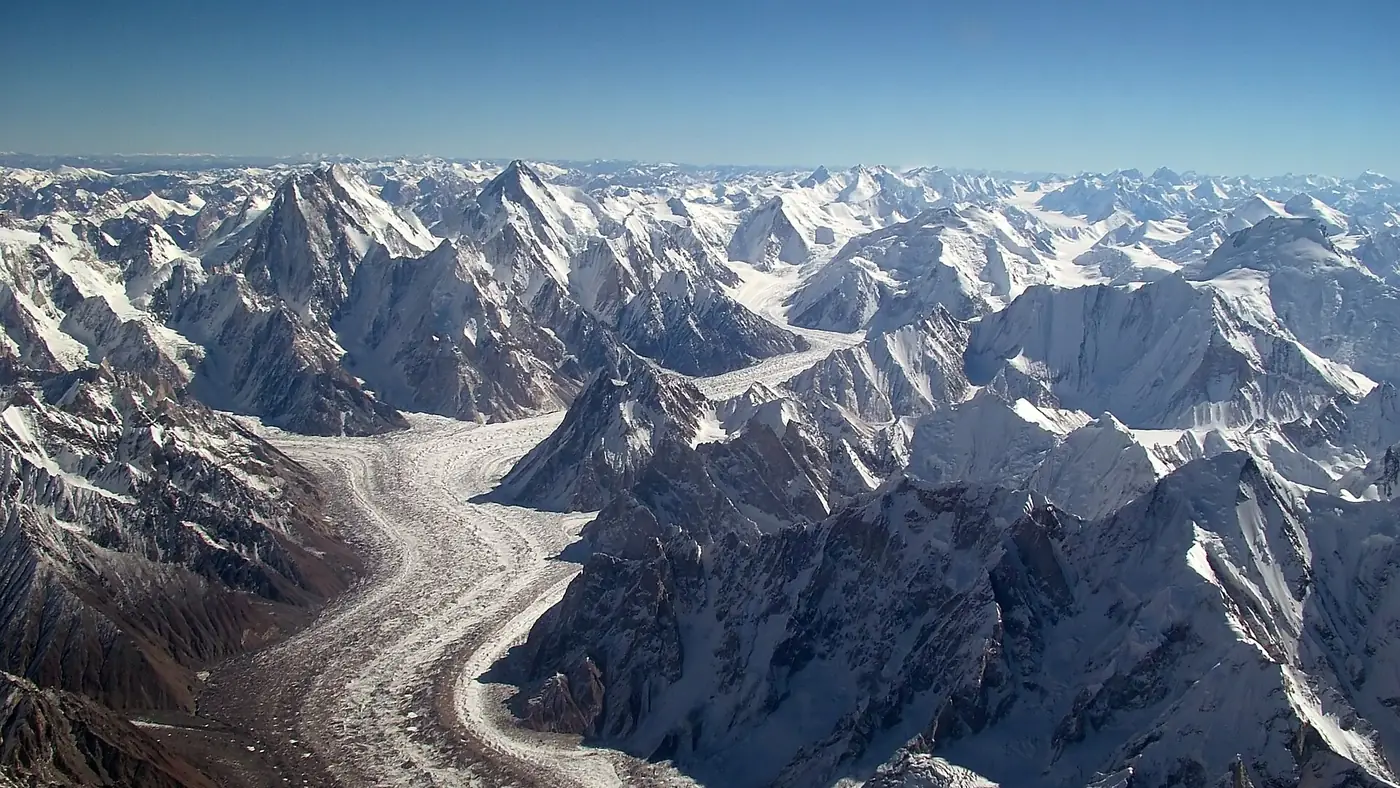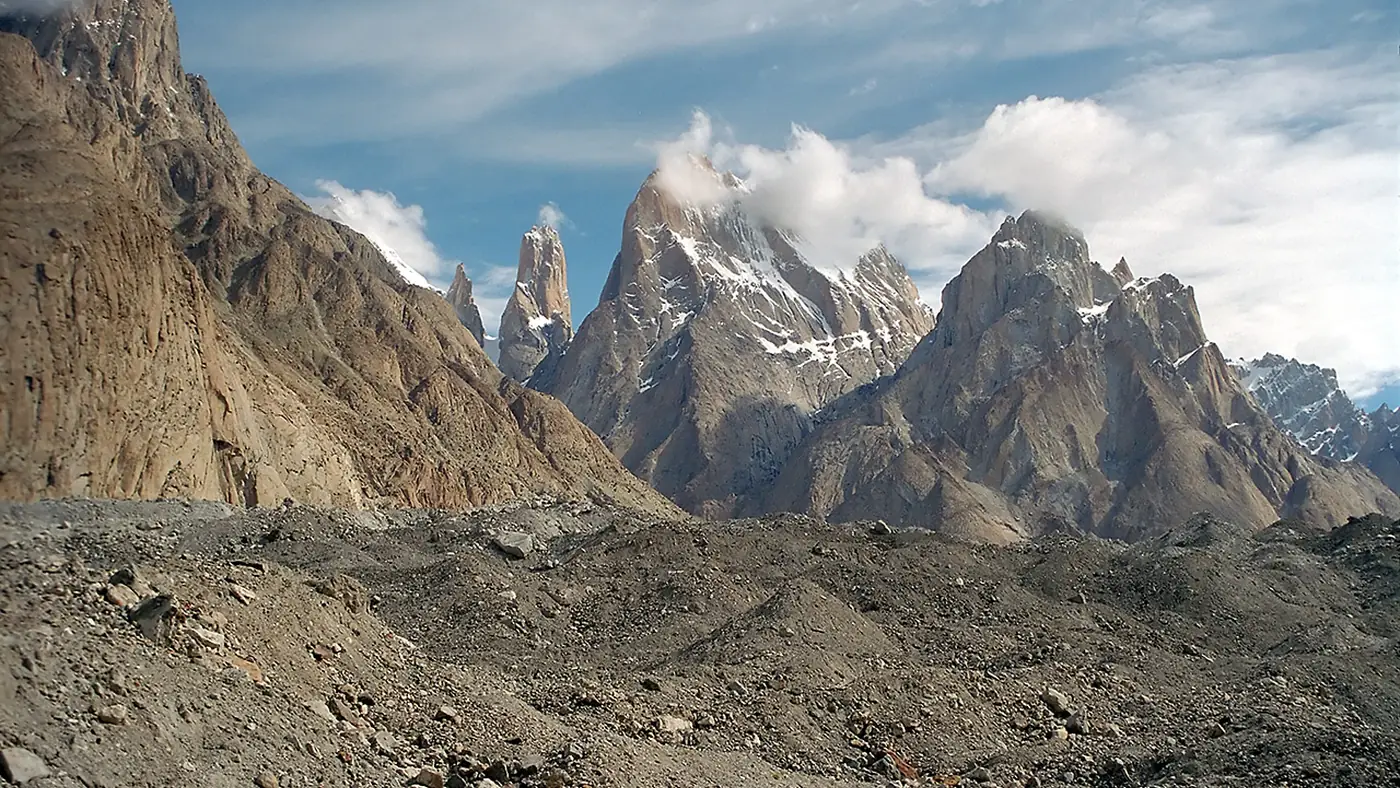
The Trango Towers are a cluster of granite spires above the Baltoro glacier in Baltistan, and the Great Trango Tower's east face is one of the largest near-vertical rock walls on earth. Trekkers walking to Concordia pass directly beneath them, days before K2 comes into view, and for climbers the towers are among the most sought-after big-wall objectives in the world.
This page covers what the Trango Towers are, their height and climbing history, and where you see them on the standard trek in.
| At a glance | |
|---|---|
| Great Trango Tower | 6,286 m, tallest in the group |
| Nameless Tower (Trango Tower) | 6,239 m |
| Range | Baltoro Muztagh, Karakoram, Baltistan |
| First ascent, Nameless Tower | 1976, British team |
| First ascent, Great Trango | 1977, American team |
| Seen from | The Baltoro glacier, between Paiju and Urdukas |
| Trekking season | July–September |
What are the Trango Towers?
The Trango Towers are a group of granite peaks and spires rising above the Baltoro glacier in the Baltoro Muztagh, part of the Karakoram range in Baltistan. The highest is Great Trango Tower at 6,286 metres, and the best known is the Nameless Tower, also called Trango Tower, a striking single spire at 6,239 metres that juts about 1,000 metres clear of the surrounding ridgeline.
What sets the group apart is not height but shape. The east face of Great Trango Tower is regarded as one of the largest continuously near-vertical rock drops in the world, a wall of granite that has drawn big-wall climbers from around the world since the 1970s.
Climbing history
The Nameless Tower was first climbed in 1976 by a British team, Joe Brown, Mo Anthoine, Martin Boysen and Malcolm Howells, up its south-west face. Great Trango Tower followed in 1977, climbed by an American team that included Galen Rowell, John Roskelley, Jim Morrissey, Kim Schmitz and Dennis Hennek, via the south face.
Since then the towers have become a proving ground for the hardest style of big-wall climbing, with expeditions spending weeks fixing ropes on the huge granite faces. This is technical rock and ice climbing at altitude, not trekking, and it draws a small, specialised group of mountaineers each summer rather than general visitors.
Where trekkers see them
You do not need to be a climber to see the Trango Towers. They stand directly above the Baltoro glacier, and every trekker walking the route to Concordia and K2 base camp passes beneath them, usually on the stage between Paiju and Urdukas, roughly the second or third day out from Askole. The Trango and Dunge glaciers flank the group on either side, and on a clear day the towers rise sharply above the moraine and ice of the main glacier, one of the most photographed stretches of the whole trek.
This means the Trango Towers are seen, not visited, by almost everyone who encounters them. There is no separate trekking route to their base; reaching the foot of the walls for a closer look, let alone climbing them, is a specialist expedition undertaking with its own approach and permits.
Getting there
Seeing the Trango Towers means doing the K2 base camp trek or the Gondogoro La trek, both of which follow the Baltoro glacier from Askole past Paiju and Urdukas. There is no shortcut: the towers are two to three days' walk in, on rough glacier and moraine trail, and the trip needs the same planning, permits and season as the wider trek. Our best treks in Gilgit-Baltistan guide sets out how this route compares with the other major treks in the region.
When to go
The Baltoro glacier is walkable from about July to early September, the same window as the rest of the K2 base camp route. Outside these months snow and cold make the trek impractical, and climbing expeditions on the towers themselves keep to broadly the same summer season.
Frequently asked questions
How tall are the Trango Towers?
Great Trango Tower, the highest in the group, is 6,286 metres. The Nameless Tower, also called Trango Tower, is 6,239 metres and is the more famous of the two for its dramatic single spire.
Why are the Trango Towers famous among climbers?
The east face of Great Trango Tower is one of the largest continuously near-vertical rock drops in the world, making the group one of the most sought-after big-wall climbing objectives anywhere.
Who first climbed the Trango Towers?
The Nameless Tower was first climbed in 1976 by a British team led by Joe Brown. Great Trango Tower followed in 1977, climbed by an American team including Galen Rowell and John Roskelley.
Can you trek to the Trango Towers without climbing them?
Yes. Trekkers on the standard K2 base camp trek or Gondogoro La trek pass directly beneath the towers on the Baltoro glacier, usually between Paiju and Urdukas, without any technical climbing.
When can you see the Trango Towers?
The Baltoro glacier trekking season runs from about July to early September. Outside that window the route is not practically walkable.