Satrangi Lake is the first and best known of the Naltar lakes, reached by a rough jeep track 12 to 13 km above the village of Naltar Bala, about an hour to an hour and a half's drive. Blue Lake and Pari Lake lie about a kilometre further on, and the jeeps reach them too; the highest lake, usually called Feroza, is a walk of 45 to 55 minutes. Go between late May and October, on a sunny day, and set off early.
This guide covers the jeep ride, each lake in turn, the walks between them, how the colours change through the season, and what to take. For the valley itself, including how to get there from Gilgit and where to stay, see our Naltar Valley guide.
| At a glance | |
|---|---|
| Altitude | A little above 3,000 m |
| From Naltar Bala | 12 to 13 km of jeep track, 1 to 1.5 hours each way |
| Satrangi to Blue Lake | About 1 km, around 10 minutes by jeep |
| The higher lake (Feroza) | 45 to 55 minutes on foot beyond the last jeep stop |
| Time needed | Half a day from Naltar Bala; longer with the walk |
| Season | Roughly late May to October; snowbound in winter |
| Best conditions | Sunny days; cloud mutes the colours |
| Facilities | Very few: bring water, food and a warm layer |
Which lake is which?
Before anything else, a word on names, because they cause more confusion than the jeep track.
Satrangi means "seven-coloured", Pari means "fairy" and Feroza means "turquoise", and all three names, along with Blue Lake, are used for the lakes above Naltar Bala. Older sources call them the Bashkiri lakes and number them. Drivers, signboards and travel blogs don't agree on which name belongs to which lake, and the lake one person calls Blue Lake another calls Pari Lake.
It doesn't matter much. The practical layout is simple: a first lake where the jeeps arrive, one or two more a short distance beyond that the jeep also reaches, and a higher lake that you can only reach on foot. Ask your driver to take you to every lake the jeep can reach, then to show you the path to the upper one.
The jeep ride from Naltar Bala
The lakes are reached on a 12 to 13 km track from Naltar Bala, following the stream up through pine forest. It is rocky and bumpy throughout, with some large stones to climb over and several meltwater streams to cross. Local drivers use old jeeps with reinforced suspension and know the track well. Allow an hour to an hour and a half each way.
A few things to know:
- Don't drive yourself. Even a good 4x4 will struggle, and the local drivers know the track.
- Agree the fare first, for the full round trip including the time spent waiting at the lakes. Jeeps can be hired in Naltar Bala, Nomal or Gilgit.
- Leave early. The streams across the track are fed by snowmelt and run higher as the day warms. In summer, jeeps coming down in the afternoon are sometimes held up until the water drops.
- Expect to be shaken about. The ride is slow and very bumpy, hard on anyone with a bad back, and not advisable in pregnancy.
Satrangi Lake
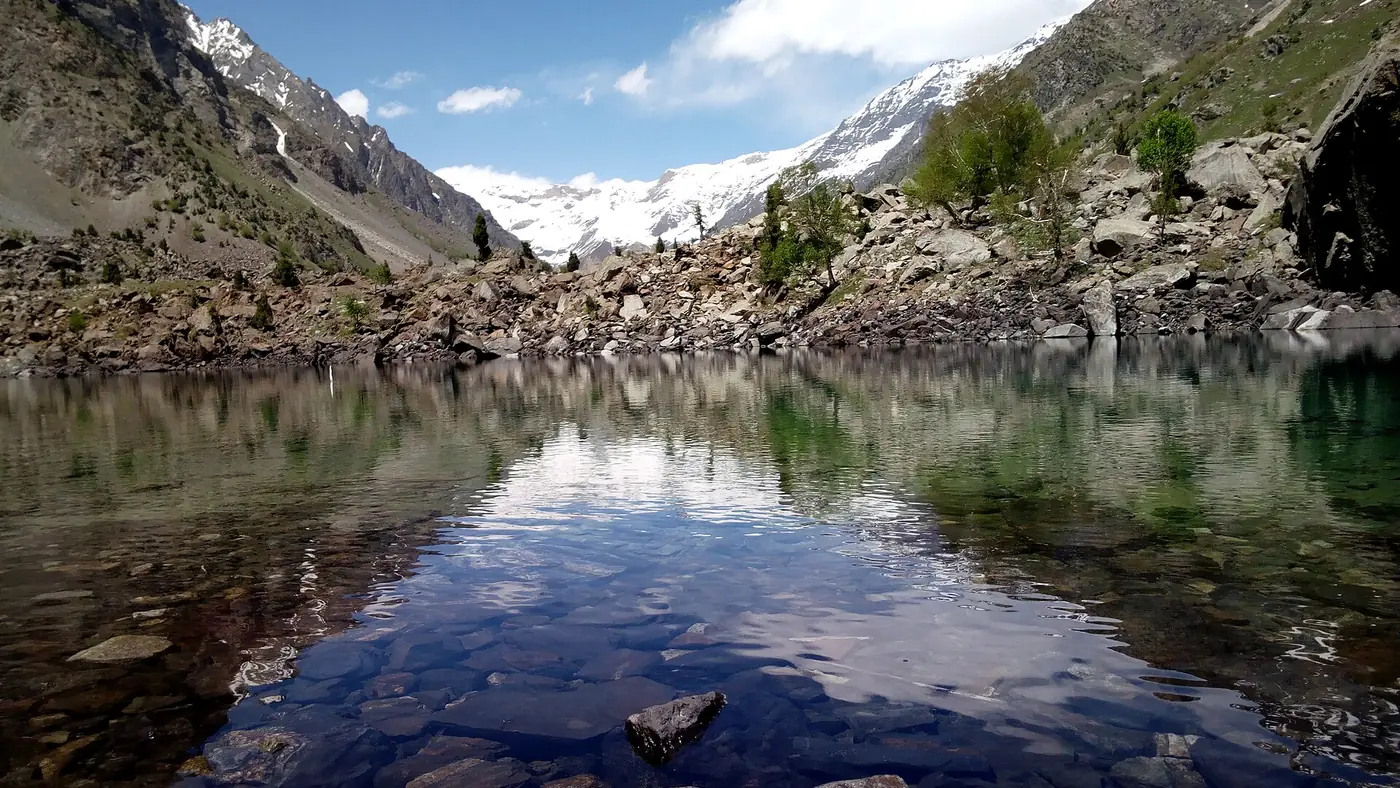
Satrangi is the first lake you reach and the one every visitor sees. It lies among pine forest, and its water is crystal clear.
The name comes from the colours in the water: patches of deep blue, turquoise and green, and in places an unexpected yellow, where algae and plants grow on the lake bed. The colours come from what grows beneath the surface and from the light, and they shift as the sun moves and clouds pass.
Because every jeep stops here, it is the busiest of the lakes, and in summer there may be a tea stall or a rowing boat for hire.
Blue Lake and Pari Lake
About a kilometre beyond Satrangi, a few minutes further by jeep or a short walk, are the lakes most people know as Blue Lake and Pari Lake.
Blue Lake has a deeper, more even blue than Satrangi. It is often described as the deepest of the lakes, and it has glaciers in the background.
Pari Lake is deep turquoise, fed by springs and snowmelt. From the track it can look like a small pool among the rocks, but walk a little further along its edge and it turns out to be much larger, hidden behind a bank of boulders. Some visitors' accounts describe a boat on it in summer and camping nearby.
If your driver's names differ from these, go by what you see. Between them, the lakes the jeep reaches give you the full range of colours, and they are all close together.
Feroza and the walk to the higher lake
Beyond the last lake the jeeps reach, a path climbs on through meadow and boulders to a higher lake, usually called Feroza. It takes about 45 to 55 minutes on foot each way, and those who make the walk often call Feroza the most beautiful of the lakes, with open meadow around it and far fewer people.
It is a real walk, not a stroll. At over 3,000 metres you will be short of breath on the climbs, and the ground is rough in places. Wear proper shoes, take water, and turn back if anyone develops a headache or feels unwell. Our travel guide has more on altitude in the north.
How the colours change through the season
The lakes look different from month to month, as much because of the ice, the light and what surrounds them as the water itself.
- Late May and June. The track usually opens once the snow melts. Snow can still lie on the slopes around the lakes, and the upper lake and the path to it can be snowbound at the start of the season. Ask in Naltar Bala before you book a jeep.
- July and August. The fullest, greenest time, with meadows around the lakes and the forest at its best. It is also the busiest time and the season of afternoon cloud and high streams, so go early.
- September and October. Clear, still air and fewer people. By October the trees and grass around the lakes turn gold and brown. Mornings are very cold and the season can end with an early snowfall.
- November to April. The lakes freeze and the upper valley lies under several metres of snow. No vehicle can reach them, and they are not a winter destination.
Whatever the month, the colours need sun. Under cloud they are muted; in bright sunlight the blues and turquoises are at their strongest. If the sky is overcast in Naltar Bala, ask your driver whether it is likely to clear before you set off. For the wider seasons in the north, see our guide to when to go.
What to take
- A warm layer and a windproof jacket, even in July; it is cold by the water in the shade
- Water and food, as there is little or nothing to buy
- Sunglasses and sunscreen
- Comfortable walking shoes, especially for the upper lake
- Cash for the jeep, and for tea or a boat if there is one
- A bag to take your rubbish back down; there are no proper toilets or restaurants at the lakes
Don't count on mobile signal at the lakes.
A half-day at the lakes, step by step
- Leave Naltar Bala by about 8 in the morning. You will be at Satrangi before 9:30, ahead of most of the day visitors from Gilgit.
- Satrangi first, for half an hour along the shore.
- On to Blue Lake and Pari Lake, by jeep or on foot.
- The walk to the upper lake if everyone is fit: allow two hours there and back, plus time at the top.
- Back at the jeep by early afternoon, before the streams on the track rise, and back in Naltar Bala by mid-afternoon.
Without the walk, allow about four hours from Naltar Bala and back. With it, allow six.
Is Satrangi Lake worth the jeep ride?
For most people, yes. The lakes are very different from the glacier-fed grey of the rivers around Gilgit, the forest is rare in this part of the Karakoram, and the upper lake repays the walk.
It is less worth it if you have only a single day around Gilgit, if anyone in your group hates rough roads, or if the forecast is cloudy, when the colours that give the lakes their name are muted. In those cases, the Kargah Buddha and Danyor make a better day, as our guide to places to visit in Gilgit explains.
If you would rather leave the jeeps and timings to someone else, our Gilgit, Hunza and Khunjerab tour spends a day in Naltar, on the jeep road to the lakes and in the pine forest.
Frequently asked questions
How far is Satrangi Lake from Naltar?
About 12 to 13 km from Naltar Bala on a rough jeep track, which takes an hour to an hour and a half each way. Naltar Bala itself is about two hours from Gilgit.
Can I take my own car to Satrangi Lake?
No. The track beyond Naltar Bala is rocky and crosses several streams, and only local jeeps with experienced drivers should use it.
Why is it called Satrangi Lake?
Satrangi means "seven-coloured". The name comes from the patches of blue, green, turquoise and yellow in the water, caused by algae, plants and the clear, shallow edges.
Is Satrangi Lake frozen in winter?
Yes. From about November to April the lakes freeze and the upper valley is under deep snow, so they cannot be reached by vehicle.
How long is the walk to the upper Naltar lake?
About 45 to 55 minutes each way from the last point the jeeps reach, over meadow and rough ground at more than 3,000 metres.
What is the best time to see the Naltar lakes?
July to early October, on a sunny day. July and August are the greenest; September and October are quieter, with clearer air and autumn colour by October.