
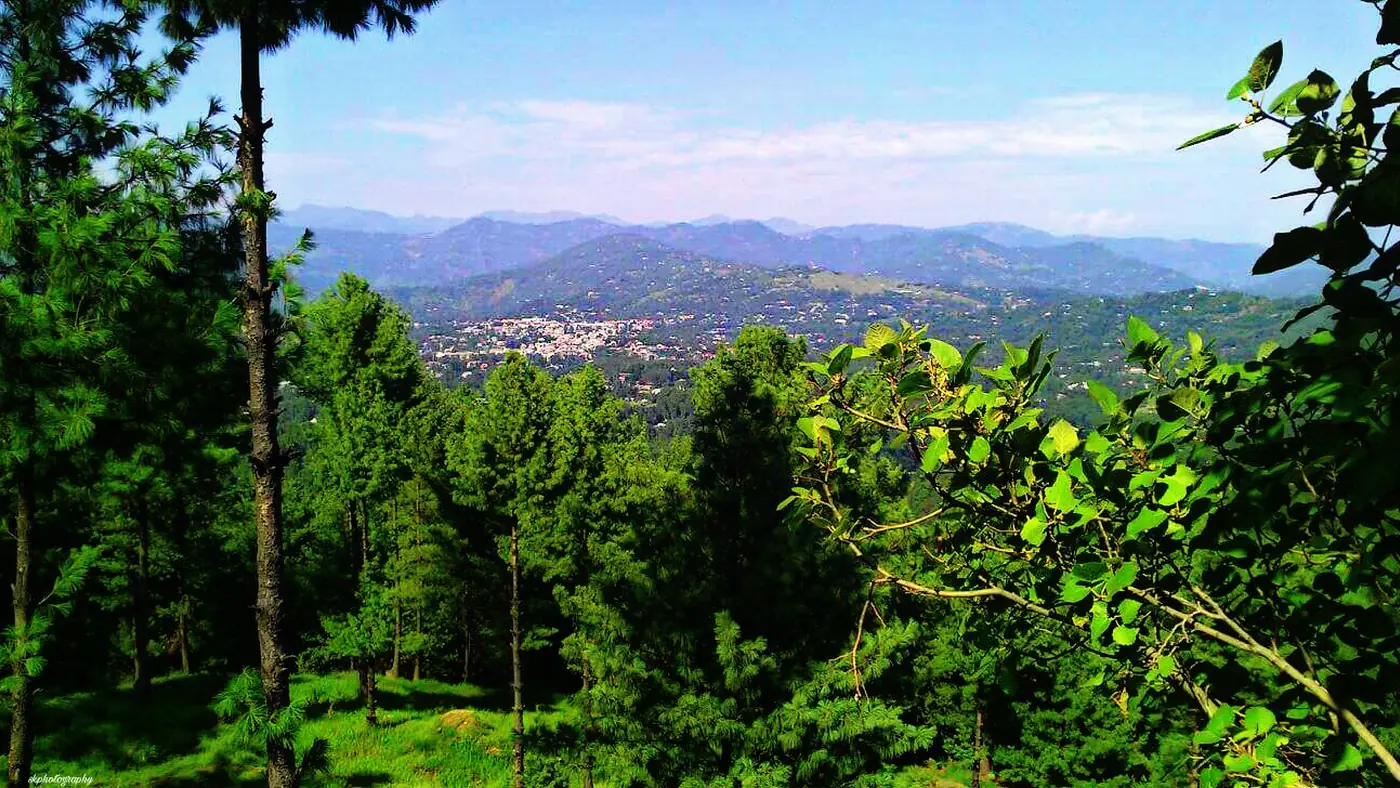

The main places to visit in Rawalakot are outside the town: Banjosa Lake in the pine forest about 18 km south-east, the hilltop meadows of Toli Pir at around 2,700 metres, about 30 km north-east, and the quiet meadow at Devi Gali, about an hour's drive towards Hajira. Khai Gala, on the way to Banjosa, adds a piece of 1947 history. Two full days cover all of them without rushing; with one day, choose Banjosa and one other.
Rawalakot, the headquarters of Poonch district and known as the Pearl Valley, is a working town rather than a sight in itself. This guide goes through each place around it, with the distance from town, the time it needs, who it suits and how to fit them together.
| At a glance | From Rawalakot | Time to allow | Best for |
|---|---|---|---|
| Banjosa Lake | About 18 km, 30 to 45 minutes | Half a day | Boating, forest walks, families |
| Toli Pir | About 30 km, around an hour | Half a day | Views, meadows, cooler air |
| Devi Gali | About an hour | Two to three hours | A quiet meadow in the pines |
| Khai Gala | About 10 km, 15 to 20 minutes | A short stop | 1947 history, on the way to Banjosa |
| Rawalakot town | In town | An hour or two | The bazaar and old Sikh ruins |
| Tatta Pani | Most of a day there and back | A full day | Hot springs by the Poonch River |
How the places around Rawalakot fit together
Rawalakot sits at around 1,600 metres among farmland and pine-covered hills. The places worth seeing lie in different directions, which matters when you plan the days:
- South-east, through Khai Gala: Banjosa Lake, with Devi Gali further on towards Hajira. The same road continues south past Banjosa to Pallandri, the headquarters of Sudhnoti district.
- North-east: the long climb to Toli Pir, the highest ground near the town.
- South, a long way down: Tatta Pani and its hot springs, near the Poonch River in Kotli district.
- West: the road down to the Jhelum at Azad Pattan, which you drive on the way in from Islamabad. Our Islamabad to Rawalakot route guide covers it and the alternative through Kohala.
Banjosa and Devi Gali pair naturally in one outing. Toli Pir is best on its own morning, because it lies in a different direction.
Banjosa Lake
Banjosa is the reason most people come. It is a small man-made lake at about 1,980 metres, roughly 300 metres from end to end, with pine forest on the slopes around it. There are boats for hire, tea stalls, rest houses and open ground for picnics, and on Eid and summer weekends it is crowded with families.
Go early in the day for the quietest water, walk the shore and up into the pines, and take a boat out before the crowds build. Half a day is enough for most families; stay the night in one of the rest houses by the lake if you want it at its calmest.
Our Banjosa Lake guide covers the boats, the facilities, where to stay and what to expect on a busy day.
Toli Pir
Toli Pir is the high ground north-east of Rawalakot, a broad hilltop of meadows and forest at around 2,700 metres, about 30 km from town. The hill and its forest are protected as Tolipir National Park. From the top the views run across the hills of Poonch towards Abbaspur, Bagh and the Poonch River valley, and on the highest point are the remains of an old Sufi shrine.
The drive takes around an hour each way, and the last part of the road climbs steeply. In dry summer weather cars do make it up, but take it slowly, and after rain or once there is snow, ask in Rawalakot about the road before you set off. There is a tourist rest house along the way; don't count on food at the top, and take water, snacks and a warm layer.
Because it is about 1,000 metres higher than Rawalakot, Toli Pir is always markedly colder than the town, and the wind on the open top makes it feel colder still. Snow usually lies up here from late autumn into spring, and in winter it can block the road entirely. The most reliable months are May to October.
Allow half a day: an hour up, an hour or two walking on the meadows, and an hour back. Go in the morning; in the monsoon months cloud often builds over the hills by the afternoon.
Devi Gali
Devi Gali is a small village and meadow at about 1,670 metres, south-east of Banjosa and a few kilometres short of Hajira. It is a stretch of open grass ringed by pine forest, and from the higher ground there are views over the valley of the Poonch River. Local tradition links the name to a Hindu temple that once stood nearby.
There is not much to do here except walk, sit on the grass and eat a picnic, and that is the point. It sees far fewer visitors than Banjosa. Allow two or three hours including the drive from the lake, and turn back towards Rawalakot well before dark.
Khai Gala
Khai Gala is a small town about 10 km from Rawalakot, on the road you take to Banjosa. Most visitors drive straight through it, but it has a place in the history of Azad Kashmir: according to Sardar Muhammad Ibrahim Khan, the first President of Azad Kashmir, the first armed clash of the 1947 Poonch uprising against the Dogra forces took place here. Sardar Muhammad Yaqoob Khan, a later President of Azad Kashmir, came from the town.
There is no museum or marked site to visit. Treat it as a short stop for tea and a sense of where the story of Azad Kashmir began.
Rawalakot town
Rawalakot itself is a busy market town, not a resort, and an hour or two is enough. Walk the main bazaar, and eat here if you can: the choice is far wider than at the lake.
History-minded visitors can look for the remains of the old Sikh buildings in and around the town, including gurdwaras from before 1947 that have been studied by architectural historians and are now largely in ruins. They are not signposted as sights, so ask locally for directions and be respectful: these are remains of places of worship.
Further afield
If you have a third day, or are passing through:
- Tatta Pani: a settlement by the Poonch River in Kotli district, at under 700 metres, known for the hot springs that give it its name ("hot water"). It is a long drive down from Rawalakot, most of a day there and back, and much warmer than the hills in summer.
- Pallandri: the headquarters of Sudhnoti district, further south on the road past Banjosa. It is a working town, and worth including if you are driving a loop back towards Azad Pattan.
- Azad Pattan: the bridge over the Jhelum on the main road from Islamabad, at about 500 metres. You cross it anyway on the usual route, and it is the natural place to stop and look at the river.
How many days do you need?
One day: Banjosa Lake in the morning, then Devi Gali or Khai Gala, back in Rawalakot for the evening. This is the classic short visit.
Two days: add Toli Pir on the second morning, and walk the Rawalakot bazaar in the afternoon. This covers everything most people come for.
Three days: add Tatta Pani, or drive out a different way: south via Pallandri or north via Arja, Dhirkot and Kohala.
Add the drive from Islamabad, three to three and a half hours each way on the usual road, and a two-night trip is comfortable. For the months when each of these places is at its best, see our guide to the best time to visit Rawalakot.
Is Rawalakot worth visiting?
For a short, gentle trip, yes. Rawalakot and Banjosa give you pine forest, cool nights and open hilltops at altitudes that suit every age, a manageable drive from Islamabad. It works well for families with young children or older parents, for a first trip into Azad Kashmir, and for anyone who wants a quieter alternative to the Murree hills.
It is not the place for glaciers, high peaks or big alpine lakes. For those, you need Gilgit-Baltistan or the upper Neelum valley; our Kashmir page covers the Neelum side of Azad Kashmir. And if all you want is a pine-forest weekend as close to Islamabad as possible, the walks and viewpoints around Nathia Gali are nearer.
The real caution for now is the situation in Rawalakot. Until the unrest that began in June 2026 has settled, and the roads, transport and phone networks are working normally, it is better to wait. When it is calm and you want help putting a trip together, send us your dates.
Frequently asked questions
What is Rawalakot famous for?
Rawalakot, known as the Pearl Valley, is best known for Banjosa Lake in the pine forest nearby, the hilltop meadows of Toli Pir, and its part in the 1947 Poonch uprising that led to the creation of Azad Kashmir.
How far is Banjosa Lake from Rawalakot?
About 18 km, through Khai Gala. The drive takes 30 to 45 minutes on a paved road.
How far is Toli Pir from Rawalakot?
About 30 km, around an hour's drive each way. The last part of the road is steep, and snow can block it in winter.
How many days are enough for Rawalakot?
Two full days cover Banjosa, Toli Pir, Devi Gali and the town. With the drive from Islamabad, a two- or three-night trip is comfortable.
Is Toli Pir open in winter?
Not reliably. Snow usually lies on Toli Pir from late autumn into spring and can close the road. May to October is the dependable season.
Is it safe to visit Rawalakot now?
Rawalakot has been at the centre of protests since June 2026, with road closures, transport strikes and communication cuts. Check recent news before planning, and don't travel while restrictions are in force.