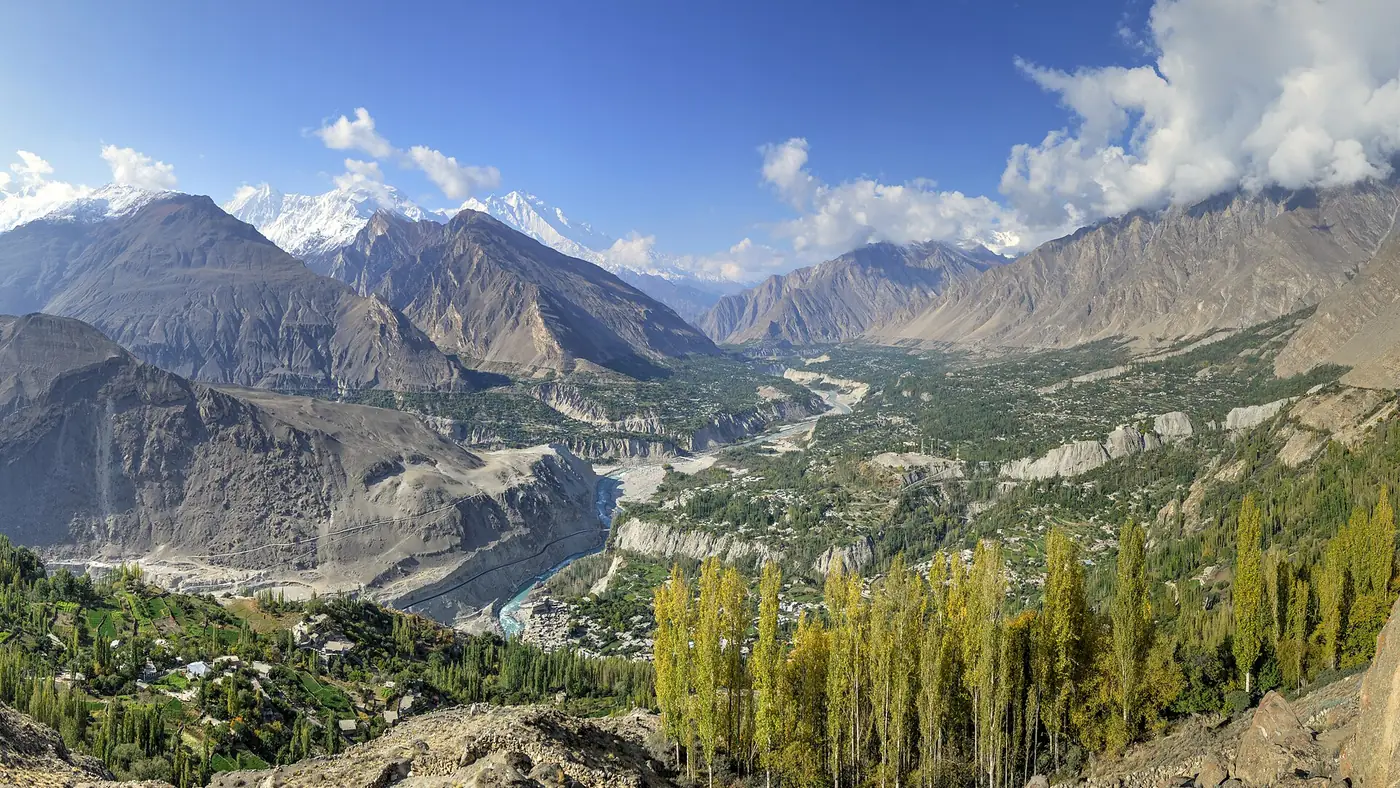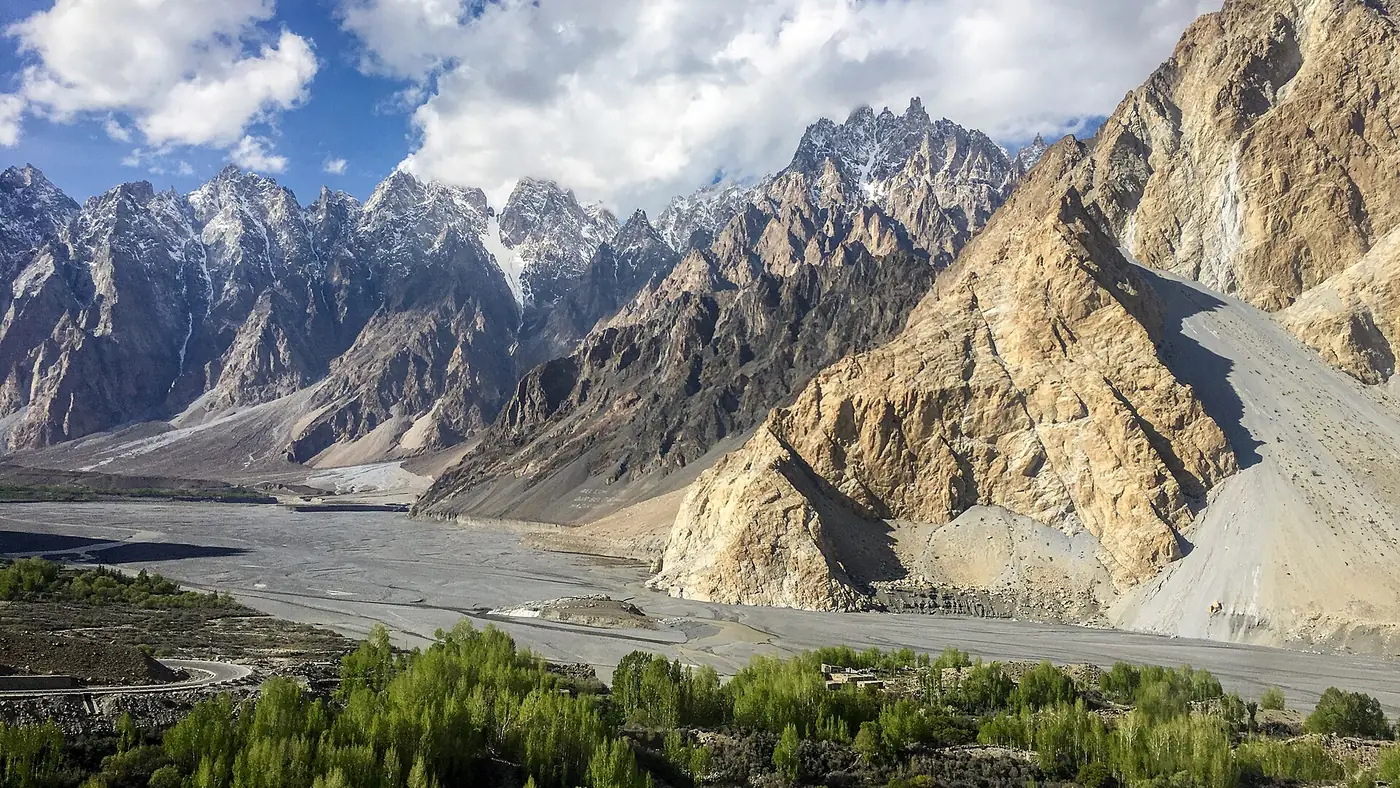
The Passu Cones are the saw-toothed ridge of Tupopdan, a 6,106-metre peak above Passu in Gojal, upper Hunza, about an hour to an hour and a half's drive north of Karimabad. The classic view is from the Karakoram Highway between Hussaini and Passu, looking north as the road runs straight towards the spires. The best light is from late afternoon to sunset, when the sun is behind you and the rock turns warm gold; early morning is the quieter second choice, and midday is flat.
This guide covers the viewpoints, from roadside pull-offs to a café terrace and a hike above the valley, how the light changes through the day and the year, and how to stop safely on a highway full of trucks.
| At a glance | |
|---|---|
| Mountain | Tupopdan, 6,106 m, also called the Passu Cathedral |
| Where | Above Passu, Gojal, upper Hunza; east of the Hunza river |
| From Karimabad | About 1 to 1.5 hours by road |
| From Gulmit | About 20 km, 20 to 30 minutes |
| Classic viewpoint | The highway between Hussaini and Passu |
| Best light | Late afternoon to sunset; early morning second |
| Worst light | Late morning to early afternoon |
| Best seasons | Late October for colour; April for blossom |
| Fee | None for the roadside viewpoints |
What are the Passu Cones?
The mountain's name is Tupopdan. The row of sharp, pale spires along its ridge is what gives it the English names Passu Cones and Passu Cathedral. Its summit is about 10 km north-north-east of Passu village, on the east side of the Hunza river, and it rises roughly 3,600 metres above the river in about 7 km, which is why it looks so sheer from the road. It was first climbed in 1987.
One explanation of the name is that it means "hot rock" in Wakhi, because its south-facing slopes lose their snow quickly. That matters for photographs: the side you see from the highway faces the sun for much of the day.
Don't confuse it with Passu Sar, the much higher, snow-covered peak of 7,478 metres at the head of the Passu glacier to the west of the village. The Cones are the rock spires; Passu Sar is the white mountain behind the glacier.
Where are the best viewpoints?
The highway south of Passu
The classic view is from the Karakoram Highway on the stretch between Hussaini and Passu, driving north. The road runs straight towards the Cones, so the highway itself leads your eye into the picture, and there are several places where you can pull right off the road. This is the view on almost every postcard.
Best for: the full ridge, the road and the valley in one frame. No walking at all.
Hussaini and the riverbank
Around Hussaini, a few kilometres south, the Cones appear above the braided Hunza river and the fields of the valley floor, and they are in view from the path down to the suspension bridge. Our Hussaini suspension bridge guide covers the crossing itself.
Best for: river and village in the foreground, and a wider, less familiar frame.
Passu village and its fields
In Passu itself, the Cones rise above orchards, poplars and stone walls. It is the view to go for in late October, when the poplars turn yellow, and in spring, when the apricot trees flower.
Best for: autumn colour, and pictures with people and houses in them.
The Glacier Breeze terrace
Glacier Breeze, a restaurant on the glacier moraine above the highway at Passu, has a terrace looking at both the Passu glacier and the Cones. It is reached by more than 100 steps from the parking beside the road, and it is well known for apricot cake. It is a good place to sit through the last hour of light with tea rather than standing beside the road.
Best for: watching the evening light change, sitting down.
From above: Borith Lake and the Passu glacier trail
For a higher angle, walk the trail from Borith Lake, above Hussaini, towards the Passu glacier viewpoints. The path climbs above the valley, and the Cones appear across it, with the glacier below you. Allow several hours there and back; if you want to go onto the glacier itself, take a local guide.
Best for: walkers, and a view most visitors never see.
Morning or evening light?
From the viewpoints south of Passu you are looking roughly north at the south and south-west side of the ridge. The sun's position through the day decides how it looks.
Late afternoon to sunset. The sun comes from the west and south-west, over your left shoulder, and lights the face you are looking at. The pale rock turns warm, the shadows between the spires fill in the shape of the ridge, and the tips hold the last light after the valley is in shade. This is the classic time, and it is why we suggest seeing the Cones on the way back from Khunjerab rather than on the way up.
Early morning. At sunrise the first light catches the tips of the spires while the valley is still dark, and soon after, low light from the east picks out the texture of the ridge from the side. The road is almost empty. It is an excellent time if you are staying in Passu or Gulmit, and a hard one to reach from Karimabad.
Late morning to early afternoon. The sun is high, the light is flat and often hazy, and the ridge looks paler and less three-dimensional. This is also when most day trips from Karimabad pass through. Stop anyway if it is your only chance, but don't expect the postcard.
Sunrise in Hunza is around 4:45 am in June and 6:05 am in October; sunset around 7:20 pm in June and 5:25 pm in October. The valley floor loses the sun well before those sunset times, but the high spires keep it.
When is the best season for photographs?
- Late October: the poplars and orchards in Passu and Gulmit turn yellow and orange, the air is at its clearest, and the Cones stand above the colour. Most photographers' favourite. Our guide to Hunza in autumn covers the timing.
- April and May: blossom in the villages and snow still on the high ridges, with fewer visitors on the road.
- June to September: long days and the easiest travel, but more haze and dust, and the busiest roadside stops.
- Winter: snow on the ridge and cold, clear days, with some hotels in Gojal closed. Dress for serious cold.
Stopping safely on the highway
The Karakoram Highway here carries trucks to and from China, and the most common mistake at the Cones is stopping badly.
- Pull right off the road, onto a proper pull-off or gravel shoulder. Never stop on a bend, on a bridge or in or near a tunnel.
- Don't stand in the road for the photograph, however empty it looks. Trucks come round the bends quickly.
- Keep children by the car and away from the edge of the road.
- Use hazard lights while you are stopped, and check behind you before pulling out.
- Leave space for others. On a summer afternoon, the good pull-offs fill up; move on after a few minutes if people are waiting.
How to fit the Cones into a trip
As a day from Karimabad. Leave mid-morning, stop at Attabad Lake, have lunch in Gulmit, cross the Hussaini bridge, and reach the Cones in the mid to late afternoon. The drive back to Karimabad takes about an hour and a half, so in spring and autumn, when the sun sets early, an evening stop means driving the Attabad tunnels after dark. In those months, stop by mid-afternoon or stay the night in Gojal.
On the way back from Khunjerab. The day trip to the pass passes the Cones twice. Drive past them in the morning and stop on the way down in the afternoon, when the light is better. Our Khunjerab Pass guide covers that day.
With a night in Passu or Gulmit. The best way to see the Cones properly: sunset from the highway or the Glacier Breeze terrace, and sunrise the next morning from the same spot. Our guide to where to stay in Hunza covers the Gojal villages, and our Gilgit, Hunza and Khunjerab tour spends the night in Gulmit or Passu for exactly this reason.
Are the Passu Cones worth the drive?
Yes. They are the most striking single view in upper Hunza, and they sit beside the highway, so they cost almost nothing in effort. Combined with Attabad Lake and the Hussaini bridge, they make one of the best days in the valley.
What makes the difference is the time. A midday stop gives you a pleasant photograph; an evening stop, or a night in Passu with sunset and sunrise, gives you the reason people come. If your time is tight, plan the day so you reach Passu in the second half of the afternoon rather than at midday. Our Gilgit and Hunza page shows how Gojal fits into the wider valley.
Frequently asked questions
How high are the Passu Cones?
The mountain, Tupopdan, is 6,106 metres high. It rises roughly 3,600 metres above the Hunza river in about 7 km, which is why the spires look so steep from the road.
Where is the best viewpoint for the Passu Cones?
The Karakoram Highway between Hussaini and Passu, looking north, where the road runs straight towards the ridge. Glacier Breeze's terrace in Passu and the trail from Borith Lake give higher views.
What is the best time to photograph the Passu Cones?
Late afternoon to sunset, when the sun lights the side of the ridge you see from the road. Early morning is the second-best time; midday light is flat.
How far are the Passu Cones from Karimabad?
About an hour to an hour and a half by road, north on the Karakoram Highway past Attabad Lake and Gulmit.
Can you hike to the Passu Cones?
Tupopdan itself is a technical climb for mountaineers. Walkers get excellent views from the trail between Borith Lake and the Passu glacier, which takes several hours there and back.
Is there an entry fee to see the Passu Cones?
No. The roadside viewpoints are free; you pay only for anything you buy at the cafés, and for the Hussaini bridge if you cross it.