
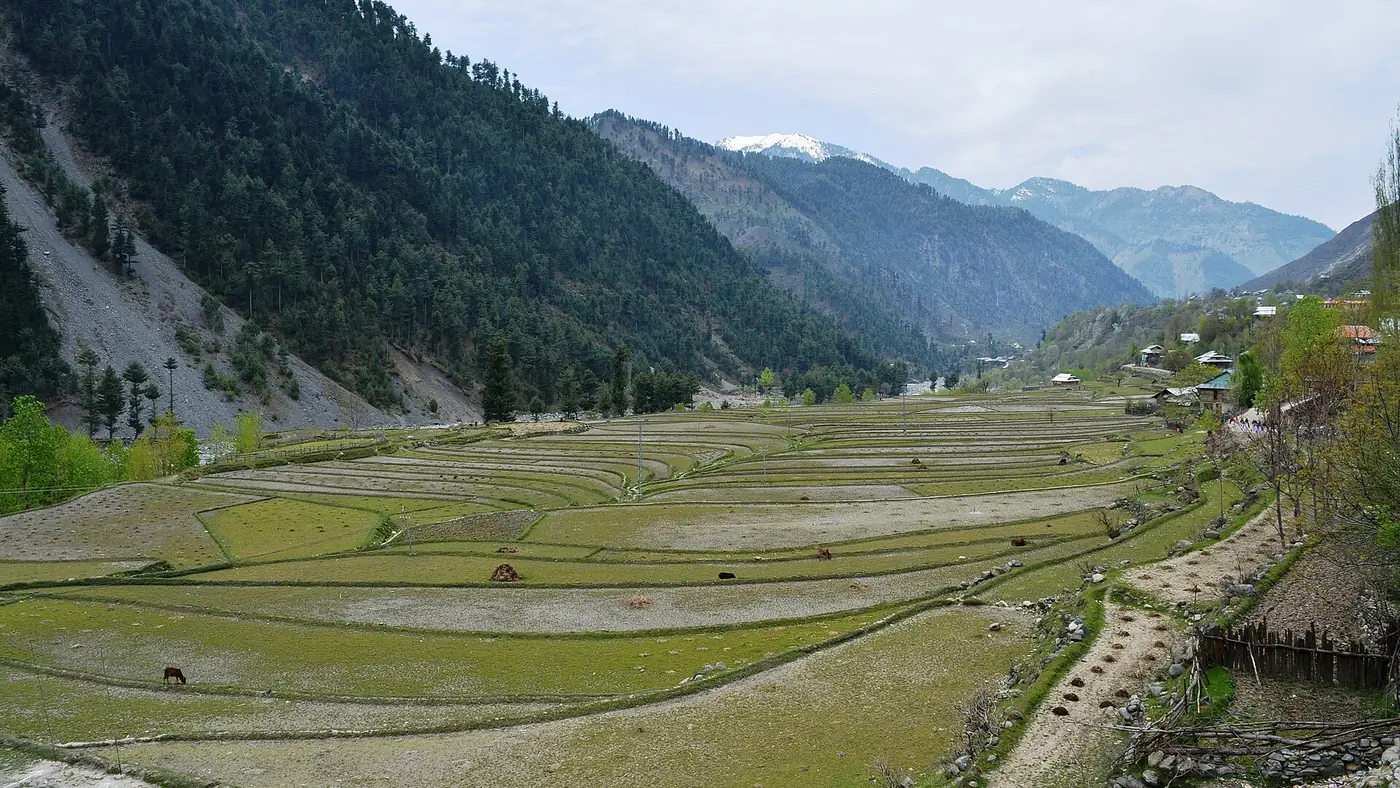

Leepa Valley is a farming valley on the Line of Control in Azad Kashmir's Jhelum Valley district, about 100 km from Muzaffarabad, known for terraced rice fields and old wooden houses. You reach it by climbing over the Reshian pass at around 3,200 metres and dropping into the valley, usually by jeep from Reshian. It is open to visitors from about May to November, and a visit from Islamabad needs at least two nights.
Leepa is smaller, quieter and much less developed than the Neelum Valley, which is exactly why people go. This guide covers where it is, the sectors from Nokot to Chananian, the rice and the houses, and what a trip actually involves.
| At a glance | |
|---|---|
| Where | Leepa tehsil, Jhelum Valley (Hattian Bala) district, Azad Kashmir |
| Altitude | Leepa village about 1,920 m; the Reshian pass about 3,200 m |
| From Muzaffarabad | About 100 km, 3 to 4 hours including the jeep section |
| From Islamabad | About 230 km, a long day of 7 to 8 hours |
| Open for visitors | About May to November; closed by snow in winter |
| Best for the rice | Green in summer; harvest in September and October |
| Transport | Jeep from Reshian for most visitors |
| Documents | CNIC for Pakistanis; foreign nationals need an NOC |
| Signal | Little or none in much of the valley |
Where is Leepa Valley?
Leepa lies east of Muzaffarabad, in the Jhelum Valley district, whose headquarters is at Hattian Bala. The valley used to be part of Karnah, most of which is now on the Indian side, and the Line of Control runs along the ridges around it. From most places in the valley you can see the LoC.
The route in follows the Jhelum Valley road east from Muzaffarabad. At Naili, about 45 km out, a road crosses the Jhelum and climbs to Reshian, the gateway village and checkpoint. From Reshian the road goes over the Reshian pass (often called Reshian Gali) at around 3,200 metres, then drops through pine forest in a long series of hairpin bends into the valley floor.
The sectors: from Nokot to Chananian
The valley is traditionally divided into five sectors: Nokot, Kasirkot, Dao Khan, Leepa and Chananian. Visitors usually see them as a string of stops along the jeep road.
Reshian and Dao Khan
Reshian is the last village before the climb and the place to hire a jeep. It has basic places to eat and is where you register at the checkpoint. Dao Khan, about 4 km from Reshian at around 2,490 metres, is a hill spot in the forest with rest houses of the AJK Tourism and Archaeology Department and the AJK Forest Department. It can be reached by car as well as by jeep, which makes it the easiest place near Leepa to spend a night.
Nokot
Nokot is the sector most people photograph: rice terraces stepping down the slopes, with wooden houses among them. If you only see one part of Leepa properly, see Nokot, ideally in the morning.
Leepa
Leepa village, at about 1,920 metres, is the centre of the valley, with a small bazaar, shops and the main cluster of houses and fields. A narrow jeep road runs through the village between the wooden houses and the rice and barley fields.
Moji
Moji is a hamlet on the newer road into the valley, and the shrine of Peer Sakhi Shahin Tootmar Khan Gali stands near Treda Sharif in Moji.
Chananian
Chananian sits opposite Leepa, at about 2,230 metres, near the LoC and surrounded by pine forest. It is higher and cooler than the valley floor around Leepa village.
The rice terraces
Rice is the main crop on the valley floor, and the terraces are what make Leepa look the way it does. Farmers flood and plant the fields in May and June, the terraces stay green through July and August, and the rice is cut in September and October, when the fields turn gold.
The valley is best known for its red rice, along with walnuts, apples, apricots, cherries and honey. If you want to take rice or walnuts home, the time to ask is after the harvest, in autumn.
Remember that the terraces are working farms. Stay on the paths and field edges, don't walk across planted fields, and ask before photographing people at work.
Wooden houses and village life
The other thing Leepa is known for is its traditional Kashmiri houses: many of them three storeys high, built of wood and mud, with metal-sheet roofs. Seen together on a hillside with the terraces below them, they are the image most people have of Leepa.
Leepa is a lived-in valley, not a resort. Kashmiri is widely spoken, alongside Pahari, Gojri and Hindko. People are generally welcoming to visitors, and the courteous approach is the usual one in rural Azad Kashmir: dress modestly, ask before photographing women or homes, and don't treat a house as a backdrop.
What a visit involves
Getting in
Most visitors drive or take public transport to Reshian, then hire a jeep for the valley. There are two ways down from the pass. The old Defence Road is a steep zigzag jeep track towards Nokot. A newer road through Moji into Leepa has been improved enough for ordinary vehicles in recent years, but some stretches are still rough and it is not the road to try in a low car after rain.
A private jeep from Reshian for a full circuit of the valley typically takes six to ten hours with stops. Agree before you set off exactly which sectors you want to see, how long the driver will wait at each and whether the price includes the return to Reshian.
How long you need
From Islamabad, Leepa needs at least two nights and is better with three:
- Day one: Islamabad to Muzaffarabad and on to Reshian or Dao Khan, arriving in the afternoon. Sleep at Dao Khan, Reshian or, if you started very early, in the valley.
- Day two: Jeep into the valley early: Nokot, Leepa, Moji and Chananian, and back over the pass by late afternoon.
- Day three: Back to Islamabad, or on to Muzaffarabad and the Neelum Valley.
A day trip from Muzaffarabad is possible, but it means nearly the whole day in vehicles and very little time in the valley.
Where to stay
Accommodation is limited. The main choices are the government rest houses at Dao Khan, which should be booked ahead through the departments that run them, a small number of guesthouses in and around Leepa, and camping. Rooms are simple, hot water is not guaranteed and power can be intermittent. On weekends and at Eid, the few decent rooms fill quickly, so book or arrive early.
When to go
Leepa is open to visitors from about May to November. June to August is green, and September and October bring the harvest and clear autumn light. From December to April snow blocks the way in. Our wider guide to the best time to visit Azad Kashmir covers how Leepa fits with Neelum and the rest.
Checkpoints, the LoC and photography
Because the valley runs along the Line of Control, there are army checkpoints, starting at Reshian. Pakistanis should carry their CNIC and expect to register. Foreign nationals need an NOC arranged before travelling. Access rules change, and in periods of tension along the LoC, as in May 2025 in the neighbouring Neelum Valley, visitors can be stopped at short notice. Ask about the current situation in Muzaffarabad or Hattian Bala before you go.
Follow what soldiers at the checkpoints tell you about where you can go and what you can photograph. Do not photograph military posts, and do not fly a drone without permission; flying is restricted near the LoC. Stay on the main roads and villages rather than wandering up ridges towards the border.
Is Leepa Valley worth the trip?
Yes, if you want to see a traditional Kashmiri farming valley and can accept basic rooms, jeep roads and no signal. In September and October, with the rice turning, it is one of the most rewarding short trips in Azad Kashmir.
It is less suited to:
- First-time visitors with limited time. The Neelum Valley has more to see for the same number of days and better roads and hotels. Our list of the best places to visit in Azad Kashmir compares the options.
- Families with small children or older parents who find long jeep rides hard. The pass road is steep, and much of the day is spent in the vehicle.
- Anyone who needs to stay connected. Expect little or no mobile signal once you are over the pass.
If you would rather have a gentler trip with more comfort, the Neelum Valley is the easier choice, and our Neelum Valley Escape covers it in five days. For help shaping a Leepa trip around your dates, see our trip planning page.
Frequently asked questions
Where is Leepa Valley located?
In the Jhelum Valley (Hattian Bala) district of Azad Kashmir, about 100 km east of Muzaffarabad, on the Line of Control. It is reached from Naili on the Jhelum Valley road, via Reshian.
Can a car go to Leepa Valley?
A car can reach Reshian and Dao Khan. A newer road through Moji into the valley has been improved for ordinary vehicles, but stretches are rough, so most visitors hire a jeep at Reshian.
Is Leepa Valley open in winter?
No, not for normal visits. Snow blocks the way over the pass from about December to April, and the valley is open to visitors from roughly May to November.
What is Leepa Valley famous for?
Terraced rice fields, including red rice, and traditional wooden Kashmiri houses, along with walnuts, apples and honey.
How many days do you need for Leepa Valley?
Two nights from Islamabad at the least, and three for a relaxed trip. A day trip from Muzaffarabad is possible but leaves little time in the valley.
Do I need an NOC for Leepa Valley?
Pakistani visitors need only their CNIC and must register at the checkpoints. Foreign nationals need an NOC arranged in advance.