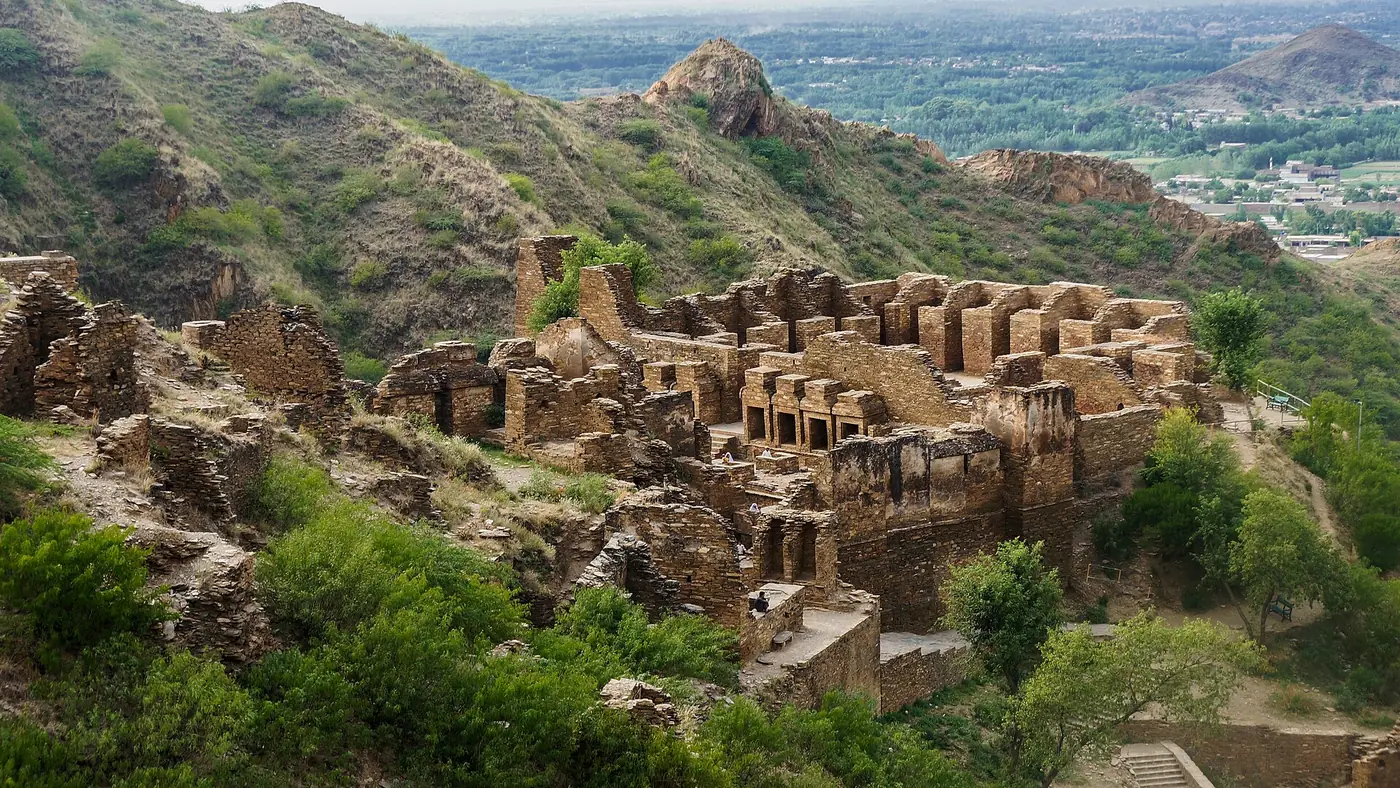
Jamal Garhi is a Buddhist monastery on a hilltop about 13 km from Mardan, on the road to Katlang, in use from roughly the 1st to the 5th century AD. It is quieter and barer than the better-known Takht-i-Bahi nearby, but it has its own hilltop climb, its own stupa court and one of the earliest dated inscriptions found at any Gandharan site. Allow an hour to an hour and a half.
This guide covers the site itself, the climb, its history and how to combine it with a Mardan trip.
| At a glance | |
|---|---|
| What it is | Buddhist monastery ruins, 1st to 5th century AD |
| Where | On Paja hill, about 13 km from Mardan on the Katlang road |
| The climb | A hillside walk to the summit, on a clear path |
| Time needed | 1 to 1.5 hours, including the walk up |
| Ticket | Small fee, higher for foreign visitors; pay what is posted |
| Best months | October to March |
What is at Jamal Garhi
The ruins occupy the western end of Paja hill and split into two parts. The stupa area is built around a circular main stupa, ringed by rows of small votive chapels, with a further court of smaller votive stupas beside it. Below and around this, the monastery proper has rows of monks' cells and a stone water tank, laid out in the same courtyard pattern as other Gandharan monasteries of the period.
Compared with Takht-i-Bahi, Jamal Garhi is barer. Much of its sculpture was removed by 19th-century diggers and now sits in the British Museum, the Indian Museum in Kolkata and the Peshawar Museum, so you are reading the layout of the site rather than seeing carved figures in place. What it has instead is quiet, and a clear view across the plain towards Mardan.
The Kharoshthi inscription
A schist inscription found at Jamal Garhi, dated in local reckoning to the equivalent of AD 275, is incised on one of the pavement slabs of the circumambulatory path around the main stupa, near the eastern entrance to the courtyard. It records a gift, reading simply "Gift of Buddharakshita." It is a modest line of text, but it is one of the more precisely dated Kharoshthi inscriptions from any Gandharan monastery, and it is part of what makes the site significant to archaeologists even though it draws fewer visitors than Takht-i-Bahi.
History and excavation
Jamal Garhi is thought to have seen the rise and fall of successive dynasties controlling Gandhara, from the Indo-Parthians through the Kushans to the Kidarites, or "Little Kushans," before the site was abandoned amid the disruption brought by the Hephthalites, or White Huns, in the 5th century.
The British archaeologist Alexander Cunningham identified the ruins in 1848, and excavations ran through the 1850s to 1870s, with further work by the Archaeological Survey of India in 1920 and 1921. As at many Gandharan sites explored in this era, the best portable finds were removed to museums rather than left on site, which is the main reason Jamal Garhi feels emptier than Takht-i-Bahi today.
How to get there
Jamal Garhi sits about 13 km from Mardan, on the road towards Katlang. With a car it is a straightforward drive of 20 to 30 minutes from the city, and the path to the ruins is clear from the base of the hill, though there is no vehicle access to the summit itself. Without your own car, agree a fare and a wait time with a local driver in Mardan before setting out, since there is little passing traffic to rely on for the return trip.
It combines well with a wider day around Mardan's Gandhara sites. Our places to visit in Mardan guide sets out how to fit Jamal Garhi alongside Takht-i-Bahi, Sahr-i-Bahlol and the Ashokan edicts at Shahbaz Garhi, and our Takht-i-Bahi guide covers that monastery's own ticket and climb in detail.
Who Jamal Garhi suits
Jamal Garhi suits visitors who have already seen Takht-i-Bahi and want a second, quieter monastery to compare it with, or anyone with a specific interest in the layout of Gandharan monastic sites rather than in sculpture. The climb is shorter and less crowded, and the view from the top is worth the walk on a clear winter day.
It suits less well anyone with only a few hours in Mardan and no earlier visit to Takht-i-Bahi. If you can only manage one hilltop monastery, Takht-i-Bahi is the better-preserved and more rewarding choice, and Jamal Garhi is the site to add once you have already seen it.
Is it safe to visit?
Mardan district has seen periodic militant activity, including attacks on police posts near Takht Bhai in 2024 and again in September 2026. Pakistani visitors continue to travel to Mardan's Gandhara sites, but the UK government's travel advice, updated 22 September 2026, advises against all but essential travel to Mardan district as a whole. If you visit, check current local news and the police situation before setting out, keep to daylight hours, and if you hold a foreign passport, check your own government's advice, since travelling against it can affect your travel insurance.
Frequently asked questions
How far is Jamal Garhi from Mardan?
About 13 km, on the road towards Katlang, roughly 20 to 30 minutes by car.
How does Jamal Garhi compare to Takht-i-Bahi?
It is smaller, barer and much quieter. Most of its carved sculpture was removed to museums during 19th and early 20th-century excavations, so you are seeing the layout of the monastery rather than the figures that made Takht-i-Bahi famous.
How long does it take to visit Jamal Garhi?
About an hour to an hour and a half, including the walk up the hill and time among the stupa court and monastery cells.
Is there an entry fee at Jamal Garhi?
Yes, a small fee that is higher for foreign visitors, paid at the site. Rates change from year to year, so carry cash and pay what is posted.
Is Jamal Garhi worth visiting if I only have one day in Mardan?
If it is your only day, see Takht-i-Bahi first. Add Jamal Garhi on a second visit or a second day, once you have seen the better-preserved monastery it is usually compared with.