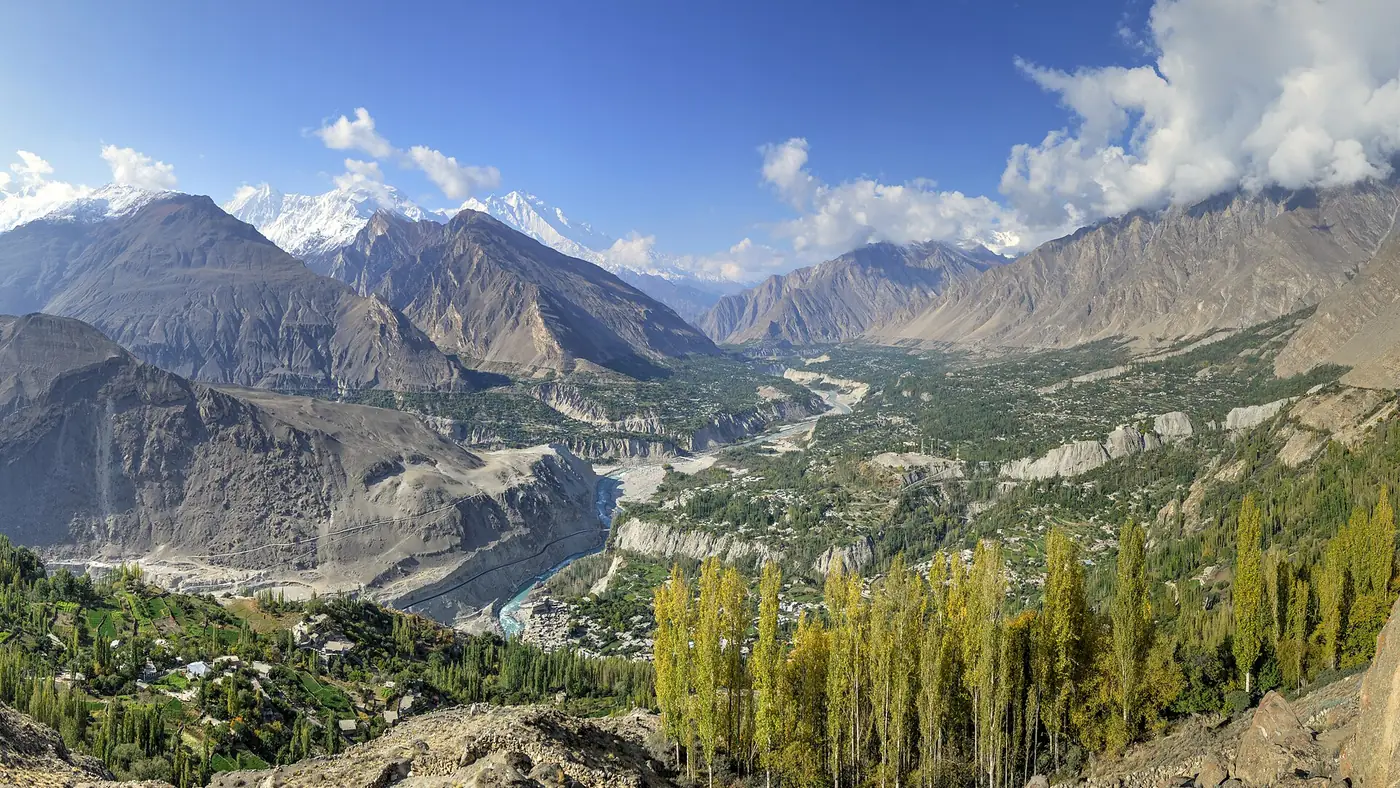
Aliabad is the market town and administrative centre of Hunza, strung along the Karakoram Highway a few kilometres below Karimabad at about 2,200 metres. It is where the valley does its business: banks and ATMs, the district hospital, fuel, pharmacies and the van stand. Some travellers base themselves in Aliabad Hunza rather than Karimabad because rooms are cheaper, parking is easy and the highway is on the doorstep, and from the upper side of town Rakaposhi fills the view.
This guide covers what Aliabad has, what staying there is really like, who it suits, and how it compares with Karimabad on the hill above.
| At a glance | |
|---|---|
| What it is | Administrative and commercial centre of Hunza district |
| Altitude | About 2,200 m |
| From Gilgit | About 90 km on the KKH, 2 to 3 hours |
| To Karimabad | About 7 km by the hill road |
| Banks | Branches and ATMs on the highway, including HBL |
| Healthcare | District headquarters hospital and an Aga Khan Health Centre |
| Transport | Van stand for Gilgit and Gojal; long-distance bus offices |
| Best for | Budget stays, drivers, long stays and early starts |
Where is Aliabad, and how does it relate to Karimabad?
Coming up the Karakoram Highway from Gilgit, you cross the stream from the Shishper glacier at Hassanabad and arrive in Aliabad, which sits in one of the wider parts of the Hunza valley. The highway is its main street, lined with shops, hotels and banks, with houses and fields climbing the slope behind.
Karimabad, with Baltit Fort and most of the tourist hotels, is on the hillside above and to the east, about 7 km by the hill road. Ganish and the bridge over to Nagar are a little further along the highway. So Aliabad is not a separate trip: it is the lower, working half of central Hunza, and most visitors pass through it twice a day without noticing.
One thing to check when you book: many hotels describe themselves simply as "in Hunza". A room in Aliabad, one in Karimabad and one on the Attabad shore are three quite different stays, so look at where the hotel actually is on a map.
What Aliabad is good for
Aliabad is where you sort things out. In one stretch of highway you will find:
- Cash. Several banks have branches and ATMs here, including HBL. Karimabad has less choice, and Gojal, Passu and Sost have very little, so withdraw what you need before heading north.
- Fuel. Petrol and diesel on the highway. Fill up before a Khunjerab day; Sost is the last fuel stop before the pass.
- Medical care. The district headquarters hospital and the Aga Khan Health Centre, a 30-bed secondary care hospital, are both in Aliabad. Note where they are if you are travelling with older parents or small children.
- Pharmacies for the things people forget: altitude headache tablets, rehydration salts, children's medicines.
- Phones and SIMs. Mobile shops sell and top up SIMs; our guide to which SIM works in Gilgit-Baltistan explains which networks to rely on.
The shopping is practical rather than touristy: groceries, dried fruit and household goods. For handicrafts, gemstones and walnut cake, go up to the Karimabad bazaar.
Staying in Aliabad: why some travellers base here
The case for Aliabad
- Price. Rooms are generally cheaper than in Karimabad for similar standards. In 2025 and 2026, simple rooms in Hunza have cost roughly PKR 2,500 to 5,000 a night, and Aliabad is where that end of the market is easiest to find.
- Parking and access. Hotels on or near the highway usually have space for cars, and you avoid the steep, narrow Karimabad bazaar road, which jams on summer evenings.
- Early starts. You are already on the highway for Khunjerab, Passu or the drive back to Gilgit, with no climb down in the morning.
- The view. Rakaposhi rises across the river from the Nagar side, and hotels on the upper slope of town have a clear look at it. Ask for a room on the Rakaposhi side, above the highway.
- Longer stays. For anyone staying a week or more, working remotely or visiting family, Aliabad's shops and services make daily life easier.
The case against
- Traffic. It is a working town on the main road to China, and trucks run at all hours. Rooms facing the highway can be noisy.
- Less charm. The streets are concrete and busy. There are no old lanes, forts or water-channel walks on the doorstep.
- You need transport. Baltit, Altit, Eagle's Nest and the Karimabad cafés are all a drive away, and the road up is steep.
- Fewer places for an evening out. Most of the cafés and restaurants aimed at visitors are up in Karimabad.
What to look for in a hotel here
Choose somewhere off the highway or on its upper side, with rooms facing Rakaposhi rather than the road. Ask about parking, heating (and what happens in a power cut), hot water, and whether the hotel is on the highway itself or up a side lane. If you are a foreign national, check that the hotel can register foreign guests, as rules in Hunza have tightened since 2025.
Aliabad or Karimabad?
| Aliabad | Karimabad | |
|---|---|---|
| Rooms | Cheaper, wider choice at the low end | More mid-range and top-end choice |
| Walking to sights | Very little | Baltit Fort, old town, channels, cafés |
| Parking | Easy | Tight |
| Noise | Highway traffic | Busy bazaar in summer evenings |
| Services | Banks, hospital, fuel, workshops | Limited |
| Views | Rakaposhi from the upper slope | Rakaposhi, Ultar and the whole valley |
For a first visit of two or three nights, Karimabad is usually the better base, because you can walk to most of what you came for. Aliabad makes more sense on a tight budget, on a long stay, or when you have your own car and plenty of driving ahead. Our guide to where to stay in Hunza compares every area of the valley, including Altit, Duikar and Gojal.
Getting there and getting around
From Gilgit, Aliabad is about 90 km up the Karakoram Highway, two to three hours with a stop at the Rakaposhi View Point. Our guide to the Gilgit to Hunza distance takes the drive village by village.
From Islamabad by road, there are two ways north to Chilas: over the Babusar Pass in summer, or along the KKH through Besham and Dasu. The UK government's travel advice (updated September 2026) advises against all travel on the KKH between Mansehra and Chilas; the Babusar route is not on that list. Pakistani travellers still use both, but check current news and police advice before you set out, and overseas visitors should read their own government's travel advice first, since it can affect travel insurance.
By public transport, Aliabad is Hunza's transport hub. Shared vans from Gilgit take about two to two and a half hours. Vans heading north to Gulmit, Passu and Sost leave from one spot and vans south to Gilgit from another; ask locally, and expect roughly PKR 500 to 1,000 (2026) depending on how far you go. Long-distance operators, NATCO among them, run buses to Rawalpindi.
Getting up to Karimabad, take a local taxi or a van up the hill road. There are footpaths too, but they are steep and not signposted.
Hassanabad, just west of town, is where the highway crosses the stream from the Shishper glacier. Floods from the glacier's lake washed away the bridge there in May 2022, and in early summer it is worth watching for flood warnings on that stretch.
Places near Aliabad
Aliabad is well placed for the lower half of central Hunza:
- Ganish, about 7 km along the highway, the oldest settlement in Hunza, with restored wooden mosques and watchtowers. Our Ganish village guide covers the guided walk.
- Karimabad and Altit, a short drive up the hill, for the forts and the old town.
- Nagar and the Hopper glacier, across the river from Ganish, for a half day.
- The Rakaposhi View Point at Ghulmet, back down the highway towards Gilgit.
Our list of day trips from Karimabad works just as well from Aliabad, since every route out passes through it.
Who should stay in Aliabad?
It suits budget travellers, groups driving their own cars, anyone staying a week or more, and people who want to be on the road to Khunjerab early. It also suits families who want easy parking and a hospital close by.
It suits less couples on a short trip, first-time visitors without a car, and anyone who wants to walk out of the hotel into old lanes and cafés. For them, the savings rarely make up for the time spent driving up and down the hill.
A good compromise on a longer trip is to spend most nights in Aliabad and one or two in Karimabad or Gojal. Our Gilgit and Hunza page gives the wider picture of the valley.
Frequently asked questions
Is Aliabad the same as Karimabad?
No. Aliabad is the market town on the Karakoram Highway; Karimabad is the older town on the hillside above it, about 7 km by road, with Baltit Fort and most of the tourist hotels.
Is it better to stay in Aliabad or Karimabad?
Karimabad is better for a short first visit, because the forts, old town and cafés are within walking distance. Aliabad is cheaper, easier for parking and closer to banks and the hospital.
Are there ATMs in Aliabad Hunza?
Yes. Several banks, including HBL, have branches and ATMs on the highway. Withdraw what you need here before going north to Gojal, where cash machines are few.
Can you see Rakaposhi from Aliabad?
Yes. Rakaposhi rises across the river on the Nagar side, and rooms on the upper slope of town have a clear view of it. Ask for a room facing the mountain rather than the highway.
How far is Aliabad from Gilgit?
About 90 km on the Karakoram Highway, which takes two to three hours with stops. Shared vans do it in two to two and a half hours.