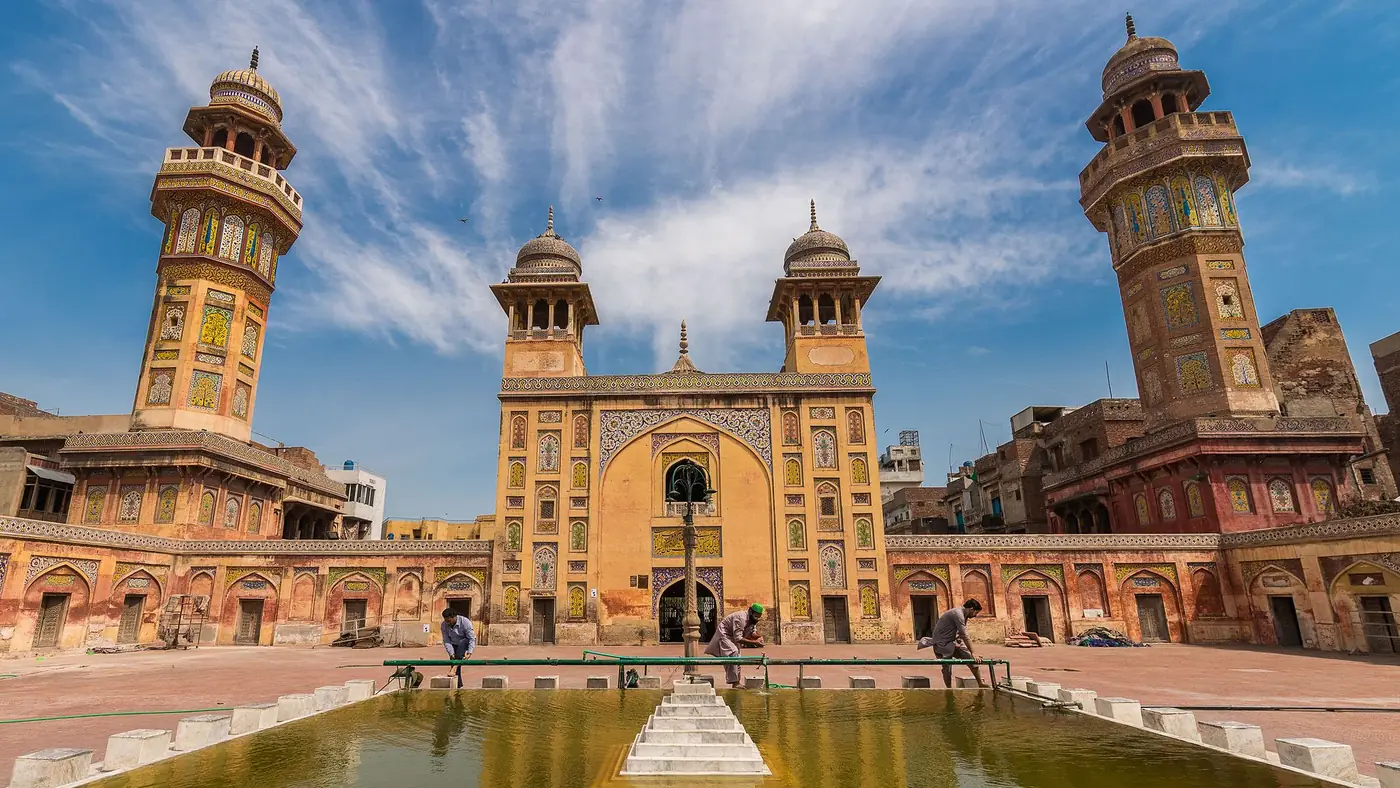
Wazir Khan Mosque, inside Delhi Gate in Lahore's Walled City, is the finest example of Mughal tile work in Pakistan and free to visit every day. It opens in the morning and closes around 8 pm, with a short pause for prayer times, and there is no entry fee, though you pay a small charge to leave your shoes at the door. Most visitors combine it with the rest of the Royal Trail walk through the old city.
| At a glance | |
|---|---|
| Built | 1634–1635, under Shah Jahan |
| Entry fee | Free (small charge for shoe-minding) |
| Hours | Roughly 8 am to 8 pm daily |
| Best for | Kashi-kari tile work and Mughal-era frescoes |
| Dress | Modest clothing; women should carry a headscarf |
| Nearby | Delhi Gate, Shahi Hammam, Wazir Khan Chowk |
Why Wazir Khan Mosque matters
The mosque was built between 1634 and 1635 during the reign of Shah Jahan, commissioned by Hakim Ilm-ud-din Ansari, known as Wazir Khan, a physician who rose to become governor of Lahore. What sets it apart from the larger, later Badshahi Mosque across the old city is the decoration: almost every surface, inside and out, is covered in Kashi-kari, the glazed tile technique that gives the mosque its reputation as Lahore's most intricately decorated Mughal building.
The tile work and frescoes
Kashi-kari combines cut and moulded glazed tiles in cobalt blue, cerulean, white, green, orange, yellow and purple, arranged into cypress trees, floral patterns and geometric borders across the entrance, the courtyard walls and the four minarets. Where the tile work gives way, painted frescoes take over, covering the interior surfaces with more of the same floral and calligraphic themes. Conservation work over the past two decades, led by the Aga Khan Trust for Culture together with the Walled City of Lahore Authority, has restored large sections of both the tiles and the frescoes, and the difference between restored and unrestored panels is often visible if you look closely.
Spend time in the courtyard rather than rushing through it. The entrance archway (the pishtaq) and the qibla wall carry the most elaborate work, and morning light picks out the colours better than the flatter light of midday.
Minarets, hujras and the mosque as a working complex
The mosque has four corner minarets, each about 32 metres tall and capped with a fluted, bell-shaped dome, a design element used here for the first time in Lahore and later echoed elsewhere in the Mughal world. Around the courtyard run rows of small cells known as hujras, originally used by students studying the Quran and calligraphy, and, according to the deed left by Wazir Khan for the mosque's upkeep, also let out as shops and workshops for craftsmen, along with a caravanserai, wells and open land. The mosque, in other words, was never meant to be only a place of worship: it was built as a small, self-sustaining institution, with the rent from its shops and hammam funding its maintenance, a fairly common model for major Mughal-era mosques.
The entrance portal facing Wazir Khan Chowk carries the most elaborate calligraphy on the building, with Quranic verses, sayings attributed to the Prophet Muhammad and formal prayers worked into the tile design around the archway. It rewards a slow look before you step through into the courtyard.
Rooftop and minaret access
Access to the minarets and roof has historically been restricted for safety and conservation reasons, and this changes from time to time as restoration work continues in different sections of the complex. Ask the caretakers on site whether any rooftop or minaret access is open on the day you visit rather than assuming either way.
Wazir Khan Chowk and the walk through the old city
The mosque sits at the edge of Wazir Khan Chowk, a small square that was restored as part of the same Walled City conservation programme and now serves as a gathering point with shaded seating, a cleaned-up facade of surrounding buildings and better lighting in the evening. From here, the Royal Trail continues through Kashmiri Bazaar toward the Sunehri Masjid and on to the Lahore Fort, and doubles back the other way toward Delhi Gate and the Shahi Hammam.
Our guide to the Walled City of Lahore covers this full walk in order, and our guide to the Shahi Hammam, a few minutes' walk away, covers the restored Mughal bathhouse.
Getting there
The mosque is inside Delhi Gate, reachable on foot from the gate itself or from the Lahore Fort side through Kashmiri Bazaar. There is no dedicated parking near the mosque; most visitors park near Delhi Gate or arrive by rickshaw and walk in, since the surrounding lanes are narrow and largely pedestrian.
Dress code and etiquette
- Cover shoulders and legs; both men and women should dress modestly
- Women should carry a headscarf, expected inside the prayer hall
- Remove shoes before entering the courtyard and prayer areas
- Avoid visiting during the five daily prayer times if you want to look around freely, and especially avoid Friday's Jumma prayer window
- Photography is generally allowed in the courtyard; ask before photographing anyone praying
When to go
Early morning, shortly after opening, is quietest and gives the best light on the tile work. Late afternoon, an hour or so before closing, is the next best option and avoids the midday heat in summer. Fridays are busiest because of Jumma prayers, so plan around midday if you visit that day. For the wider question of which months suit Lahore best, see our best time to visit Lahore guide.
Is it worth the visit?
Yes, and for most visitors it is a highlight of the old city rather than a stop to rush through. The Badshahi Mosque is larger and more famous, but Wazir Khan's tile work is the more intricate and, for many visitors, the more memorable of the two. Pair it with the rest of the Royal Trail rather than visiting it alone, since the mosque, the chowk, the hammam and the bazaars in between are close together and best seen as one walk.
Frequently asked questions
Is there an entry fee for Wazir Khan Mosque?
No, entry is free. You pay a small fee to leave your shoes with an attendant at the door.
What are the opening hours?
Roughly 8 am to 8 pm daily, with a short closure during each prayer time. Hours can shift slightly around Ramadan and public holidays, so build in some flexibility.
Can I go up to the roof or the minarets?
Access varies depending on ongoing conservation work. Ask the caretakers on the day, since it is not consistently open.
What should I wear to visit Wazir Khan Mosque?
Modest clothing covering shoulders and legs for everyone, with a headscarf for women. Shoes come off before entering the courtyard and prayer hall.
How long should I spend there?
Thirty to forty-five minutes covers the courtyard and tile work at an unhurried pace; longer if you want to study the frescoes closely or photograph them in good light.
Is Wazir Khan Mosque near the Lahore Fort?
It is a short walk through Kashmiri Bazaar, roughly ten to fifteen minutes, making it easy to combine both in a single morning along with the Badshahi Mosque.