
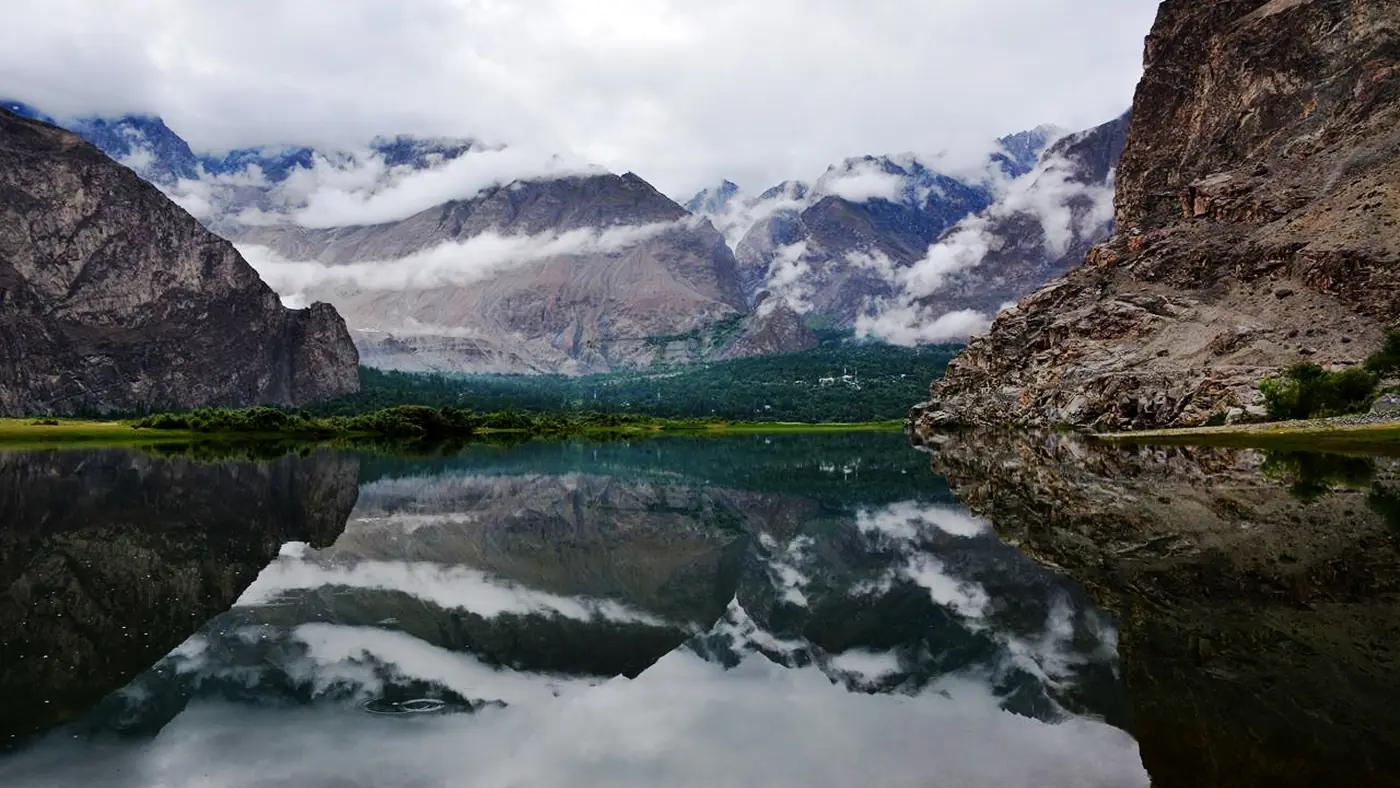

Skardu to Khaplu is about 103 km, or roughly three hours each way by car. The road is paved the whole way and kept open all year: it runs east from Skardu along the Indus, crosses near the point where the Shyok joins it, and then follows the Shyok upstream through a string of orchard villages to Khaplu. A normal car manages it without trouble in dry weather.
You can do it as a day trip, and many people do, but it means six hours of driving for a few hours in Khaplu. This guide covers the route, the stops worth making, and how to decide between a day trip and a night in Khaplu.
| At a glance | |
|---|---|
| Distance | About 103 km |
| Driving time | About 3 hours each way, without long stops |
| Road | Paved throughout; narrow in places, with the odd rough patch |
| Open | All year, weather permitting |
| Vehicle | Any car in good order; no jeep needed |
| Khaplu altitude | About 2,600 m, some 400 m higher than Skardu |
| Fuel | Fill up in Skardu before you leave |
| Best start | 7:00 to 8:00 am for a day trip |
The route, step by step
The drive falls into three parts: the Indus, the confluence, and the Shyok.
- Skardu east along the Indus. You leave town on the road towards Kharmang and Kargil, with the Indus on one side and sand and bare rock on the other. Poplar-lined villages break up the desert every few kilometres.
- The Indus–Shyok confluence. After roughly 30 km the Shyok joins the Indus from the east. Here the roads divide: the Kargil road continues up the Indus into Kharmang, and the Khaplu road crosses the Indus and turns up the Shyok.
- Keris. Keris, about 33 km from Skardu, is the first village of Ghanche district and is known locally as the gateway to it. It sits by the confluence with green fields, old houses and a pedestrian suspension bridge.
- Up the Shyok. The road runs above the river through Ghowari and on to Yugo, about 70 km from Skardu, then past Kharfaq. The valley alternates between sandy bends of the river and patches of orchard and wheat.
- Doghoni and the last stretch. Shortly before Khaplu, at Doghoni, a side road turns north into the Thalle valley. The main road carries on east to Khaplu town.
The distances above are approximate. Drive times vary more with traffic, roadworks and how often you stop than with the distance.
Stops worth making
There is no need to stop at all, but these are the places where most people pull over.
- The confluence. Two big rivers meet in a wide bowl of sand and rock. It is the best photograph of the drive, and it is less than an hour from Skardu.
- The Keris bridge. The suspension bridge over the river is a short walk from the road and a good leg-stretch. Stay off it if it is crowded or swaying badly, and hold children's hands.
- Yugo and the villages. The orchard villages along the Shyok are at their best in April for blossom and in late October for autumn colour. Stop where there is room to pull fully off the road; the shoulders are narrow.
- Kharfaq. Kharfaq Lake sits high above the village, a steep climb of around three hours on foot. It is a separate outing rather than a roadside stop, so leave it for a trip with more time.
Some visitors try to combine Khaplu with the Manthoka waterfall in Kharmang. Manthoka is not on the way: it is up the Indus from the fork, so adding it means a long detour and a very long day. We would see it on a separate day.
Day trip or overnight?
Both work, but they are different days.
As a day trip from Skardu
A day trip is the usual way to fit Khaplu into a short Skardu trip. It is how our Skardu and Deosai trip includes it: three hours up the Shyok, the palace and the Chaqchan Mosque, and back to Skardu in the evening.
A typical day runs like this:
- Leave Skardu at 7:00 or 7:30 am. Stop at the confluence while the light is soft.
- Reach Khaplu around 10:30. Go straight to Khaplu Palace, then walk to the Chaqchan Mosque.
- Lunch in Khaplu, at the palace restaurant or a simple place in the bazaar.
- Leave by 2:30 or 3:00 pm, and make the village stops on the way back.
- Back in Skardu by about 6:00 pm.
The drawback is that you spend twice as long in the car as in Khaplu, and there is no time for Thoqsikhar, Saling or the Hushe road. In October and November, when the light goes early, the return leg runs into dusk.
With a night in Khaplu
A night turns Khaplu from a sight into a place. You can see the palace in the afternoon light, walk up to Thoqsikhar the next morning, and cross the river to Saling before driving back. It also makes the Hushe valley possible as a day out from Khaplu.
Our advice: if you have five days or fewer in Skardu, do the day trip or skip it. With a week or more, stay a night. Our guide to hotels in Khaplu covers where to stay, from the palace itself to simple guesthouses.
How to get there: car, driver or minivan
- Your own car. The road is paved and a sedan is fine. Drive in daylight, give way on the narrow sections, and watch for tractors, livestock and children on the village stretches.
- A car with a driver from Skardu. The easiest option for most visitors, and one any hotel in Skardu can arrange. Agree the waiting time and return time before you set off. Our guide to hiring a car with a driver in the north covers what to ask.
- Local minivans and shared cars. They run between Skardu and Khaplu for residents, mostly in the morning. They are cheap but slow, and they suit travellers staying the night rather than day-trippers. Ask at your hotel where and when they leave.
Road conditions through the year
The Skardu–Khaplu road is open in every month, but conditions change with the seasons.
- April and May: blossom in the villages, and generally easy driving. Rising rivers can cause occasional damage near the water later in spring.
- June to September: the busiest months. Heavy summer rain can bring rockfall and short closures for clearing, so check locally if it has rained overnight.
- October and November: usually dry and clear, the best months for colour and for the drive itself. Days are short, so start early.
- December to March: open, but shaded bends can be icy in the mornings and evenings. Go only in settled weather and aim to be back before dark.
In September 2026 the federal government proposed handing this road, along with six others in Gilgit-Baltistan, to the National Highway Authority for widening and long-term maintenance. If the plan goes ahead, expect roadworks and occasional delays in coming seasons.
Don't count on mobile signal along the Shyok. Tell someone your plan, and download offline maps before you leave Skardu. For a wider picture of what to see from Skardu, see our guide to places to visit in Skardu.
Is the drive worth it?
Yes, if you have the time. The road itself is one of the gentler drives in Baltistan, the villages along the Shyok see far fewer visitors than the sights around Skardu, and Khaplu Palace is one of the finest restored buildings in the north.
It is not worth squeezing into a three-day trip. On a short visit, Shigar Fort, an hour from Skardu, gives you a restored palace for much less driving. And if anyone in your group struggles on long car journeys, a night in Khaplu is the difference between an enjoyable trip and a tiring one.
Frequently asked questions
How far is Khaplu from Skardu?
About 103 km by road, east along the Indus and then up the Shyok valley. It takes roughly three hours each way in a car.
Is the Skardu to Khaplu road open in winter?
Yes. The road is kept open all year, though icy mornings and occasional snow can slow it between December and March. Travel in daylight and check the weather before setting out.
Can a normal car go from Skardu to Khaplu?
Yes. The road is paved all the way, and a sedan in good condition manages it easily. You need a jeep only if you are going on from Khaplu into the Hushe valley.
Can you visit Khaplu in a day from Skardu?
Yes, if you leave by 7:30 am and keep to the palace and the Chaqchan Mosque. You will be back in Skardu by early evening, but with six hours of driving it is a long day.
Is there public transport from Skardu to Khaplu?
Local minivans and shared cars run between the two, mostly in the morning. They suit travellers staying overnight rather than day-trippers.