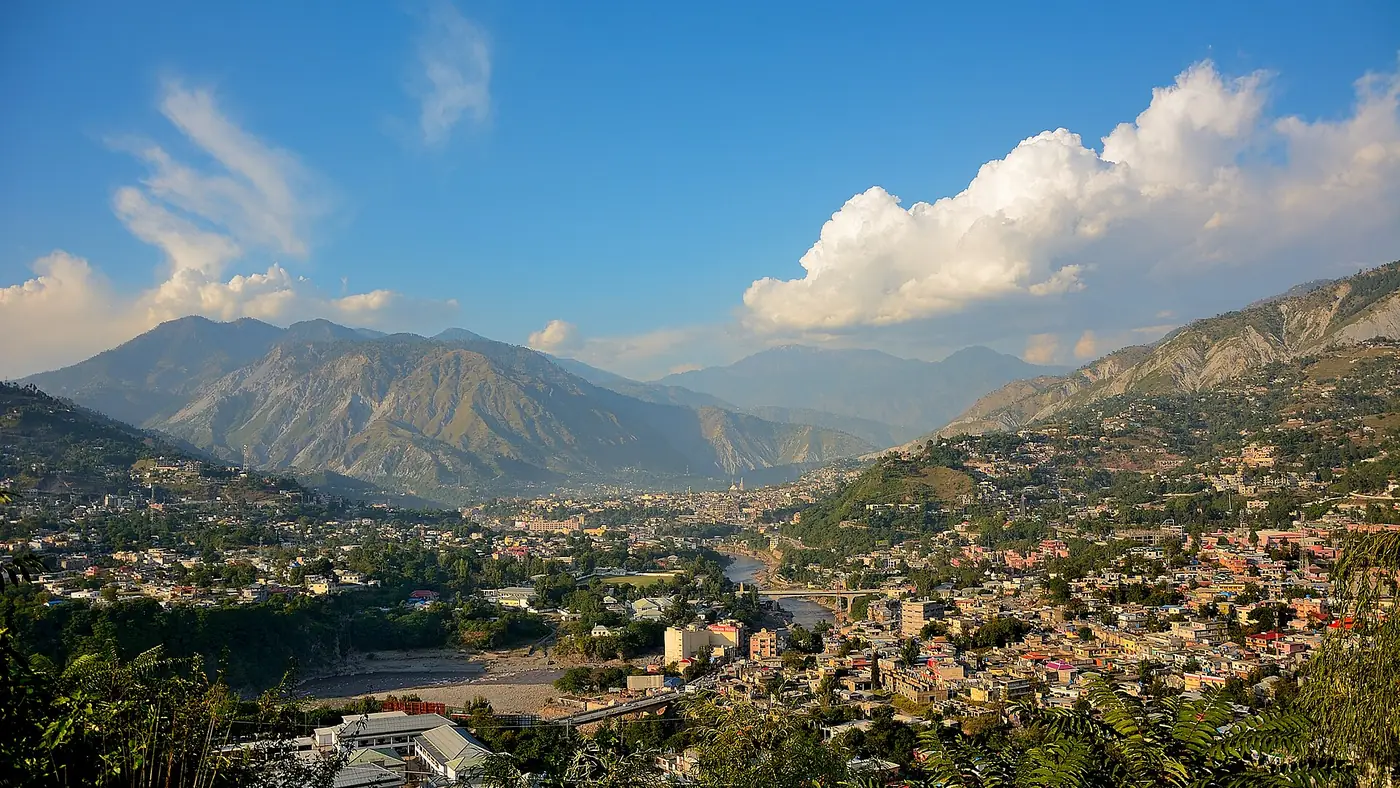
The Red Fort in Muzaffarabad, known locally as Rutta Qila, is a 16th-century stone fortress on the Neelum river, begun under Kashmir's Chak dynasty and finished nearly a century later by the founder of the city. It stands open to the public on Neelum Road, roughly 45 minutes to an hour of your time, and it is the closest thing Muzaffarabad has to a proper monument. This guide covers its history, its condition today, and how to plan a visit.
At a glance
| Location | Neelum Road, near Challah bridge, west bank of the Neelum river |
|---|---|
| Built | Begun 1559 (Chak dynasty), completed 1646 (Sultan Muzaffar Khan) |
| Style/period | Kashmiri fort architecture, river stone construction |
| Condition | Ruined in parts; badly damaged in the 2005 earthquake |
| Timings | Roughly daytime hours; not consistently posted, check at the gate |
| Fee | Not consistently reported; carry small cash in case one is charged |
| Time needed | 45 minutes to an hour |
From Chak stronghold to a city's namesake
The fort's origin lies in a 16th-century power struggle. The Chak dynasty, then ruling the Kashmir valley, began building it in 1559 as a defensive post against an expected Mughal advance up the Jhelum and Neelum valleys. The site was well chosen: a rocky spur with the river curving around three sides, leaving only one approach to defend.
The threat it was built against arrived anyway. The Mughals annexed Kashmir in 1587, before the fort was finished, and construction stalled for decades. It was completed only in 1646, under Sultan Muzaffar Khan of the local Bomba dynasty, who gave his name to the town that grew up around it: Muzaffarabad.
Ownership and use changed again in the 19th century. Under Dogra rule, which took over the wider region from 1846, the fort was reconstructed and extended for use as a garrison and administrative post, a role it kept until the Dogra state's control of the area ended in the late 1940s. Later reporting on the site also credits the Chak builders with adapting it into a residence once its military purpose faded under Mughal rule, before the Dogra rebuilding.
What the fort actually looks like today
Inside the walls, what survives is closer to a ruined outline than a furnished monument. Reporting on the site describes an original footprint of about 59 kanals, built largely from river stone, with terraces on the northern side stepping down to the water, a well-defended eastern gateway, barracks, a set of prison cells with brick-vaulted ceilings, and underground chambers. A caravanserai once stood near the entrance; only traces of it remain.
Expect walls, gateways, open ground and river views rather than roofed rooms or furnished interiors. Much of what is described in older accounts, such as the prison block and underground chambers, is not something a casual visitor will be able to enter or clearly make out; treat these as background on what the site once contained rather than a checklist for your visit.
The 2005 earthquake and the damage before it
The fort's ruined state is not solely down to age. It had already been damaged by flooding in 1992, and a protective embankment was later built along the riverside after further flood damage around 2010.
The heaviest blow was the October 2005 earthquake, centred not far from Muzaffarabad, which destroyed roughly a third of the remaining structure and brought down walls that had stood for centuries. In the disorder that followed, items from the small on-site museum were reported stolen. What is visible now, mostly broken walls and open courtyards rather than intact rooms, is largely a result of that damage.
Restoration: where the 2019 project stands
In October 2019, the Azad Kashmir government signed an agreement with the Walled City of Lahore Authority (WCLA) to restore the Red Fort along with other heritage sites in the territory. On paper, the scope is substantial: a structural and architectural survey of the fort as it stands, consolidation of the surviving stonework, new lighting, public toilets, a ticket office and signage, and a small museum inside one of the old residential blocks. Later phases, described by WCLA itself, add a crafts bazaar, a restaurant and eventually a boutique hotel.
How much of that has actually been built is harder to pin down from outside Muzaffarabad. Separate reporting on the project has described funding for renovation being released slowly and the fort's boundary shrinking under encroachment, which points to a restoration that has moved in fits and starts rather than to completion. We could not confirm a finished museum, working ticket office or fixed timetable from current, verifiable sources, so don't plan your visit around any of those existing. Ask locally, or check the WCLA's own page on the project, before you go if this matters to your trip.
Getting there and what to expect at the gate
The fort sits on Neelum Road on the west bank of the Neelum river, near Challah bridge, a short drive or rickshaw ride from the city centre around Bank Road and Domel. There is no dedicated fort bus or shuttle; a taxi, rickshaw or your own car from wherever you are staying is the normal way in.
Timings are not consistently posted anywhere we could verify, and multiple independent visitor accounts describe checking at the gate rather than relying on a fixed schedule; expect it to be open through the day and closed after dark. The same applies to any entry fee: some visitors report free entry, others a small charge, which is consistent with a site whose ticketing has not been reliably set up. Carry some cash in case one is asked for, and don't be surprised either way.
Bring your own water. Past visitor reports mention that none is sold inside, and there is little shade once you are away from the gate.
Best photo angles and times
Morning is the best time to visit, for light and for temperature; by early afternoon the stone walls hold the heat and there is little shelter. The strongest photographs come from two spots: the northern terraces, looking down to where the river curves around the base of the walls, and the eastern gateway, which still has enough of its original form to photograph as a gateway rather than a gap in a wall.
Across the river stands the Black Fort, also known as Gojra Fort, inside a military area and closed to the public. You can see it clearly from the Red Fort's riverside walls, and it makes a useful second subject in the same shot without needing to cross over. Avoid pointing a camera at anything that looks military on either bank, on the Red Fort side or across the water.
Is it worth visiting?
For half an hour spent on the way through Muzaffarabad, yes. The history is genuinely old and the river setting is a good one, and there is nowhere else in the city that gives the same sense of how long people have been contending for this spot where the valleys meet.
Go in with the right expectations and it won't disappoint: this is a walk through broken walls and open ground with a river view, not a restored palace or a full museum experience. If you want polished heritage architecture, this isn't it yet; if you want to stand somewhere with four centuries of history behind it for the price of a short detour, it earns its place on the itinerary. Our wider guide to places to visit in Muzaffarabad covers the rest of the city, including Domel and the bazaars, so you can build a fuller half-day around the fort. It is also a natural stop for anyone driving up from Islamabad, as covered in our Islamabad to Muzaffarabad guide, or for wider plans around our Kashmir destination page.
Travellers on our Neelum Valley Escape, which routes through Muzaffarabad at both ends of the trip, can fit a stop at the fort into the same morning as the drive out of or back into the city; it isn't a scheduled stop on the itinerary, but it costs little extra time to add.
Frequently asked questions
Who built the Red Fort in Muzaffarabad?
Construction began in 1559 under the Chak dynasty, then ruling Kashmir, as a defence against the Mughals. It was completed in 1646 by Sultan Muzaffar Khan, the local ruler who founded Muzaffarabad and gave the city its name.
Is the Red Fort open to visitors?
Yes. It remains open to the public despite its damaged state, and there is no requirement to book ahead. Hours are not consistently posted, so treat any time you read online, including this one, as a guide and confirm at the gate.
Is there an entry fee for the Red Fort?
Reports vary, from free entry to a small charge, and no fee is officially and consistently confirmed. Carry a little cash in case one is asked for.
How long does a visit to the Red Fort take?
Most visitors spend 45 minutes to an hour, enough time to walk the walls, look over the river and take photographs. It suits a short stop rather than a half-day outing on its own.
Has the Red Fort been restored since the 2005 earthquake?
An agreement to restore it was signed with the Walled City of Lahore Authority in 2019, and the published plan includes new facilities and a museum. We could not confirm how much of that work has been finished, so expect a site still showing earthquake damage rather than a finished heritage park.
Is it safe to visit the Red Fort right now?
Muzaffarabad city itself sits outside the Line of Control exclusion zone, but Azad Kashmir has seen wider unrest through 2026. Check current advice before you travel; our guide to whether Azad Kashmir is safe to visit has the detail.