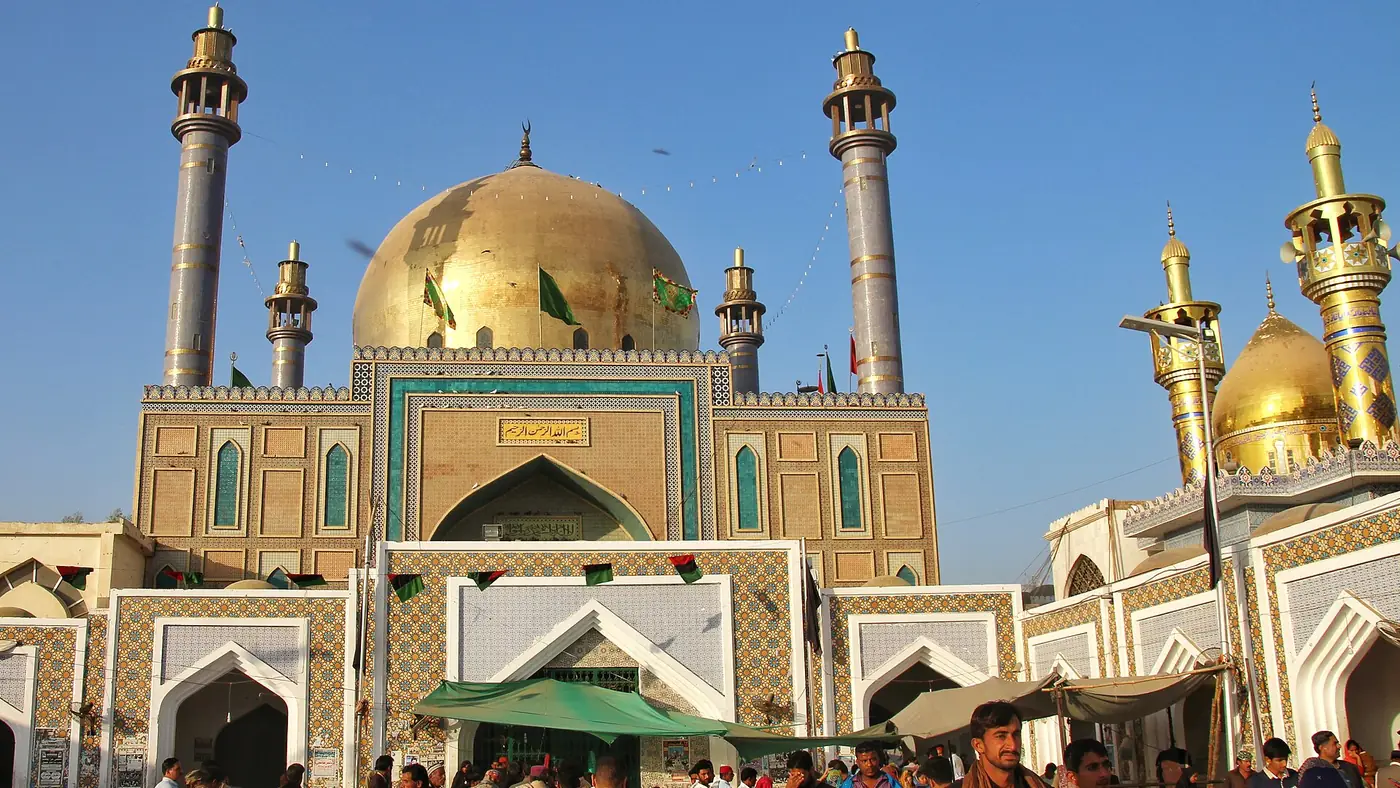
Hyderabad's sights are close together and you can see the main ones in a day: the old walled quarter of Pakka Qila, the domed tombs of the Talpur Mirs, the Sindh Museum, and the bazaars of the old city. None of them needs more than an hour or two, so the real question is which to prioritise if your time is short.
This list of places to visit ranks them by what most visitors get the most out of, with how long to give each and how they connect.
| Place | What it is | Time needed |
|---|---|---|
| Pakka Qila | Old walled fort quarter, still inhabited | 1 to 1.5 hours |
| Tombs of the Talpur Mirs | Domed 19th-century mausoleums | 30 to 45 minutes |
| Sindh Museum | Provincial museum, Indus Valley to Talpur era | 45 minutes to 1 hour |
| Shahi Bazaar and Resham Gali | Old city markets, bangles and textiles | 1 hour or more |
| Kotri Barrage | 1950s barrage on the Indus | 30 to 45 minutes, plus travel |
Pakka Qila: the old walled quarter
Pakka Qila is not a ruin you buy a ticket to walk around; it is a living neighbourhood built inside the fort that Mian Ghulam Shah Kalhoro founded in 1769 and the Talpur Mirs later used as their seat of government. After the British defeated the Talpurs at the Battle of Miani in 1843, most of the original palaces were pulled down for military use, and the space inside the walls has been settled ever since, especially by families who arrived at Partition in 1947.
What survives is worth the visit anyway: sections of the eastern and western ramparts, the Mir Haram building from the Talpur period, a former museum with faded murals, and a sealed tunnel known locally as Qilay ki Surang. Go in through the western gate that faces Shahi Bazaar and walk the narrow lanes inside rather than trying to see it from outside. The walls are genuinely crumbling in places, so keep to the main paths and don't climb on anything.
Tombs of the Talpur Mirs
A short distance away in Hirabad is the tomb complex of the Talpur dynasty, who ruled Sindh from 1783 until the British takeover in 1843. The largest domed tomb holds the graves of Mir Karam Ali Khan and Mir Murad Ali Khan, and around it are smaller mausoleums for their wives and children, built in marble with carved Quranic inscriptions.
The Sindh culture department has been restoring the complex slowly, so some tombs are in better condition than others. It is a quiet, low-key site rather than a major tourist stop, which is part of the appeal if you want a break from the bazaars.
Sindh Museum
The Sindh Museum in Rani Bagh, Qasimabad, was established in 1971 and covers the province's history from the Indus Valley civilisation through the Samma, Soomra, Kalhora and Talpur periods, alongside displays on village life in Sindh. It has indoor galleries and an open-air section, and it occasionally hosts craft fairs and cultural events at weekends.
Entry is inexpensive, and the museum is usually closed one day a week. Opening days and hours have changed more than once in recent years, so confirm the current schedule before you plan a trip around it, particularly if you are coming from outside Hyderabad.
Shahi Bazaar and Resham Gali
The old city's two best-known markets sit close together. Shahi Bazaar is the main artery of the old city, running near Pakka Qila's western gate, and Resham Gali, named for the Urdu word for silk, is known for fabric, lawn suits and the glass bangles Hyderabad is famous for. Both have food stalls worth stopping at.
Go in the late afternoon or early evening, when the bazaars are busiest and coolest. Traffic and parking near both markets are tight, so a rickshaw in from your hotel is usually easier than driving.
Kotri Barrage and the Indus riverside
Kotri Barrage, also called the Ghulam Muhammad Barrage, was built between 1950 and 1955 to control the Indus for irrigation and flood protection in lower Sindh. It sits a short drive from central Hyderabad and is one of the few places in the city with an open view of the river. It is a working barrage rather than a park, so there is little in the way of facilities, but it is a straightforward stop if you have transport and half an hour to spare.
Getting to Hyderabad
Hyderabad sits on the M-9 motorway, about 136 kilometres and roughly two hours from Karachi by car or coach, which makes it an easy day trip or a first overnight stop heading further into Sindh or up the Indus Highway. Frequent coaches run from Karachi's main terminals, and Hyderabad is also a stop on several long-distance train routes. Within the city, rickshaws are the simplest way to move between Pakka Qila, the bazaars and the Sindh Museum, since parking in the old city is limited and the lanes around Shahi Bazaar are narrow.
Best time to visit
Like the rest of lower Sindh, Hyderabad is very hot from around May to September, with summer daytime temperatures regularly well above 40°C, which makes walking the old city and bazaars uncomfortable in the middle of the day. November to February is the more comfortable season for sightseeing, with cooler mornings and evenings. If you do visit in summer, plan the outdoor parts of the day, Pakka Qila and the bazaars, for the morning or early evening rather than midday.
If you have more time
Hyderabad also works as a base for two well-known shrine towns further out: Bhit Shah, the shrine of the Sindhi Sufi poet Shah Abdul Latif Bhittai, and Sehwan Sharif, the shrine of Lal Shahbaz Qalandar. Both are a separate half-day trip rather than an add-on to a Hyderabad city day; see our guides to visiting Bhit Shah and to the Sehwan Sharif shrine for what each involves.
Planning your time
One full day is enough to see Pakka Qila, the Talpur tombs, the Sindh Museum and one of the bazaars without rushing. If you only have a few hours between a train, bus or flight connection, Pakka Qila and Shahi Bazaar are the pair that give the clearest sense of the old city.
Hyderabad is more a stop to break a journey through Sindh than a multi-day destination in its own right. If you're building a longer route through the province, see our trip planning guide for how to sequence stops like this alongside Bhit Shah, Sehwan Sharif and the Sindh coast.
Frequently asked questions
Is one day enough to see Hyderabad?
Yes. Pakka Qila, the Talpur tombs, the Sindh Museum and one of the old city bazaars can all be covered in a single day without rushing.
Is Pakka Qila open to the public?
Yes, though it is not a ticketed monument. It is a working, inhabited neighbourhood, so visit respectfully and keep to the main lanes, as parts of the old walls are unstable.
Is there an entry fee for the Sindh Museum?
Entry is inexpensive. The museum's opening days have changed more than once in recent years, so check the current hours before travelling to see it specifically.
What is Hyderabad known for besides its old city?
Hyderabad is known across Pakistan for its bangles, sold in Resham Gali and Shahi Bazaar, and for its rabri and bakery cakes; see our guide to Hyderabad's famous food for where to try them.
Can I visit Bhit Shah or Sehwan Sharif as a day trip from Hyderabad?
Bhit Shah is close enough for a half-day round trip. Sehwan Sharif is further and usually needs a full day, so plan accordingly if you want to see both a Hyderabad sight and a shrine town on the same trip.