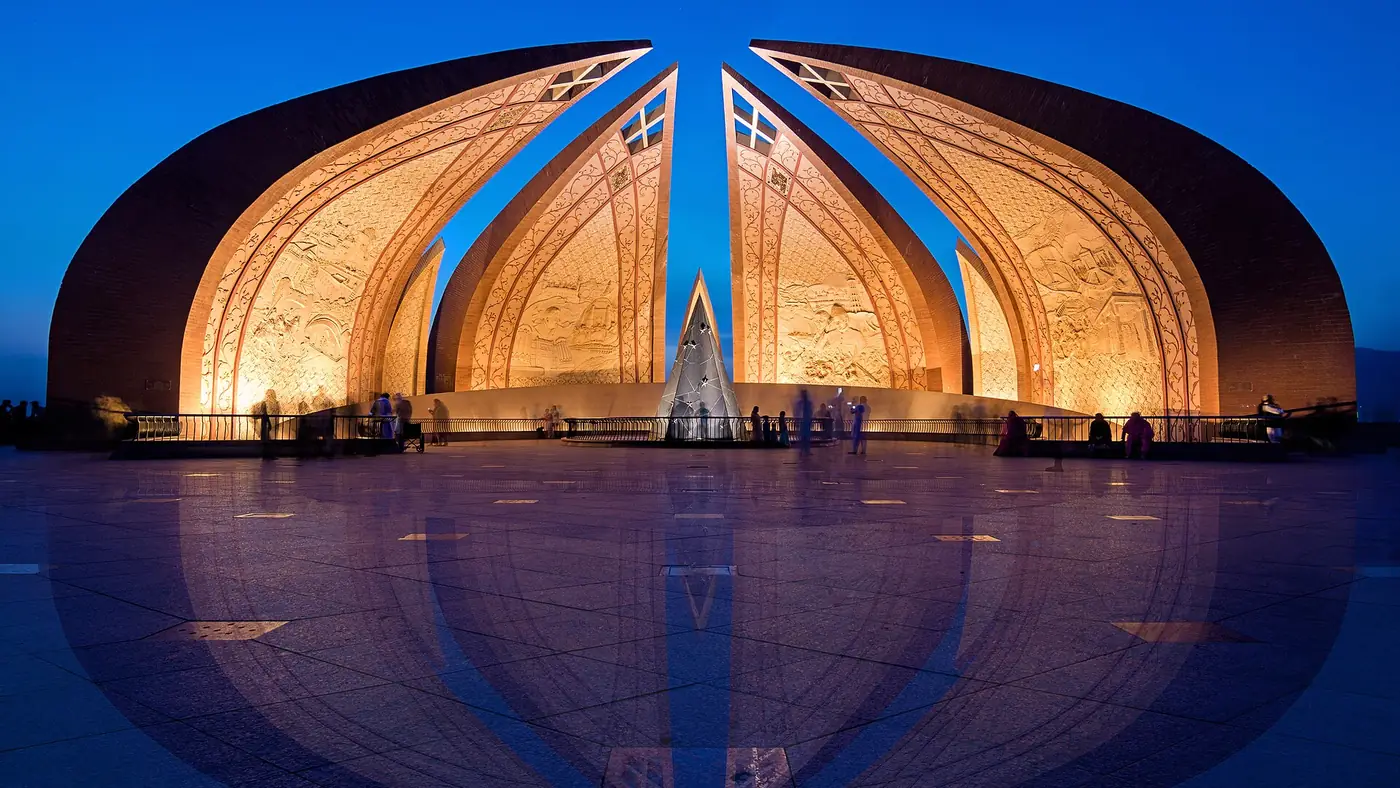
The Pakistan Monument stands on the western hill of Shakarparian in south-east Islamabad, shaped like an opening flower, and it is one of the capital's most recognisable landmarks. The monument itself is free to walk around at any time; the museum beside it, run by Lok Virsa, opens Tuesday to Sunday from 10 am to 8 pm and charges PKR 200 for local adults and PKR 100 for students, with children under seven free (2026). Go late in the afternoon to see both the museum and the monument lit up after dark.
This guide covers the design and history of the monument, the museum's galleries, current ticket prices and timings, and how to combine the visit with Lok Virsa next door.
| At a glance | |
|---|---|
| Where | Western hill of Shakarparian, south-east Islamabad |
| Monument entry | Free |
| Museum hours | Tuesday to Sunday, 10 am to 8 pm; closed Mondays |
| Museum tickets (2026) | PKR 200 local adults, PKR 100 students, free under 7 |
| Foreign nationals (2026) | PKR 2,000; SAARC/ECO delegates PKR 600 |
| Best time | Late afternoon, staying for the night lighting |
| Time needed | 1.5 to 2 hours |
What the monument represents
The Pakistan Monument was inaugurated in 2007, designed by the architect Arif Masoud, and built as a national symbol rather than a memorial to a single event. Its four large petals represent the peoples of Punjab, Sindh, Khyber Pakhtunkhwa and Balochistan, and three smaller petals stand for Gilgit-Baltistan, Azad Kashmir and the country's federally administered areas at the time it was built. Together they form the shape of an opening flower, standing on the highest point of the western Shakarparian hill with views across both Islamabad and Rawalpindi.
Around the base, murals and engravings reference the independence movement and figures from Pakistan's history, and the platform itself is one of the more popular photo spots in the capital, particularly around sunset.
The museum
Beside the monument, the Pakistan Monument Museum, run by the Lok Virsa organisation, tells the story of the independence movement and the country's early years through galleries that mix documents, artefacts and a wax museum of key historical figures, with sections devoted to Muhammad Ali Jinnah and Allama Iqbal among others. It is a more focused, chronological museum than the folk-heritage galleries of Lok Virsa's Heritage Museum on the same hilltop, and suits visitors who want the historical and political story of Pakistan's founding rather than its regional cultures.
Tickets and timings
The museum keeps published hours of Tuesday to Sunday, 10 am to 8 pm, and is closed on Mondays. According to Lok Virsa's own current pricing, tickets are:
- PKR 200 for local adults
- PKR 100 for students
- Free for children under seven
- PKR 2,000 for foreign nationals
- PKR 600 for SAARC and ECO country delegates
Prices and hours are set by Lok Virsa and can change; check the Lok Virsa website for the current figures before you go, particularly around holidays when timings sometimes shift.
The monument's outdoor platform itself has no separate entry fee and no fixed closing time in the way the museum does, so you can walk up to it and enjoy the view even outside museum hours, though the galleries themselves are only open in that window.
The night lighting
The Pakistan Monument is lit at night, and this is one of the best reasons to time a visit for late afternoon rather than the middle of the day: see the museum and the historical galleries first, then stay on the platform as the light goes and the monument and the city below it light up together. It is a popular spot for this at weekends, so expect company if you go on a Friday or Saturday evening.
Combining it with Lok Virsa and Shakarparian
The Pakistan Monument sits within Shakarparian, the wider hilltop park, a short walk from the separate Lok Virsa Heritage Museum, Pakistan's national museum of folk heritage, and close to the Pakistan Museum of Natural History. Together they make a natural half-day: the monument museum for the political history, Lok Virsa for the country's regional cultures, and a walk on the open hillside for the view. Our Lok Virsa guide covers that museum's galleries and timings in full, and our guide to Shakarparian covers the wider park's walking paths and quieter viewpoints.
Getting there
The monument sits on Garden Avenue in Shakarparian, close to the Zero Point interchange in south-east Islamabad, an easy drive or ride-hailing trip from most of the city. There is parking near the museum entrance, though it gets busier on weekend evenings when the crowds for the night lighting build up. Public buses stop near the Zero Point interchange, from where it is a short walk up into the park.
Photography at the monument
The petal structure and the platform beneath it are popular with photographers, and there is no restriction on ordinary photography for personal use around the monument grounds. The best angles are from the lower approach looking up at the petals against the sky, and from the platform itself looking out over the city at dusk, once the lights are on. If you are planning anything beyond casual photography, such as a formal shoot or filming with extra equipment, check current rules with the museum staff on the day, since larger productions typically need separate permission.
Who it suits
The Pakistan Monument suits anyone spending a day in Islamabad who wants a landmark with real symbolic weight rather than just a photo stop, and it works well for families, since the museum's wax figures and dioramas hold children's attention better than a purely academic display would. It is an easy, worthwhile hour and a half whatever else is on your itinerary.
It suits history-focused visitors less well if they are hoping for deep archival detail; the museum is broad and accessible rather than exhaustive, and serious researchers may find it thin. For a wider look at the country's regional cultures rather than its political history, Lok Virsa next door goes further. For the rest of the capital, our guide to places to visit in Islamabad covers where else to fit into a two-day visit, and if Islamabad is part of a longer trip north, tell us your dates.
Frequently asked questions
What is the entry fee for the Pakistan Monument Museum?
PKR 200 for local adults and PKR 100 for students, with children under seven free (2026). Foreign nationals pay PKR 2,000, and SAARC or ECO delegates pay PKR 600. The monument's outdoor platform itself is free.
What are the timings of the Pakistan Monument Museum?
Tuesday to Sunday, 10 am to 8 pm. It is closed on Mondays.
Is the Pakistan Monument free to visit?
The outdoor monument and platform are free at any time. Only the museum beside it charges an entry fee.
What do the petals of the Pakistan Monument represent?
The four large petals represent the peoples of Punjab, Sindh, Khyber Pakhtunkhwa and Balochistan, and the three smaller petals represent Gilgit-Baltistan, Azad Kashmir and the federally administered areas.
Is the Pakistan Monument lit up at night?
Yes, and the evening, staying on after the museum closes to see it lit against the city, is one of the best times to visit.
How long should I plan to spend at the Pakistan Monument?
About an hour and a half to two hours for the museum and a walk around the platform. Combine it with Lok Virsa next door for a half-day on Shakarparian.