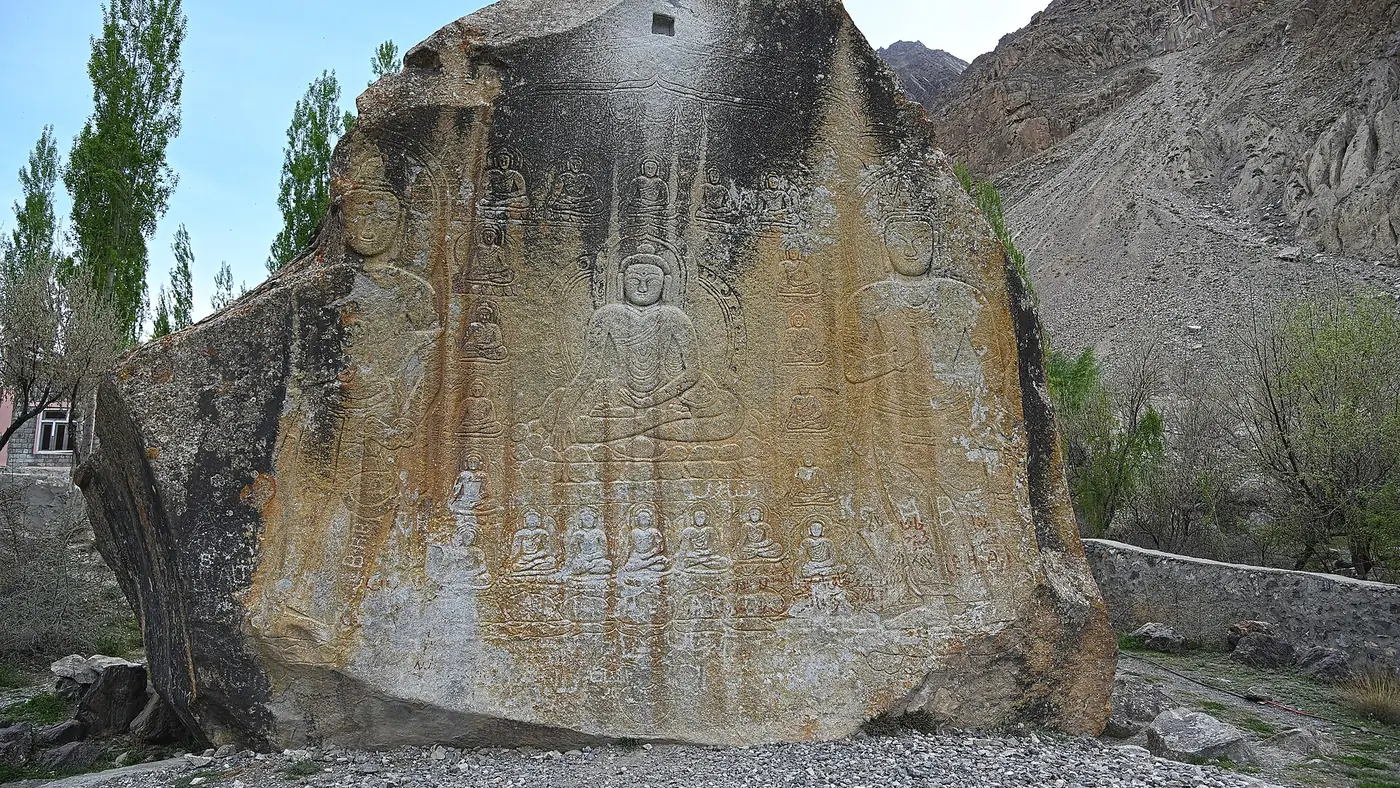
The Manthal Buddha Rock is a large granite boulder in Manthal village, a few kilometres south of Skardu bazaar on the road to Satpara Lake. Carved into one face is a seated Buddha surrounded by about twenty smaller Buddhas, with a standing figure on either side. It probably dates from the eighth century, when Baltistan was Buddhist, and it is the most complete reminder of that period close to Skardu. A visit takes half an hour, and it fits easily on the way to Satpara Lake or Deosai.
This guide explains what the carving shows, the history behind it, how to find it, and how to make the short visit worth the stop.
| At a glance | |
|---|---|
| Where | Manthal village, off the Satpara road south of Skardu |
| From the bazaar | A few kilometres; a short drive |
| Date | Probably eighth century |
| The carving | A seated Buddha, about 20 small Buddhas, two standing bodhisattvas |
| Inscriptions | Tibetan-script lines at the base |
| Time needed | 30 minutes to an hour |
| Best light | Morning |
| Entry | A small fee is sometimes collected; carry small notes |
| On the way to | Satpara Lake and Deosai |
What does the carving show?
The central figure is the Buddha, seated with his legs crossed and his right hand reaching down to touch the ground. This is the bhumisparsha gesture, "calling the earth to witness", which recalls the moment of his enlightenment.
Around him, in rows, sit about twenty much smaller Buddhas. Most descriptions give twenty; the Gilgit-Baltistan tourism department counts twenty-one. They are usually read as the Buddhas of past ages.
On either side stands a taller figure, identified as Maitreya, the Buddha who is to come. The tourism department describes them as the Buddha's two vicegerents.
At the base of the rock are lines of inscription in Tibetan script. The German scholar A. H. Francke studied the inscriptions of this region in the early twentieth century. Their date is debated: one account dates them to around 1000 CE, while a UNESCO adviser quoted by Dawn suggested some could be far older.
Walk around the boulder and the stones nearby. There are further, fainter carvings, which are easy to miss if you only photograph the main face.
A little history: Buddhist Baltistan
Long before Islam reached the valley, Baltistan was part of the Buddhist world that stretched from Kashmir to Ladakh and Tibet. The eighth to tenth centuries have been called a golden age for Buddhism in the upper Indus basin, and the Manthal carving belongs to that time. According to a Dawn report, the rock remained a place of worship into the thirteenth century.
Islam arrived in Baltistan in the fourteenth century. The oldest mosques in the region, the Amburiq mosque in Shigar and the Chaqchan mosque in Khaplu, date from that period. The Buddha at Manthal stayed where it was, and people in the village have lived beside it ever since.
The carving drew wider attention in 1906, when the Scottish traveller Ella Christie described it in an account of her journey. In recent decades, local writers have repeatedly called for national heritage status and stronger protection, most recently in a Pamir Times article in August 2026 warning about the risk that development poses to Baltistan's ancient rock art.
If you are also travelling through Gilgit, the standing Buddha carved into a cliff face at Kargah, usually dated to around the seventh century, is the best-known Buddhist carving around Gilgit. Our Kargah Buddha guide covers it.
How to get there
- Take the Satpara road south out of Skardu, the same road that climbs on to Satpara Lake and Deosai.
- Turn off for Manthal village after a few kilometres. Taxi drivers and hotel staff in Skardu know the site as the Buddha rock, so ask if you are unsure.
- Walk the last stretch from where the car stops. It is short and easy, although if you walk all the way from town there is a steady uphill section.
The road is paved and any car will do. You can walk from the bazaar, but it is mostly uphill on a busy road, so most people use a car or taxi and combine the rock with Satpara.
What to expect on a visit
The rock stands within the village rather than in a separate park, so a visit feels quite informal.
- Entry. A small fee is sometimes collected at the site, and reports of the amount vary. Carry small notes.
- Time. Twenty minutes is enough to look properly. Allow up to an hour if you want to study the inscriptions or photograph the carving in different light.
- Light. The relief is shallow, and it shows best in the angled light of the morning. At midday it can look flat in photographs.
- Respect the carving. Don't touch it, climb it, or wet or chalk it to make the figures stand out. Oil and chalk damage the stone.
- Respect the village. People live around the site. Keep noise down and ask before photographing anyone.
Combining it with Satpara, Deosai and the fort
The rock makes most sense as part of a half-day or a longer trip south of town:
- With Satpara Lake. The lake, at about 2,600 metres and fed by snowmelt from Deosai, is further up the same road. The two together make a gentle first afternoon after flying in, which is how our two-day Skardu plan uses them.
- On a Deosai day. From June to October, jeeps to the plateau use the same road. The rock takes ten minutes on the way up in the morning light, or on the way back if the day has gone well. Our guide to the Skardu to Deosai drive covers the route.
- A history morning in town. Pair it with Kharpocho Fort, the hilltop fort above the bazaar, for Skardu's Buddhist and royal past in one outing.
Is it worth the stop?
Yes, as a stop rather than a destination. It is quick, close to town and on the way to places you are going anyway, and there is nothing else like it around Skardu. The carving is small compared with the photographs you may have seen, and a visit rarely lasts more than half an hour.
It suits anyone interested in history or art, photographers who can come in the morning, and families on their way to Satpara.
It suits less people hoping for a large monument or a site with a museum. If you have only one short day in Skardu, the Kachura lakes or Shigar Fort will give you more. On the Skardu destination page you can see how it fits with the rest of the valley.
Frequently asked questions
How old is the Manthal Buddha Rock?
The carving probably dates from the eighth century, during Baltistan's Buddhist period. The inscriptions at the base are harder to date, and scholars disagree about them.
Where is the Manthal Buddha Rock?
In Manthal village, a few kilometres south of Skardu bazaar, just off the road that leads to Satpara Lake and Deosai.
Is there an entry fee for the Manthal Buddha Rock?
A small fee is sometimes collected at the site, but reports of the amount vary. Carry some small notes.
How long does a visit take?
About 30 minutes, including the short walk from the car. Allow up to an hour if you want to look closely at the inscriptions.
What does the Manthal carving show?
A seated Buddha touching the earth with his right hand, about twenty smaller seated Buddhas around him, and two standing figures, identified as Maitreya, on either side.
Is the Manthal Buddha the same as the Kargah Buddha?
No. The Kargah Buddha is a standing figure carved into a cliff near Gilgit. Manthal is a boulder near Skardu with a seated Buddha and many smaller figures.