Kharpocho Fort is the ruined fortress on the bare rock that rises straight out of Skardu town, above the Indus. The climb starts in the bazaar and is short but steep: 20 minutes for a fit walker, 45 or more at an easy pace. The reward is the widest view of the Skardu valley you can reach on foot from town. Go early in the morning or in the two hours before sunset, wear shoes with grip, and allow about two hours for the round trip.
The walls are only part of the story. Below the fort stood Mindoq Khar, the palace of a Ladakhi queen, and Skardu still tells her legend. This guide covers the history, the legend, the climb step by step, and whether it suits your group.
| At a glance | |
|---|---|
| Where | On the rock above Skardu bazaar and the Indus |
| Built | Credited to Ali Sher Khan Anchan; the date is disputed |
| Destroyed | 1840, by the Dogra army of Zorawar Singh |
| The climb | 20 to 45 minutes up, steep and rocky |
| Round trip | About 2 hours, with time at the top |
| Best time | Early morning, or the two hours before sunset |
| Wear | Shoes with grip, a hat and sunscreen |
| Entry | A small ticket may be charged; carry some cash |
A short history of the "king of forts"
Kharpocho means "king of forts" in Balti, and for more than two centuries it was the seat of the Maqpon rulers of Baltistan. It is credited to Ali Sher Khan Anchan, the most celebrated of them, whose armies reached as far as Ladakh. The date is argued over. The Gilgit-Baltistan tourism department puts the fort's construction at 1490 to 1505, while most historical accounts place Ali Sher Khan's reign around the turn of the seventeenth century.
The fort's military life ended in 1840. That year the Dogra general Zorawar Singh invaded Baltistan, stormed Kharpocho and razed it, then built a new fort on the level ground nearby. A century later Skardu was besieged again during the war of 1947–48: the garrison of the Jammu and Kashmir State Forces surrendered on 14 August 1948, and Baltistan became part of what is now Gilgit-Baltistan.
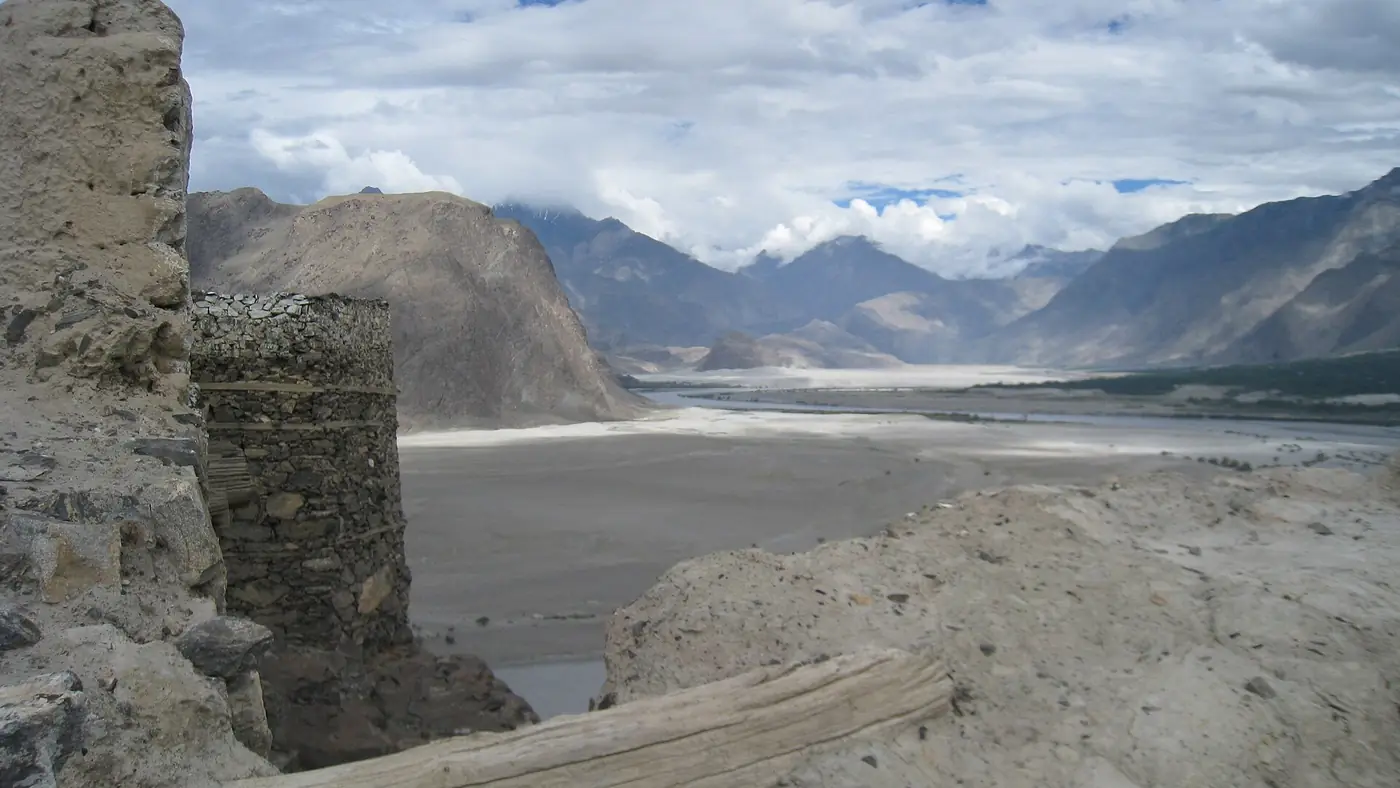
What you find today is a partly ruined fort: stretches of wall, gateways, and a small old mosque inside the complex. It is not a restored museum like the palaces at Shigar or Khaplu. Come for the place and the view rather than for exhibits. Our overview of forts in Gilgit-Baltistan sets Kharpocho beside the restored ones.
The legend of Mindoq Khar
Mindoq Khar, the "flower palace", stood below the fort, and its story is the one people in Skardu like to tell.
Mindoq Gyalmo, the "flower queen", was a Ladakhi princess, the daughter of the ruler Jamyang Namgyal. According to the chronicles, Ali Sher Khan Anchan captured Leh and gave the throne back to her father on marrying her, sealing the peace between Baltistan and Ladakh. She came to Skardu as his queen.
While her husband was away campaigning towards Gilgit, the story goes, she built her own palace at the foot of the rock, surrounded by gardens. To water them, she had a channel built to bring water down from Satpara, and she laid out a garden with marble pavilions that Balti songs still remember as Halo Bagh. The Satpara stream is still Skardu's main source of water today. Folklore also credits her with bringing the surnai and dhol to Baltistan.
The palace did not survive the Dogra invasion. Only remains are left below the fort, but the legend is the best company you can take up the hill: from the top you can see the whole valley her channel was meant to turn green.
How to climb Kharpocho
The climb is simple to follow and short, but it is steep throughout, on rock and loose gravel.
- Start in the main bazaar. The usual way up leaves the middle of the bazaar along a lane heading straight for the rock. Travel writers have described it as the alley beside the Bank Alfalah branch; if in doubt, ask any shopkeeper for the path to the qila.
- Walk through the houses to the foot of the rock, where the path begins to climb.
- Take the switchbacks slowly. The path zigzags up the face of the hill. Fit walkers reach the top in 15 to 20 minutes from the foot of the rock; at a gentler pace, with stops, allow 30 to 45 minutes.
- At the top, walk with care. There are loose stones, broken walls and unguarded drops. Keep children close and don't climb on the walls for photographs.
- Come down slowly. Loose gravel makes the descent harder on the knees than the climb, and it takes almost as long. Start down at least an hour before sunset.
There may be a small entry ticket for visitors; carry some cash in small notes. Take water, because there is little shade on the rock and nothing to buy at the top.
What you see from the top
The view is the reason to climb. Below you the Indus spreads across its sandbanks in wide channels, with Skardu's bazaar and fields on one side and bare mountains on every horizon. Across the river to the north lies the mouth of the Shigar valley, where the Shigar river comes down to join the Indus.
Morning brings still air, soft light and cool temperatures, the best combination for families. Late afternoon is better for photographs, when the low sun picks out the ridges and the river shines. On a hazy midsummer afternoon the far mountains fade, so a clear day after rain is the time to go if you can choose.
When to go
- April to June and September to October are the most comfortable months, with milder days and clear light.
- July and August are hot on the valley floor. Climb before 9 am or after 5 pm.
- November to March is cold, and the path can be icy after snow or a frosty night. Only go with proper boots, and turn back if the path is slick.
If you have just flown in, leave the climb for your second day. Skardu is at about 2,200 metres, and a steep climb on the first afternoon leaves many people breathless. Our guide to altitude in Gilgit-Baltistan explains why.
Fitting it into a day in Skardu
Kharpocho is in town, so it slots into almost any day:
- An easy afternoon in town: Kharpocho, then Nangsoq, the organic village behind the hill, and dinner in the bazaar.
- A history morning: the fort early, then the Manthal Buddha Rock a few kilometres south, with Satpara Lake beyond it.
- A sunset climb at the end of a day at Shigar or Kachura, if you are staying in town and still have the legs for it.
For a proper day's hike rather than a short climb, Marsur Rock above Hussainabad is the next step up. For everything else in the valley, see the Skardu destination page.
Is the climb worth it?
For most people who can manage a steep path, yes. It costs an hour or two, it is right in town, and no other short walk gives you the whole valley at once. Just set expectations: the ruins are modest, and the fort is not restored.
It suits fit families with older children, couples, photographers and anyone with an interest in history, particularly with the Mindoq Khar story in mind.
It suits less people with bad knees, anyone who struggles on loose ground, and families with toddlers who would need carrying. For them, the restored fort at Shigar, an hour away, shows far more of Baltistan's royal history with much less climbing, and a drive up the Chunda valley above town gives a view over Skardu without the walk.
Frequently asked questions
How long does it take to climb Kharpocho Fort?
Fit walkers reach the top in 15 to 20 minutes from the foot of the rock, and most people take 30 to 45 minutes. Allow about two hours for the round trip from the bazaar.
Who built Kharpocho Fort?
It is credited to Ali Sher Khan Anchan of the Maqpon dynasty. The date is disputed: the Gilgit-Baltistan tourism department gives 1490 to 1505, while other accounts place it around 1600.
What is Mindoq Khar?
Mindoq Khar, the "flower palace", was the palace of Mindoq Gyalmo, the Ladakhi queen of Ali Sher Khan Anchan, below Kharpocho. Legend says she brought water from Satpara to its gardens. Only remains survive.
Is there an entry fee for Kharpocho Fort?
A small ticket may be charged to visitors. The amount is not fixed in any official source, so carry some cash in small notes.
Can children climb Kharpocho Fort?
Older children who walk well usually manage it. The path is steep and loose and the top has unguarded drops, so keep them close, and think twice with toddlers.
Can you visit Kharpocho Fort in winter?
Yes, but the path can be icy after snow or frost. Go only with boots that grip, in the middle of the day, and turn back if it is slippery.