
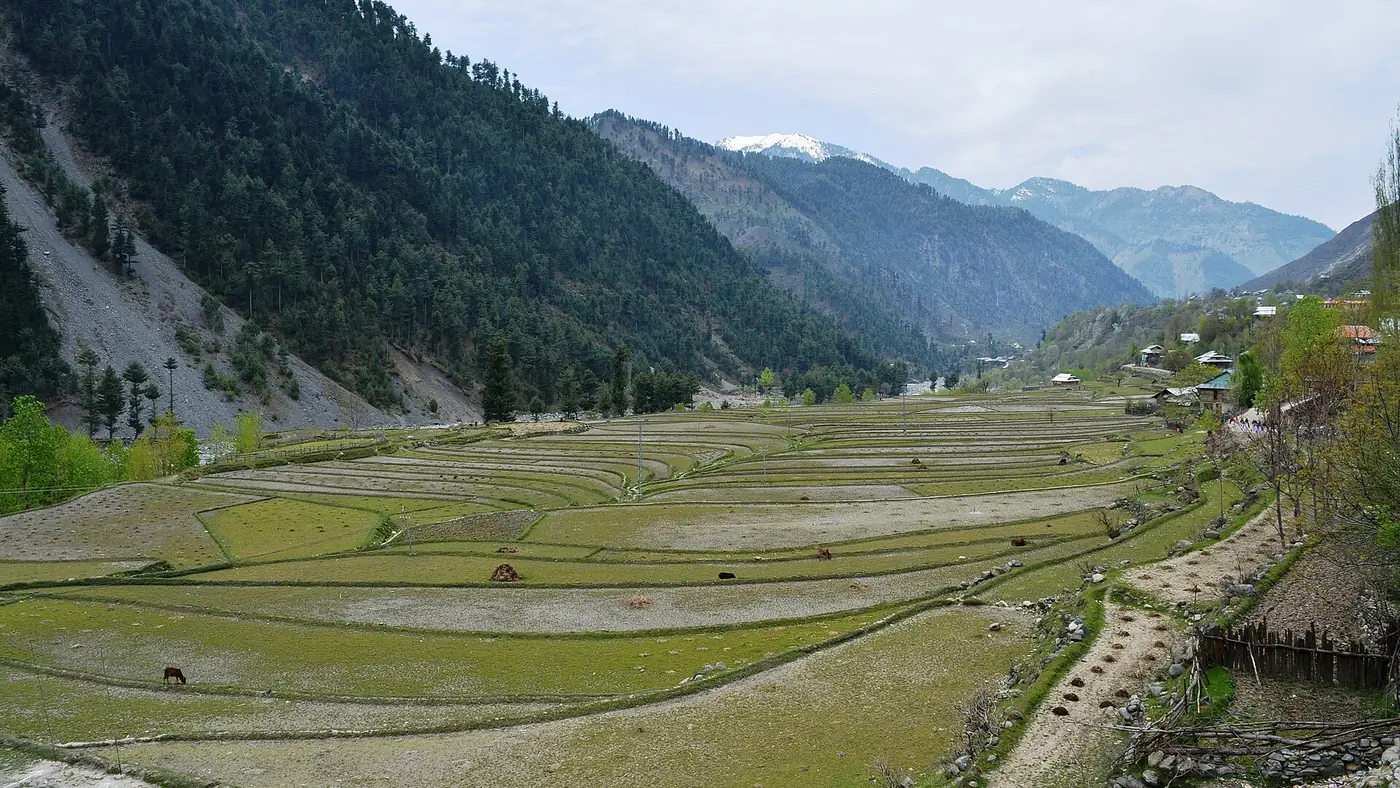

Leepa Valley's red rice is a local variety grown on the valley's terraced fields and considered distinctive enough that people travel to buy it after the autumn harvest. It is planted in early summer, harvested by hand in October, and is the valley's staple food as well as its best-known farm product.
This guide covers how the rice is grown and processed, when it is ready, and what to expect if you want to taste or bring some home.
What makes it "red rice"
The rice grown in Leepa is a red-husked local variety rather than the polished white rice sold in most of Pakistan. Growers and local accounts attribute its colour and character to the valley's water, which comes straight off the surrounding mountains and is unusually mineral-rich, and it is valued locally both as an everyday staple and, increasingly, as something worth carrying home after a visit. It is grown on terraced fields that step down the hillsides through Leepa's sectors, wherever the valley floor is flat enough to flood and plant.
How it is grown
The rice is planted in late spring, once the terraces can be flooded from the streams that come down off the surrounding slopes. It grows through the summer, with the fields visibly green by July and August, then ripens and is harvested in October. Because most fields are small and worked by hand rather than machine, the whole cycle, from flooding a terrace to bringing in the crop, still looks much as it has for generations.
How it is harvested
Harvesting is done by hand. Farmers cut the ripe stalks, then thresh them using a traditional method: bundles are beaten against long sticks, with a temporarily dug channel used to separate the grain, rather than a mechanical thresher. It is slow work, spread across households and neighbours rather than concentrated into a single mechanised harvest, which is part of why the fields stay busy for weeks rather than being cleared in a few days.
If you want to see this in progress rather than just photograph gold terraces, October is the month, and mornings are generally when the work happens. Ask before photographing anyone in their own field; these are working farms, not a display for visitors.
When you can buy it
The rice is only really available to buy once the October harvest is in and processed, so a summer visit will show you the growing crop but not the grain itself. Visitors who want to take some home generally ask in Leepa village or at Nokot after the harvest, where households sell what they have beyond their own needs; there is no shop or export operation set up specifically for tourists, so expect an informal transaction in cash rather than packaged retail. Our guide to Leepa Valley in October covers the harvest season and the colour it brings to the valley in more detail.
Eating it locally
Where it is served in guesthouses and homes in the valley, red rice is cooked much like any other rice, alongside dal, vegetables and whatever meat or fish is available that day, rather than presented as a special dish for visitors. If you are staying in the valley during or just after the harvest, it is worth asking whether the rice on your plate is the local variety.
Is it worth planning a visit around?
If you specifically want to buy Leepa's red rice, plan for October, after the harvest, rather than summer, when the fields are still green and nothing is yet for sale. For most visitors, though, red rice is one part of a wider October visit built around the terraces, the walnut colour and the wooden houses, rather than a reason to travel on its own. Our Leepa Valley guide covers the sectors where the terraces are most visible, and the Kashmir destination guide has more on Azad Kashmir's food and produce generally.
Frequently asked questions
What is special about Leepa Valley's red rice?
It is a local, red-husked variety grown on the valley's terraced fields, valued as both a staple food and a product worth buying after harvest, with growers attributing its character to the valley's mineral-rich mountain water.
When is Leepa Valley's rice harvested?
In October, following planting in late spring and a growing season through the summer months.
Can visitors buy red rice in Leepa Valley?
Yes, informally, from households in Leepa village and other sectors once the October harvest is processed. There is no dedicated shop for it, so expect a cash transaction with a local seller rather than packaged retail.
Is Leepa Valley's rice harvested by machine?
No. It is cut and threshed by hand using traditional methods, including beating the stalks against sticks over a temporary channel to separate the grain.
Is red rice served in Leepa Valley's guesthouses?
Sometimes, particularly around and after the harvest, though it is cooked as an everyday dish rather than presented as something special. Ask if you would like to try it.