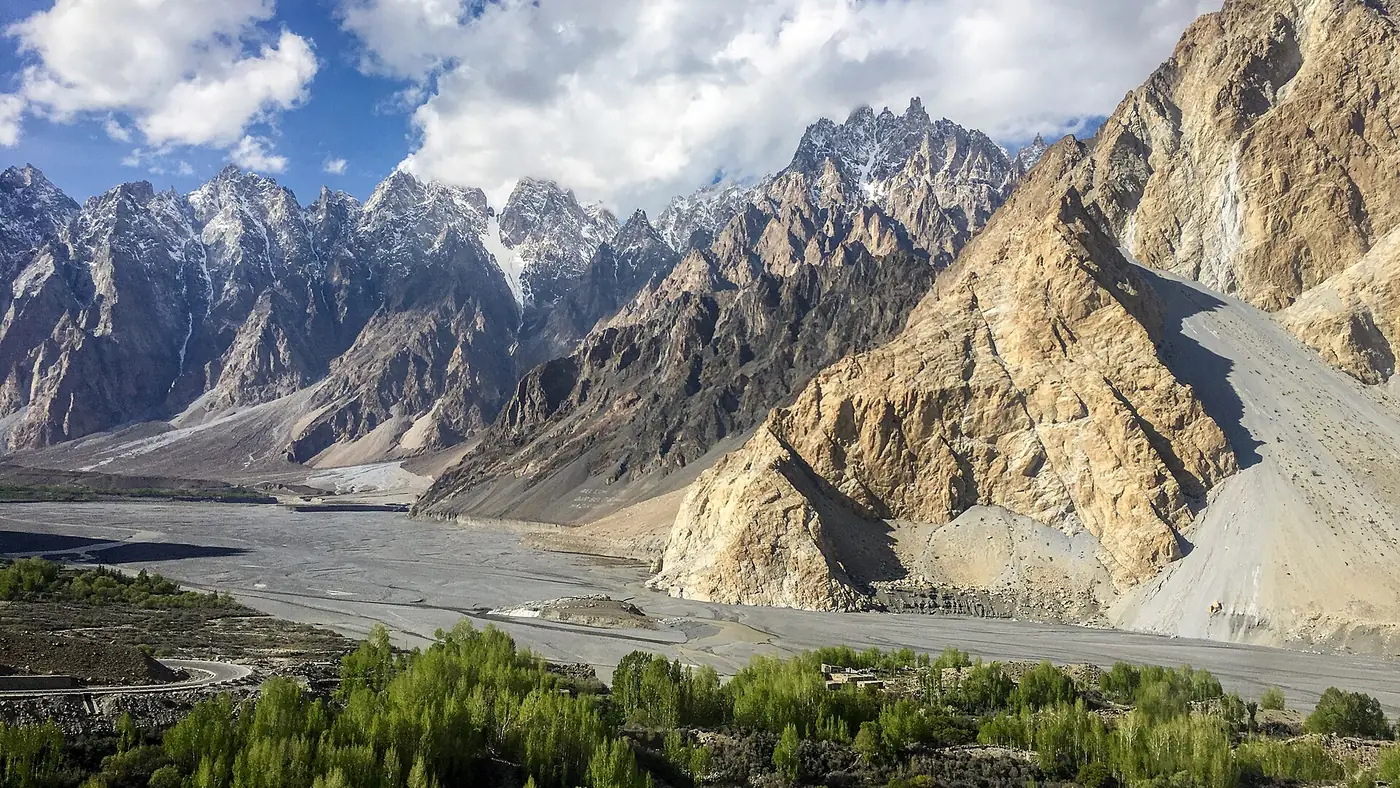
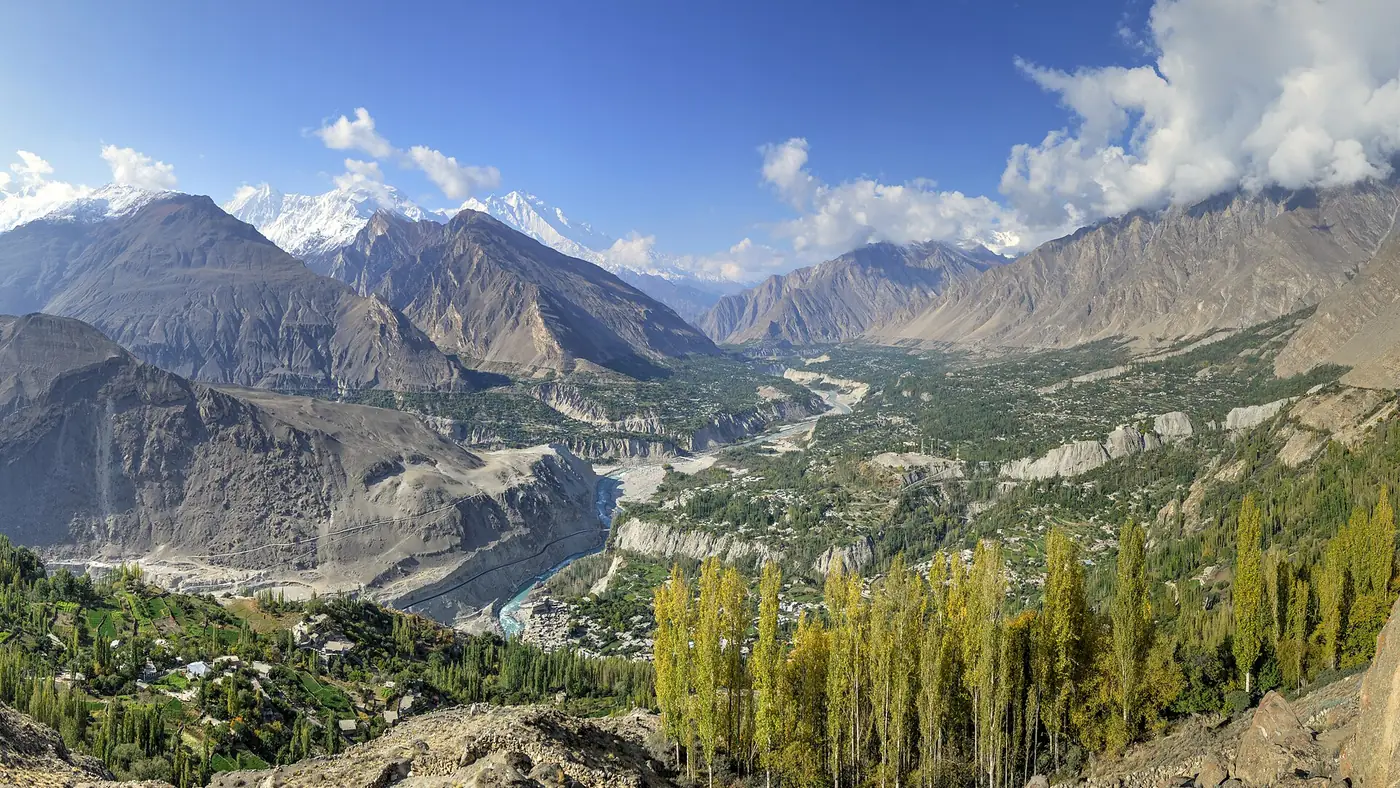
Islamabad to Hunza by road is roughly 650 to 700 km on the Karakoram Highway, through Besham, Chilas and Gilgit, and takes 14 to 16 hours of actual driving. Almost everyone splits it over two days, with a night in Chilas, and reaches Karimabad in the early afternoon of day two. From late May to autumn there is a second way to Chilas, over the Babusar Pass through Naran, which is more scenic but depends on the pass being open and the weather being dry.
This guide covers the whole journey to Hunza: how long each stage takes, where to spend the night so you arrive with daylight and energy to spare, the last leg from Gilgit into the valley, and what to do when a landslide closes the road, which on this journey is a question of when rather than if.
| At a glance | |
|---|---|
| Distance | Roughly 650 to 700 km to Karimabad |
| Driving time | 14 to 16 hours, plus stops |
| Usual plan | Two days, overnight in Chilas |
| Main route | Karakoram Highway via Besham, Dasu, Chilas, Gilgit |
| Summer alternative | Naran and the Babusar Pass (4,173 m) to Chilas |
| Hardest stretch | Besham to Chilas, through Kohistan |
| Worst months for closures | July and August |
| Help in Gilgit-Baltistan | Tourist Police, 1422 |
The route, stage by stage
Times are driving times in a car, in good conditions, with short stops. A day that looks like 10 hours on a map is often 12 in practice, once you add prayer, meals, fuel, photographs and police checks.
| Stage | Distance | Driving time |
|---|---|---|
| Islamabad to Besham, via the Hazara Motorway | About 250 km | 4 to 6 hours |
| Besham to Chilas, through Kohistan | About 200 km | 5 to 8 hours |
| Chilas to Gilgit | About 135 km | 2.5 to 3 hours |
| Gilgit to Karimabad | About 100 km | 2 to 3 hours |
The first three stages, as far as Gilgit, are the same for anyone driving north, and our Islamabad to Gilgit road guide covers them in detail: the motorway to Thakot, the Kohistan gorge, the construction hold-ups at Dasu and the checkposts. What follows here is what changes when Hunza, not Gilgit, is the destination.
The last leg: Gilgit into Hunza
From Gilgit the Karakoram Highway turns north and follows the Hunza river. The road on this stretch is wide, paved and well kept, and after Kohistan it feels easy.
- Leave Gilgit through Dainyor and head north up the Hunza river.
- The Nagar villages. For much of the way the highway runs through Nagar district, with terraced villages on the slopes above the river.
- The Rakaposhi viewpoint at Ghulmet, about 70 km from Gilgit. Rakaposhi rises almost straight up from the road. There are tea stalls and a car park; stop here in the afternoon light.
- Hasanabad and Aliabad. You enter central Hunza. Aliabad is the market town on the highway, with fuel, banks and ATMs.
- Up to Karimabad. A short, steep climb off the highway. The bazaar road is narrow and busy in the evening, so arrive in daylight and ask your hotel where to park.
If you are staying in Gulmit or Passu instead, carry on up the highway past Ganish, Attabad Lake and its tunnels. Add about 45 minutes to Gulmit and one to one and a half hours to Passu.
Where should you stop overnight?
The aim is simple: get the Kohistan stretch done in daylight on day one, and arrive in Hunza with enough of day two left to enjoy it.
Chilas does that best. It is roughly two-thirds of the way, it puts Kohistan behind you, and it leaves a five to six hour drive to Karimabad. Leave Chilas by 7 and you are in Hunza for a late lunch, with the afternoon for Altit or the Eagle's Nest viewpoint. The price is a long first day, 10 to 13 hours, with a very early start from Islamabad. Chilas sits at about 1,265 metres and is very hot in June and July, so ask for air conditioning.
Besham gives you a gentle first day of four to six hours, but leaves 11 to 13 hours for day two, all of Kohistan included, and you reach Hunza tired and close to dark. It works if you are leaving Islamabad after work.
Besham and then Chilas turns the journey into three shorter days: four to six hours to Besham, five to eight through Kohistan to Chilas, and five to six on to Karimabad. No day is much over eight hours of driving, and you arrive in Hunza rested. It suits families with small children, older parents and anyone new to mountain roads.
Naran is the stop on the Babusar route in summer. The first day through the Kaghan valley is short and pretty; the second, over the pass and on to Hunza, is long.
| Plan | Day 1 | Day 2 | Day 3 |
|---|---|---|---|
| Standard | Islamabad to Chilas, 10 to 13 h | Chilas to Karimabad, 5 to 6 h | |
| Late start | Islamabad to Besham, 4 to 6 h | Besham to Karimabad, 11 to 13 h | |
| Three days | Islamabad to Besham, 4 to 6 h | Besham to Chilas, 5 to 8 h | Chilas to Karimabad, 5 to 6 h |
| Summer | Islamabad to Naran, 6 to 8 h | Naran to Karimabad over Babusar, 9 to 11 h |
Should you take the Babusar route?
Between June and September, if the forecast is dry and everyone in the car is comfortable with a high pass, the road through Naran and over Babusar is the more enjoyable drive and avoids Kohistan entirely. It reopens in late May or early June, once the snow has been cleared, closes with the first heavy snow of autumn (in 2025, early November), and it is a daylight-only road.
Take the KKH instead when rain is forecast (a cloudburst below Babusar Top in July 2025 killed several tourists), in May or November when the pass may be shut, or if anyone in the group is likely to struggle at 4,173 metres. The two routes meet at Chilas, so from there to Hunza the drive is the same.
What happens if the road closes?
Landslides, rockfall and flash floods close the KKH several times a year, usually for hours and sometimes for days. In July 2025 monsoon debris flows blocked the highway in Kohistan and Gilgit-Baltistan and the authorities told travellers to postpone journeys. In July 2026 flash floods closed it again at several points in Diamer district near Chilas. Hunza itself is not immune: in December 2025 a rockfall at Chanas cut off road access to Hunza and Nagar for most of a day.
How to plan around it:
- Build in a spare day, especially for the return. We keep one on every northern trip, so a closure changes the plan rather than ruins it.
- Avoid July and August if your dates are fixed. The monsoon months carry the highest risk on the southern KKH and on Babusar.
- Check each morning before you set off. Ask your hotel and the police at the checkposts, and look at the latest advisories from the Gilgit-Baltistan tourism department.
- Know your alternatives. If the KKH is blocked in Kohistan in summer, the Babusar route may still be open, and the reverse after a cloudburst on the Kaghan side. If the road south of Gilgit is closed on your way home, the Gilgit flight is a fallback, weather permitting.
- If you are stuck, stay put. Machinery clears blockages from both ends, usually within hours. Don't cross debris on foot or follow local detours you don't know.
- Keep supplies in the car: water, snacks, warm layers and any medicines, because a queue at a landslide can last several hours with nothing nearby.
If the road closes while you are in Hunza, the practical choice is usually to stay an extra night rather than drive to Gilgit and wait there. Hotels in Karimabad are used to it.
Safety on the road
Two things matter more than anything else on this drive: daylight and a rested driver. The Kohistan and Diamer sections are narrow, unlit and full of trucks, and most accidents happen late in the day or after dark. Plan each day to finish by sunset.
Security also needs a sentence. In December 2023 gunmen attacked a passenger bus near Chilas, killing ten people, and travel on this part of the KKH has at times been subject to convoys or restrictions. Check current advice before you travel, carry your CNIC (and for foreign nationals, passport copies) for the checkposts, and follow what the police tell you.
For the car, a normal sedan in good order is fine. Get the brakes and tyres checked before you leave, fill up in each town, and expect long stretches without mobile signal between Besham and Chilas. Our travel guide has more on road travel across the north.
Is driving to Hunza worth it?
Driving gives you freedom once you are in Hunza, lets you stop wherever you like, and costs less than flying for a family or a group of four sharing a car. The road from Chilas onwards is some of the most spectacular driving in the country.
The downside is two long days each way, one of them through the least pleasant stretch of the trip. On a week's holiday, that is four days out of seven spent mostly in the car.
Driving makes sense if you have eight days or more, are travelling as a group, and have an experienced mountain driver. With five or six days, our five-day Hunza itinerary shows how to make the drive work, including flying one way. Our nine-day Gilgit, Hunza and Khunjerab tour starts in Gilgit, so you can fly in and skip the two days on the road, or drive up and hand over the driving from there.
Frequently asked questions
How many hours is Islamabad to Hunza by road?
About 14 to 16 hours of driving on the Karakoram Highway, more with stops and checkposts. Most people split it over two days with a night in Chilas.
Can I drive from Islamabad to Hunza in one day?
It is possible with a very early start and an experienced driver, but it means 15 hours or more on mountain roads and usually some driving after dark. We don't recommend it, especially for families.
Which is the best overnight stop between Islamabad and Hunza?
Chilas, because it puts the Kohistan stretch behind you on day one and leaves an easy five to six hours to Karimabad. In summer, Naran is the stop on the Babusar route.
How far is Gilgit from Hunza?
Karimabad is about 100 km from Gilgit, two to three hours on the Karakoram Highway, passing the Rakaposhi viewpoint at Ghulmet on the way.
Is the road from Islamabad to Hunza open in winter?
The Karakoram Highway is kept open all year, though snow and rockfall can close it for hours or days. The Babusar route is closed in winter, roughly from November to late May.
Can a normal car go from Islamabad to Hunza?
Yes. The whole route is paved and sedans drive it every day in summer. Make sure the brakes and tyres are in good order and carry a proper spare.