
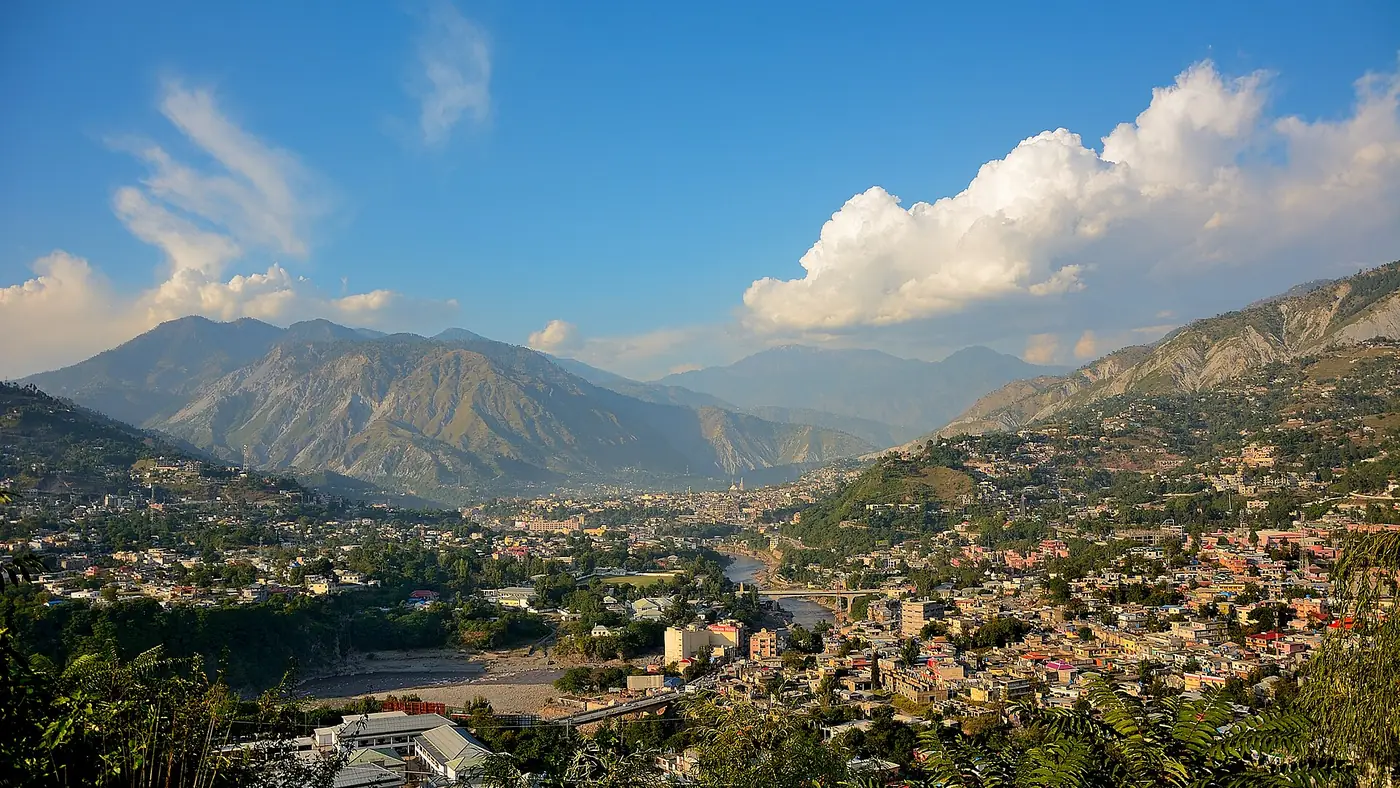

The best food in Muzaffarabad is Kashmiri: slow-cooked mutton dishes, salted pink noon chai, and flaky bakarkhani bread from the bakeries around Madina Market and Upper Adda. Add a few hotel restaurants running Kashmiri and Pakistani menus, simple kebab and karahi places downtown, and tea stalls on the Jhelum bank at Domel, and that covers most of what people in the city actually eat. This guide is about where in Muzaffarabad to find it, not a list of dishes you would only meet at a wedding.
For the wider picture of Kashmiri food across Azad Kashmir, including harissa season and Leepa's red rice harvest, see our guide to the region's traditional food. This post stays inside the city: which areas to head to, what is genuinely worth ordering, and where families tend to sit down.
| At a glance | |
|---|---|
| Best area for Kashmiri dishes | Madina Market and Upper Adda |
| Best area for a riverside meal or tea | Domel, on the right bank of the Jhelum |
| Established hotel restaurants | PC Hotel Muzaffarabad, Mir Continental Hotel |
| Salted tea | Noon chai, served across the bazaars |
| Trout | Not really a city dish; the nearest place is Patika, about 30 minutes up the Neelum road |
| Busiest hours to eat out | Late afternoon into the evening |
Where people in Muzaffarabad actually eat
Muzaffarabad does not have a single food district. It has a handful of areas that do different jobs, and locals move between them depending on what they want.
Domel, where the Neelum meets the Jhelum, is the city's natural meeting point, and a cluster of simple restaurants and tea stalls sit on the right bank of the Jhelum there. It is a pleasant spot for tea and a plate of something before dinner, with the rivers below and the evening light on the hills.
Madina Market and Upper Adda, the central bazaars, are where most everyday eating happens: bakeries, kebab shops, fast food counters and juice and ice cream stalls, all busiest from late afternoon into the evening once the day's heat has passed. This is also the part of the city to look for bakarkhani, kulcha and noon chai.
A short list of established hotel restaurants covers the more formal end: sit-down dining, air conditioning and menus that mix Kashmiri dishes with standard Pakistani and continental fare. PC Hotel Muzaffarabad, in Upper Chatter, runs three restaurants including one serving Kashmiri delicacies alongside international dishes. Mir Continental Hotel & Restaurant, near Bank Square by the Legislative Assembly in Chattar, is a long-established mid-range option with a similar mix of barbecue and local dishes. Both are useful if you want a proper sit-down meal rather than a bazaar stall.
If you are arriving after the drive from Islamabad, most people reach the city by mid-afternoon or early evening; our guide to getting from Islamabad to Muzaffarabad covers the route and timing, and either Domel or the bazaars make a sensible first stop before checking in.
Kashmiri dishes worth ordering
Muzaffarabad's Kashmiri-speaking families keep a food culture that is distinct from the rest of Azad Kashmir, and a few of its dishes are worth ordering if you see them on a menu.
Harissa, a mutton and rice dish cooked for hours into a thick paste and finished with fried onions, is a winter breakfast tradition, made in Kashmiri cafés in the older bazaar areas from around early December and often sold only at weekends until the pot runs out. Outside winter you will not find it.
Goshtaba and rista, pounded-mutton dishes in yoghurt or red gravy, are the centrepiece of the Kashmiri wazwan wedding feast. They are not everyday street food, but the hotel restaurants that run Kashmiri menus, including PC Hotel and Mir Continental, cook them to order; it is worth asking a day ahead if you want them for dinner.
Our traditional food of Azad Kashmir guide covers both dishes, and Leepa's red rice and Kashmiri weddings, in more depth.
Noon chai and the city's tea culture
Tea is a bigger part of eating out in Muzaffarabad than any single dish. Noon chai is the traditional Kashmiri version: green tea, milk, a pinch of baking soda that turns it pink, and salt. It is drunk through the day, more so in cold weather, and it surprises most first-time visitors from Lahore or Karachi, who expect the sweet, nut-topped "Kashmiri chai" served elsewhere in Pakistan under the same name.
Both versions are easy to find in the city. Bazaar tea stalls around Madina Market and Upper Adda serve noon chai with bakarkhani or kulcha, and it is a good, cheap way to try Kashmiri food without committing to a full meal. Domel, in the evening, is a comfortable place to sit with a cup before deciding on dinner.
What about trout?
Trout is closely associated with Azad Kashmir, but it is a Neelum valley fish, not really a Muzaffarabad city dish. The cold streams that suit it, and the farms and hatcheries that supply it, are upstream: at Patika, Kutton, Keran, Sharda and Kel, and around Kundal Shahi, roughly 74 km from the city.
The closest place most visitors actually find it is Patika, about 30 minutes up the Neelum road, where riverside restaurants grill or fry it fresh. If trout is the reason you are here, plan to eat it there or further up the valley rather than looking for it downtown. Fish is usually priced by weight, so agree the rate before it goes on the fire.
Travellers on our five-day Neelum Valley Escape, which runs through Muzaffarabad on both the way in and the way back, will pass Patika on the drive up and have a proper chance to try it there.
Kebabs, karahi and everyday food
Away from the Kashmiri specialities, Muzaffarabad eats much like any city in northern Pakistan: chicken karahi, seekh and chapli kebab, roti, rice and daal. A well-known chapli kebab shop in Upper Adda, near Hamam Wali Masjid, draws a steady queue of locals for its kebabs and fresh-off-the-griddle rotis, though seating is limited.
The bazaars also have the usual run of fast food counters, a few cafés doing continental-style menus, and ice cream and juice stalls that fill up on warm evenings. None of this is specific to Muzaffarabad, but it is what fills most menus on an ordinary day, and it is reliable if a group wants something quick and familiar.
Family-friendly notes
For a sit-down meal with children, the hotel restaurants are the easier choice: proper seating, air conditioning, working washrooms and menus with familiar options alongside the Kashmiri dishes. The bazaar stalls and kebab shops are better suited to a quick bite than a long family dinner, since seating is often limited to a few benches or plastic chairs.
Jalalabad Garden, a public park on Jalalabad Stadium Road, is a reasonable place to let children run around before or after eating in the city; our guide to places to visit in Muzaffarabad has more on it and the rest of the city's sights.
Is it worth planning meals around?
Mostly, no. Muzaffarabad is a stopover on the way to or from the Neelum Valley for most travellers, and an hour or two in the bazaars, or a sit-down dinner at one of the hotel restaurants, covers what the city has to offer. Noon chai and bakarkhani are worth seeking out because they are quick, cheap and genuinely local; harissa is worth planning around only if you are in the city in winter.
Trout and the full Kashmiri wazwan are the two things not really worth chasing inside the city itself. Save the trout for Patika or further up the Neelum, and save goshtaba and rista for a hotel restaurant that will cook it to order, or for a wedding if you are lucky enough to be invited to one.
For more on the wider Kashmir region and its valleys, see our Kashmir destination page.
Frequently asked questions
What is the most famous food in Muzaffarabad?
Noon chai, the salted pink Kashmiri tea, and harissa, a winter mutton and rice dish, are the two most distinctive. Goshtaba and rista, from the Kashmiri wazwan, are the best-known special-occasion dishes.
Can I eat trout in Muzaffarabad city?
Not reliably. Trout comes from farms and streams in the Neelum valley upstream of the city. The nearest place most visitors find it is Patika, about 30 minutes up the Neelum road.
Where do locals eat in Muzaffarabad?
Mostly around Madina Market and Upper Adda for everyday food, kebabs and tea, and at Domel for tea and a riverside meal. Hotel restaurants such as PC Hotel Muzaffarabad and Mir Continental cover more formal sit-down dining.
Is noon chai the same as Kashmiri chai sold elsewhere in Pakistan?
No. Noon chai, as served in Muzaffarabad, is traditionally salted. The sweet, pistachio-topped tea sold as "Kashmiri chai" in the rest of Pakistan is a different, sweetened version of the same pink tea.
When can I get harissa in Muzaffarabad?
Only in winter, roughly December to February, at Kashmiri cafés in the older bazaar areas, usually in the morning and often only at weekends until the pot is sold out.
Is Muzaffarabad worth a stop just for the food?
Not on its own. It is worth combining with the Red Fort, Domel and Pir Chinasi, or with a Neelum Valley trip, rather than visiting purely to eat.