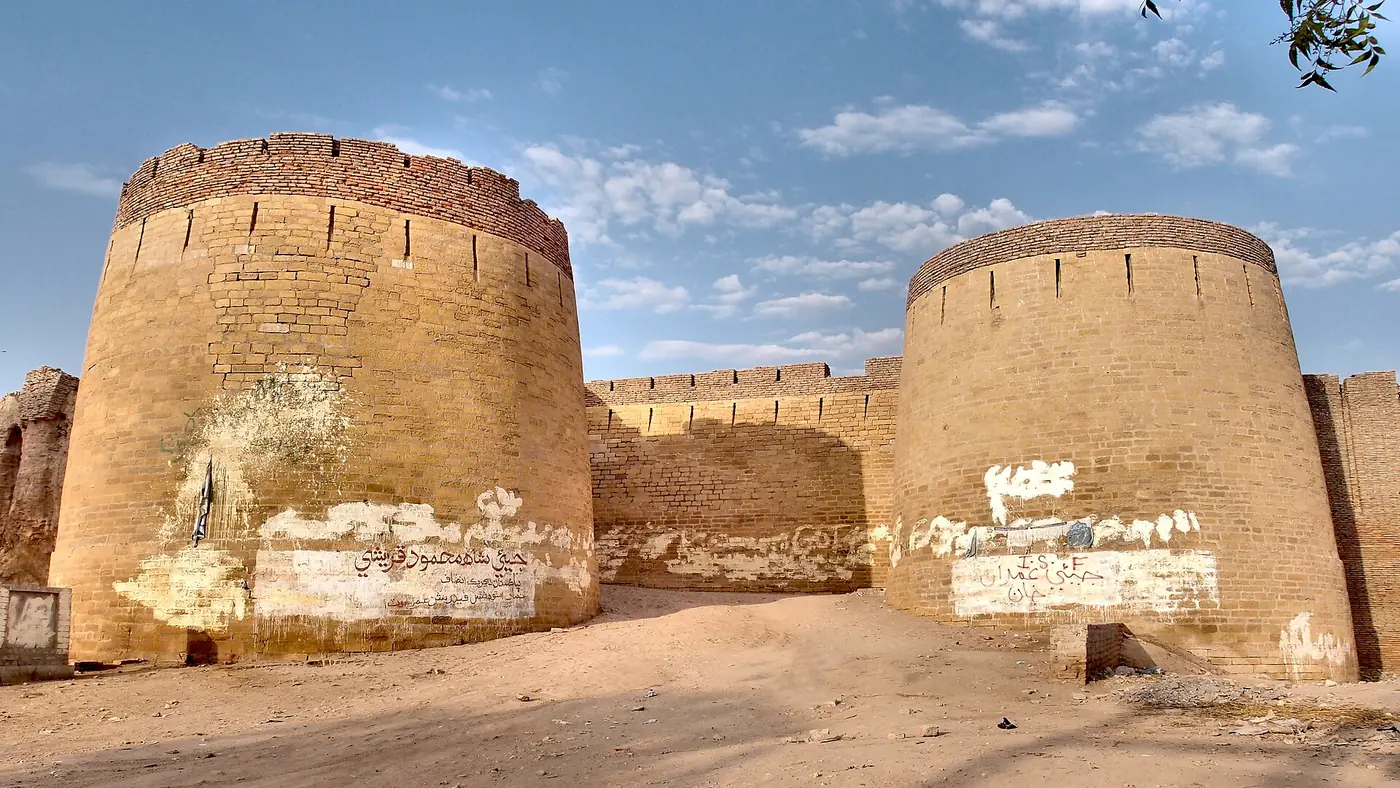
Umerkot Fort is an 11th-century fortification in the Sindh town of Umerkot, built by the Sodha Rajput ruler Rana Amar Singh, and best known as the place where the Mughal emperor Akbar was born in 1542. It now houses a small archaeological museum and is a protected government monument, making it one of the more accessible historical sites on a Tharparkar trip.
This guide covers the fort's history, the museum inside it, the separate monument marking Akbar's birthplace, and how to fit it into a visit to the district.
| At a glance | |
|---|---|
| Built | 11th century, by Rana Amar Singh of the Sodha Rajput dynasty |
| Known for | Birthplace of the Mughal emperor Akbar, 15 October 1542 |
| Inside | A small archaeological museum with Mughal-era coins, weapons and manuscripts |
| Status | Protected government monument, open to the public |
| From Mithi | About 110 km, 2 to 2.5 hours |
| From Karachi | Roughly 300 km via Hyderabad and Mirpurkhas |
The history of the fort
Umerkot Fort was built in the 11th century by Rana Amar Singh, and the town remained the seat of the Sodha Rajput rulers, known as the Ranas of Umerkot, for centuries afterwards, right up to Pakistan's formation. The fort is built in Rajput architectural style, distinct from the Mughal and Talpur-era forts found elsewhere in Sindh, and reflects Umerkot's history as a Rajput stronghold on the edge of the Thar Desert rather than a Sindhi one.
The Sodha family's descendants still hold a jagir, a landed estate, a short distance from the fort, a rare living link to the dynasty that built it.
Akbar's birthplace
The fort's best-known claim to history is that it sheltered the Mughal emperor Humayun when he was in exile after military defeats to Sher Shah Suri. Rana Prasad Singh Sodha gave Humayun refuge at Umerkot, and it was there, on 15 October 1542, that Humayun's wife Hamida Banu Begum gave birth to the future emperor Akbar.
The actual birthplace site is a separate, smaller monument near the fort rather than inside the fort walls themselves. It is a modest structure built of pink Jodhpur-style brick, with four arched openings, constructed considerably later, in 1746, by the Mughal governor Noor Mohammad Kalhoro, to mark the spot. Visitors sometimes expect a grand Mughal building; what is actually there is a small commemorative structure, worth seeing for the history it marks rather than its scale.
The museum inside the fort
Umerkot Fort houses an archaeological museum, first opened in 1968 and moved into a larger, purpose-built gallery space in 2006. The museum is arranged across three main galleries and two connecting lobbies, and its collection focuses heavily on the Mughal period: coins, old guns, pistols, swords and armour, along with manuscripts, royal documents and examples of calligraphy. It is a modest collection by national-museum standards, but a genuine one, and worth the half hour or so it takes to see properly.
Government-run heritage museums in Sindh typically operate six days a week with one closure day, so check locally for the current weekly closure and opening hours before you plan your visit around it, since these can change and are not reliably listed online. A small entry fee applies, cheaper for Pakistani visitors than for foreign nationals; fees at government sites like this change from time to time, so bring cash and expect to pay whatever is posted at the gate rather than a fixed figure.
The story of Umar Marvi
Umerkot Fort also features in one of Sindh's best-known folk stories, that of Marvi, a Thari village girl said to have been held at the fort after refusing marriage to the local ruler Umar, and who represents an enduring local ideal of loyalty and courage. The story is told across Sindhi literature and song, and the fort's association with it is part of why Umerkot carries weight in Sindhi culture beyond its Mughal history.
Umerkot beyond the fort
Umerkot district is the only Hindu-majority district in Pakistan, with Hindus making up 54.7% of the population according to the 2023 census, and that history runs deeper than any single monument. A short distance from the fort, on the edge of town, the Umerkot Shiv Mandir is among the oldest Hindu places of worship in Sindh, and its Maha Shivratri festival draws pilgrims from across the province in one of the largest religious gatherings in the country. It is a working temple rather than a heritage site, so visit with the same courtesy you would show any active place of worship.
Getting to Umerkot Fort
Umerkot is roughly 300 km from Karachi via Hyderabad and Mirpurkhas on the N-120 national highway, and about 110 km, two to two and a half hours, from Mithi if you are already in Tharparkar. It sits on a natural route between Mirpurkhas and Mithi, which makes it an easy stop to add to a wider circuit rather than a separate trip. Our guide to places to visit in Tharparkar sets out how Umerkot fits alongside Mithi, Nagarparkar and the Karoonjhar hills.
For the drive from Karachi itself, our guide to Karachi to Tharparkar by road covers route choices, road quality and fuel stops in more detail.
Getting around once you arrive
The fort, the museum inside it and the Akbar birthplace monument are all within a short walk of each other in the centre of Umerkot, so once you arrive you do not need a vehicle to see the main sights. Parking near the fort is informal but generally easy to find outside festival periods. If you are also visiting the Shiv Mandir, it is a short drive rather than a walk from the fort, so keep your vehicle with you rather than setting off on foot.
Is it worth the visit?
For anyone already travelling through Tharparkar, yes. The fort takes an hour or two to see properly, including the museum and the nearby birthplace monument, and it is a genuinely significant historical site rather than a manufactured stop. As a destination on its own from Karachi, the distance is considerable for what is, honestly, a modest fort and a small museum; it earns its place as part of a wider trip through the district rather than a reason to travel on its own.
Frequently asked questions
Why is Umerkot Fort famous?
It is the birthplace of the Mughal emperor Akbar, born there on 15 October 1542 while his father Humayun was sheltering with the local Sodha Rajput ruler. It also houses an archaeological museum and is tied to the Sindhi folk story of Marvi.
Is the Akbar birthplace monument inside the fort?
No, it is a separate, smaller structure near the fort, built later in 1746 to mark the spot, not the original 16th-century building.
What is inside the Umerkot Fort museum?
Mughal-era coins, weapons including swords and armour, manuscripts, royal documents and examples of calligraphy, displayed across three galleries.
How far is Umerkot Fort from Mithi?
About 110 km, roughly two to two and a half hours by road, making it an easy add-on to a Tharparkar circuit based in Mithi.
Is there an entry fee for Umerkot Fort and the museum?
Yes, a modest fee applies, lower for Pakistani visitors than for foreign nationals. Fees at government heritage sites change from time to time, so bring cash and check what is currently posted at the gate.