Uch Sharif is a small city south-west of Bahawalpur built around a cluster of centuries-old Sufi shrines, the best known of which is the blue-tiled Tomb of Bibi Jawindi. It sits about 80 km from Bahawalpur, roughly an hour and a half's drive on the National Highway, and entry to the shrines is free. This guide covers the history behind the tombs, how to get there, and what to expect from the visit.
| At a glance | |
|---|---|
| Where | Uch Sharif, Bahawalpur district |
| From Bahawalpur | About 80 km, roughly 1.5 hours by road |
| Main site | Tomb of Bibi Jawindi, plus several other Sufi shrines |
| Entry | Free |
| UNESCO status | On the tentative World Heritage list since 2004 |
| Best months | November to March, avoiding the worst of the heat |
| Time needed | 2 to 3 hours for the main shrines |
What is Uch Sharif?
Uch is one of the oldest continuously settled towns in Punjab, with a history stretching back to antiquity; some accounts trace its founding to Alexander the Great's campaigns in the region. Between the 12th and 17th centuries it grew into a major religious and scholarly centre, drawing Sufi teachers and their followers, and it became known for a distinctive style of tiled shrine architecture found nowhere else in Pakistan in quite the same concentration.
Today's Uch, sometimes called Uch Sharif in recognition of its religious status, is a modest town of roughly 100,000 people, but its cluster of medieval tombs and mosques has kept it on the map for visitors interested in Sufi history and south Punjab's tile-work tradition.
The Tomb of Bibi Jawindi
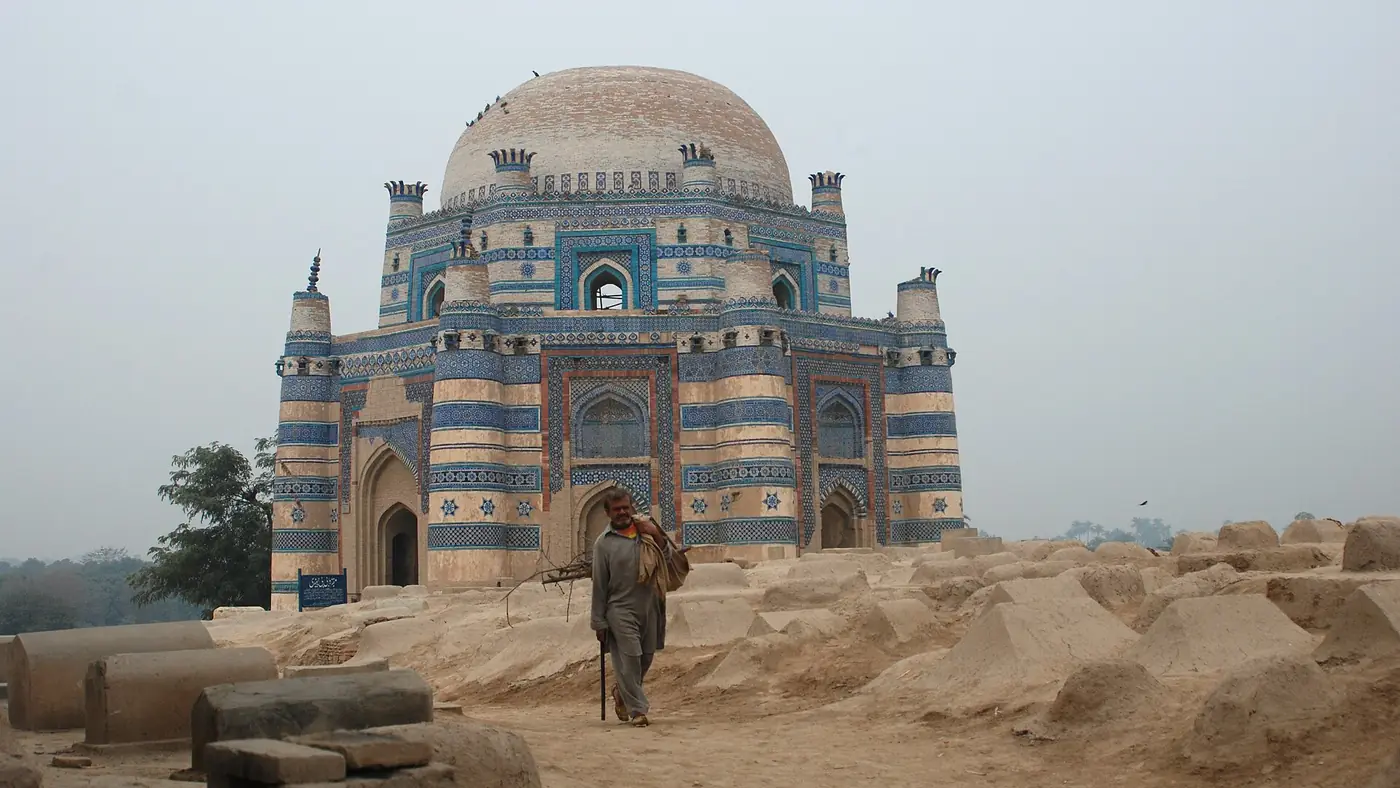
The Tomb of Bibi Jawindi is the most photographed of Uch's monuments and the one most visitors come to see. It was built in the late 15th century in honour of Bibi Jawindi, a descendant of the revered Sufi saint Jahaniyan Jahangasht.
The tomb was originally an octagonal, three-tiered structure topped with a dome, decorated with carved timber, Quranic inscriptions and glazed blue and white tiles in the geometric patterns typical of the region. Floods in 1817 washed away roughly half the original building, and what stands today is the surviving portion: still striking, with its blue tilework catching the light, but visibly a fragment of a larger monument. Continuing erosion, salt damage and some past repair work using inappropriate materials have added to the wear over the years, which is part of why the site remains on UNESCO's tentative World Heritage list rather than fully inscribed.
Other shrines to see
The Bibi Jawindi tomb sits within a wider complex of monuments that forms the basis of Uch's tentative UNESCO listing, including the shrines of other Sufi figures associated with the town's history, among them Jalaluddin Bukhari and Baha'al-Halim. Most visitors focus their time on Bibi Jawindi's tomb, since it is the best preserved and most visually striking, but walking a little further through the old town takes you past several more tiled tombs and an old mosque, giving a better sense of Uch as a living religious site rather than a single monument.
Why Uch's shrines look the way they do
The tile-work seen at Bibi Jawindi's tomb and the other Uch shrines is part of a broader decorative tradition found across south Punjab and Sindh, using glazed terracotta tiles in blues, whites and turquoise set into brick structures. Uch's shrines are among the earliest and most elaborate surviving examples of this style, which is one of the reasons the town's monuments were put forward as a group for UNESCO's tentative list rather than as a single building. Later Sufi shrines elsewhere in the region, including some in Multan, drew on the same visual language, but Uch's tombs are generally regarded as the style's most refined early expression.
Getting there from Bahawalpur
Uch Sharif is reached from Bahawalpur via the Ahmadpur East bypass onto National Highway 5, a paved route the whole way, with the drive taking around an hour and a half. There is no need for a 4x4 or any special vehicle; a normal car manages the trip without difficulty.
A few practical points:
- Fuel and buy water before you leave Bahawalpur, or in Ahmadpur East along the way, since Uch itself is a small town with limited facilities for visitors.
- The site is free to enter, so there is no ticket to plan around, though a small donation to the shrine's caretakers is customary at many Sufi sites in Pakistan.
- Mobile signal is generally fine on the main highway but can be patchy closer to the old town.
What to wear and how to behave
Uch's shrines are active places of worship as well as heritage sites, visited by pilgrims as much as tourists. Dress modestly: shoulders and knees covered for everyone, and a headscarf for women is a sensible precaution even where it isn't strictly required. Remove your shoes before entering any shrine interior, keep your voice down, and ask before photographing people who are there to pray rather than to sightsee.
Best time to visit
November to March is the easiest window, with daytime heat manageable for walking between the shrines. From April onward, south Punjab's heat builds quickly, and by the peak summer months a midday visit is genuinely uncomfortable, with little shade around the monuments themselves. If you are combining Uch with a wider desert trip, our guide to the best time to visit Cholistan covers the same seasonal pattern in more detail.
Is Uch Sharif worth the drive?
For anyone interested in Sufi history, tile architecture or Pakistan's medieval past, yes. There is nothing else in the country quite like the concentration of tiled shrines in Uch, and the Bibi Jawindi tomb alone justifies the trip for photography. It suits a half-day out from Bahawalpur well, and combines naturally with a longer trip that also takes in the city's palaces or the desert route to Derawar Fort.
It's a quieter, more contemplative stop than the desert forts or the jeep rally, and it disappoints visitors expecting a polished museum experience: there are no formal displays or guided tours, just the shrines themselves and the town around them. If you'd like Uch built into a wider Bahawalpur itinerary, send us your dates and we can suggest how to fit it in.
Frequently asked questions
How far is Uch Sharif from Bahawalpur?
About 80 km, roughly an hour and a half by road via Ahmadpur East and National Highway 5.
Is there an entry fee for the Tomb of Bibi Jawindi?
No, entry to the shrine is free, though a small donation to the caretakers is customary.
Why is only half of the Tomb of Bibi Jawindi standing?
Floods in 1817 destroyed roughly half of the original 15th-century structure. What remains today is the surviving portion of a larger monument.
Is Uch Sharif on the UNESCO World Heritage list?
It is on the tentative list, submitted in 2004, alongside several other Sufi monuments in the town. It has not yet been fully inscribed.
What should I wear to visit Uch Sharif's shrines?
Modest dress covering shoulders and knees, with a headscarf recommended for women. Shoes come off before entering any shrine interior.
Can I visit Uch Sharif and Derawar Fort in the same trip?
Yes, though they lie in different directions from Bahawalpur, so plan them as separate day trips rather than trying to combine both in one day.