Derawar Fort is the great square fortress of the Cholistan desert, roughly 100 km by road south of Bahawalpur, beyond Ahmadpur East and Dera Nawab Sahib. The road is paved all the way and the drive takes about two hours each way. You can walk right round the outside walls, visit the white marble Abbasi Mosque and see the royal tombs, but going inside is not guaranteed: the fort still belongs to the family of the former Nawabs of Bahawalpur, and entry has traditionally needed their permission.
Go between November and February, and time your visit for early morning or the last hour before sunset, when the brick turns warm gold. This guide covers the road, the access question, what else is at the site, where to stay, and whether the long drive is worth it.
| At a glance | |
|---|---|
| Where | Cholistan desert, Bahawalpur district, south of Dera Nawab Sahib |
| From Bahawalpur | Roughly 100 km by road, about 2 hours each way |
| Road | Paved all the way; the last stretch runs through open desert |
| Inside the fort | Private property; entry not guaranteed |
| Outside | Walls, Abbasi Mosque and royal tombs, open to see |
| Best months | November to February |
| Best light | Soon after sunrise, and the hour before sunset |
| Time at the fort | 2 to 3 hours |
How do you get to Derawar Fort?
Almost everyone comes from Bahawalpur, which has the hotels, the restaurants and the city sights. From there the route runs south-west along the N-5 to Ahmadpur East, then a short way on to Dera Nawab Sahib, the old seat of the Nawabs, and from there south into the desert to the fort. Allow about an hour from Bahawalpur to Dera Nawab Sahib and another hour from there to Derawar.
The road into the desert was once a rough track. It was paved as the Cholistan Jeep Rally grew, and a normal car manages it without trouble outside rally week. The last part crosses open sand country with scattered settlements, and the fort appears long before you reach it: forty bastions standing up out of a flat horizon.
A few practical points for the drive:
- Fill up and buy water in Ahmadpur East or Dera Nawab Sahib. Don't count on fuel or proper shops near the fort.
- Mobile signal is patchy in the desert. Tell someone your plan and expected return time.
- In December and January, fog on the Punjab plains can make the early part of the drive slow. Leave a little later on a foggy morning rather than drive the N-5 blind.
- In February, rally week fills the road with traffic. If you want the fort quiet, avoid those days; if you want the rally, see our guide to the Cholistan Jeep Rally.
Can you go inside Derawar Fort?
This is the question most visitors arrive with, and the honest answer is: sometimes, but don't plan on it.
The fort has remained in the possession of the Abbasi family, the heirs of the Nawabs of Bahawalpur, and the standard position is that entry needs permission from the head of the family, the Amir of Bahawalpur. In practice, some visitors are let in by the men guarding the gate and walk the ramparts and the old administrative block; others are politely turned away. It depends on the day, on who is on duty and on the current instructions from the family.
The state has a hand in it too. Derawar was declared a protected monument under the Antiquities Act in 2005 and placed on UNESCO's tentative list in 2016, and the Punjab archaeology department has spent several years restoring it: the eastern bastions, a stretch of wall, the main gate, a baradari and a historic mosque, and then, in a project completed in May 2026, parts of the last Nawab's secretariat and residential quarters. At the time, officials said the restored sections might be opened to visitors in due course. As of September 2026 we have seen no official announcement of public opening hours or tickets.
You may read online that Derawar now runs on e-tickets with a daily limit on visitors. We could not find any official source for this, so don't rely on it.
What this means for planning:
- Treat the outside as the visit and the inside as a bonus. The walls, the mosque and the tombs are worth the drive on their own.
- If going inside matters to you, ask in Bahawalpur before you set off, through your hotel or a local contact, whether visitors are currently being admitted.
- If you are let in, keep off the upper bastions and any crumbling sections. Parts of the fort have been restored; much of it has not.
What to see outside the walls
The walls and bastions
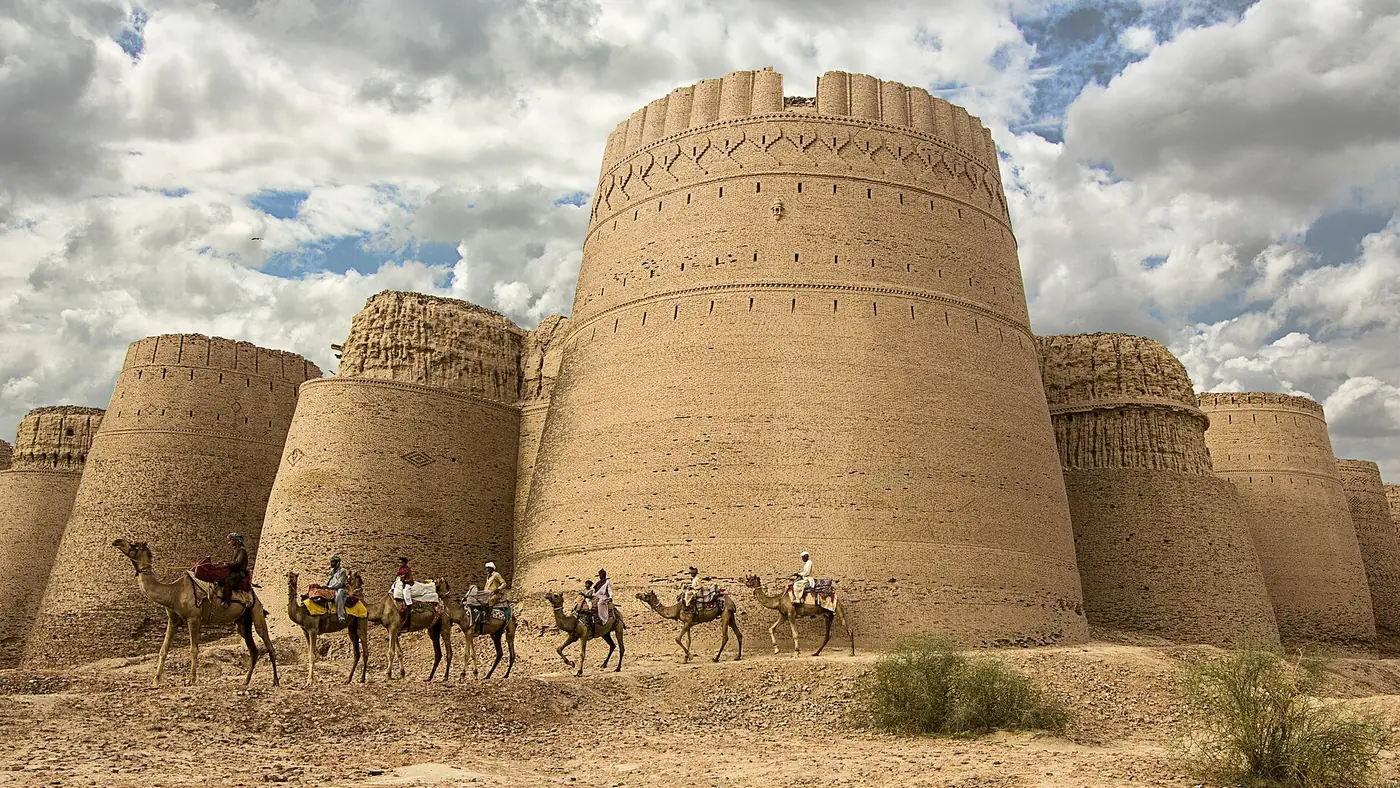
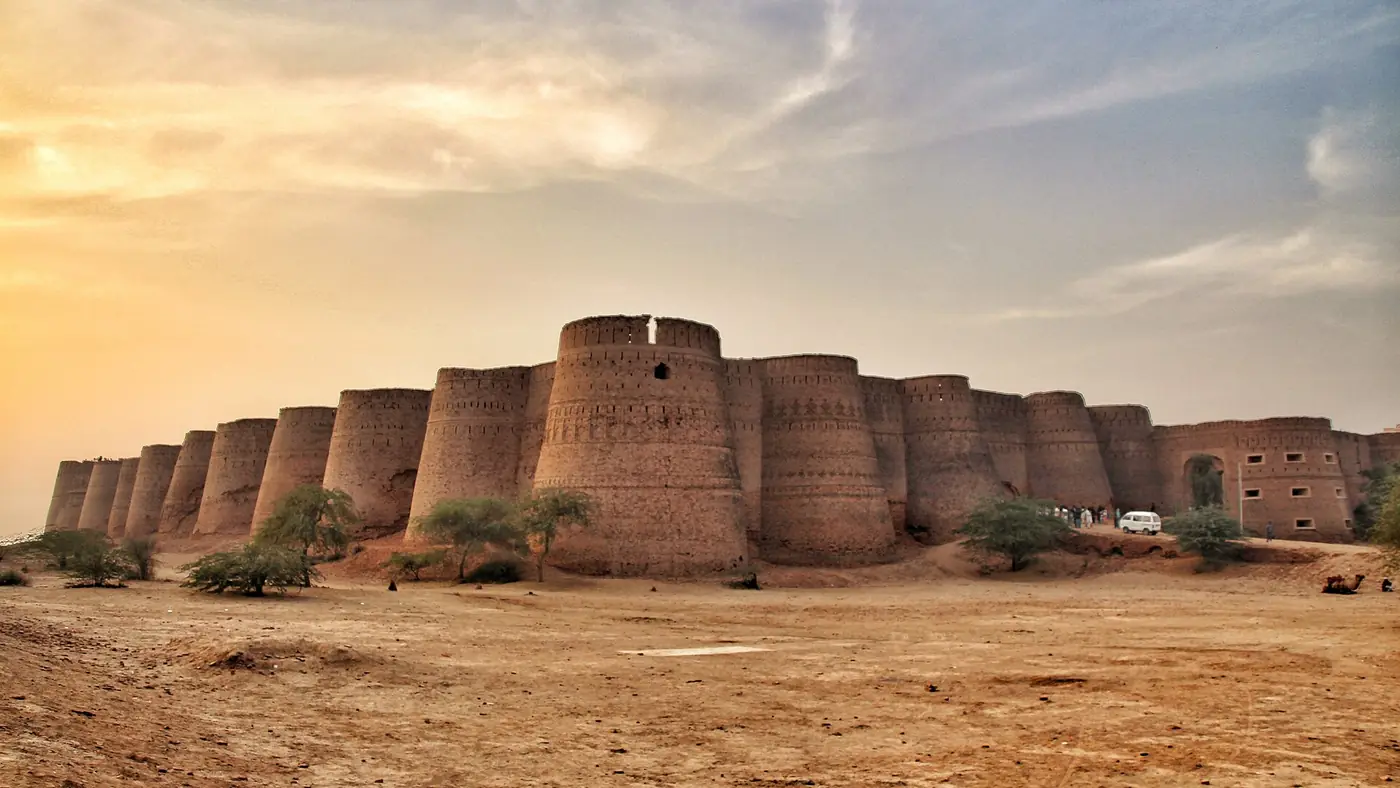
The fort is a near-perfect square, with forty round bastions, ten on each side, and walls of fired brick that rise to about 30 metres. The walls run for about 1,500 metres around, so a full circuit on foot takes a while in soft sand. The most striking views are from a little way out in the desert, where you can see a whole face at once, and from close in at the foot of the walls, where the scale is hard to believe.
Walk at least one side. The brickwork carries patterns in its courses that you only notice up close, and the bastions on the restored eastern side show what the whole fort once looked like.
The Abbasi Mosque
Just outside the fort stands the Abbasi Mosque, built in 1849 by Nawab Bahawal Khan in white marble, with three domes. It is said to be modelled on the Moti Masjid in the Red Fort at Delhi, and against the brown walls and the sand it is startlingly white.
It is a working mosque. Dress modestly, take off your shoes, cover your head if you are a woman, and avoid prayer times. Ask before photographing anyone at prayer.
The royal tombs
East of the fort is the burial ground of the Nawabs of Bahawalpur, with domed tombs decorated in blue glazed tiles that stand out sharply against the ochre ground. It is a family graveyard, not a monument park, so keep your voice down and don't climb on anything.
When to go and the best light
November to February is the season. Days are mild and bright, and the desert nights are cold, so bring a warm layer if you stay for sunset. March is still manageable in the mornings. From April to September the Cholistan heat, well over 40 °C in the hottest months, makes a desert day trip hard work and, for children and older people, risky.
For photographs and for comfort, the time of day matters as much as the month:
- Early morning: low light along the walls, cool air and few people. This means leaving Bahawalpur before dawn.
- Late afternoon: the most popular choice. The bricks glow in the last hour of sun and the marble of the mosque warms with them. Leave time to drive the desert stretch back before it is fully dark.
- Midday: flat, harsh light and the most heat. Fine for a walk round, poor for pictures.
A short history of Derawar
The first fort here was built in the 9th century by Rai Jajja Bhatti, a Rajput of the Bhati clan, and the place was known as Dera Rawal, which over time became Derawar. It stood guard over the desert routes of the region and changed hands more than once.
In 1733 it was taken by Nawab Sadiq Muhammad Khan I, of the Abbasi family, who rebuilt it largely into the fort you see today. The Abbasis lost it in 1747 and regained it in 1804 under Nawab Mubarak Khan. The last ruling Nawab, Sadiq Muhammad Khan Abbasi V, was born at Derawar in 1904. After his death in 1966 the fort was left largely to the weather, and its decline is what the recent restoration projects set out to reverse.
Where to stay: desert camps and Bahawalpur
Most visitors do Derawar as a day trip from Bahawalpur, which has the widest choice of hotels and guesthouses and makes the drive a comfortable one.
Staying in the desert is possible, with some planning:
- The TDCP resort near the fort. The Tourism Development Corporation of Punjab completed a small resort near Derawar in late 2022, with six rooms, bath blocks and a camping area. Ask TDCP about current availability before counting on it.
- Rally-week camps. During the Jeep Rally in February, private operators set up tented camps around the fort. They are busy and noisy, and they exist only for that week.
- Organised desert camping at other times, through an established Bahawalpur-based operator. Don't pitch a tent alone in the open desert: it is a long way from help, and you need local knowledge of where you are allowed to camp.
What to carry
- Water, more than you think, and snacks
- A hat, sunglasses and sunscreen, even in winter
- A scarf or buff for dust and wind
- A warm layer for the evening from November to February
- Your CNIC, and cash, since there is nowhere to pay by card
- A full tank of fuel
Our travel guide has more general advice on money, connectivity and getting around Pakistan.
Is Derawar Fort worth the drive?
For anyone who likes forts, deserts or photography, yes. There is nothing else in Pakistan quite like forty brick bastions rising out of empty sand, and the mosque and tombs beside it make a real half-day. The drive is long but easy, on a paved road.
It suits people less well if they are in Bahawalpur for a single day and would rather see the city's palaces, or if they are travelling in the hot months, when the trip becomes an ordeal. It also disappoints visitors who arrive expecting a ticketed monument with a museum inside: there are no guides, no cafés and, on many days, no entry.
If you would like help fitting Derawar into a wider trip through south Punjab, send us your dates and plans and we will suggest how to arrange it.
Frequently asked questions
Can you go inside Derawar Fort?
Not reliably. The fort belongs to the Abbasi family, and entry traditionally needs their permission; some visitors are let in at the gate and others are not. Plan your visit around the outside walls, the Abbasi Mosque and the tombs.
How far is Derawar Fort from Bahawalpur?
Roughly 100 km by road, through Ahmadpur East and Dera Nawab Sahib. The drive takes about two hours each way on a paved road.
Is there an entry fee for Derawar Fort?
We know of no official ticket for the site as of 2026. That may change if the restored sections open to the public, so carry some cash in case.
Who built Derawar Fort?
The first fort was built in the 9th century by Rai Jajja Bhatti, a Bhati Rajput. The present structure is largely the work of the Abbasi Nawabs of Bahawalpur, who took it in 1733 and rebuilt it.
What is the best time to visit Derawar Fort?
November to February, in the early morning or the hour before sunset. Summer heat in Cholistan makes a visit between April and September hard going.
Can you stay overnight near Derawar Fort?
Yes, with planning. TDCP has a small resort near the fort, and tented camps appear during the February rally; otherwise stay in Bahawalpur and make it a day trip.