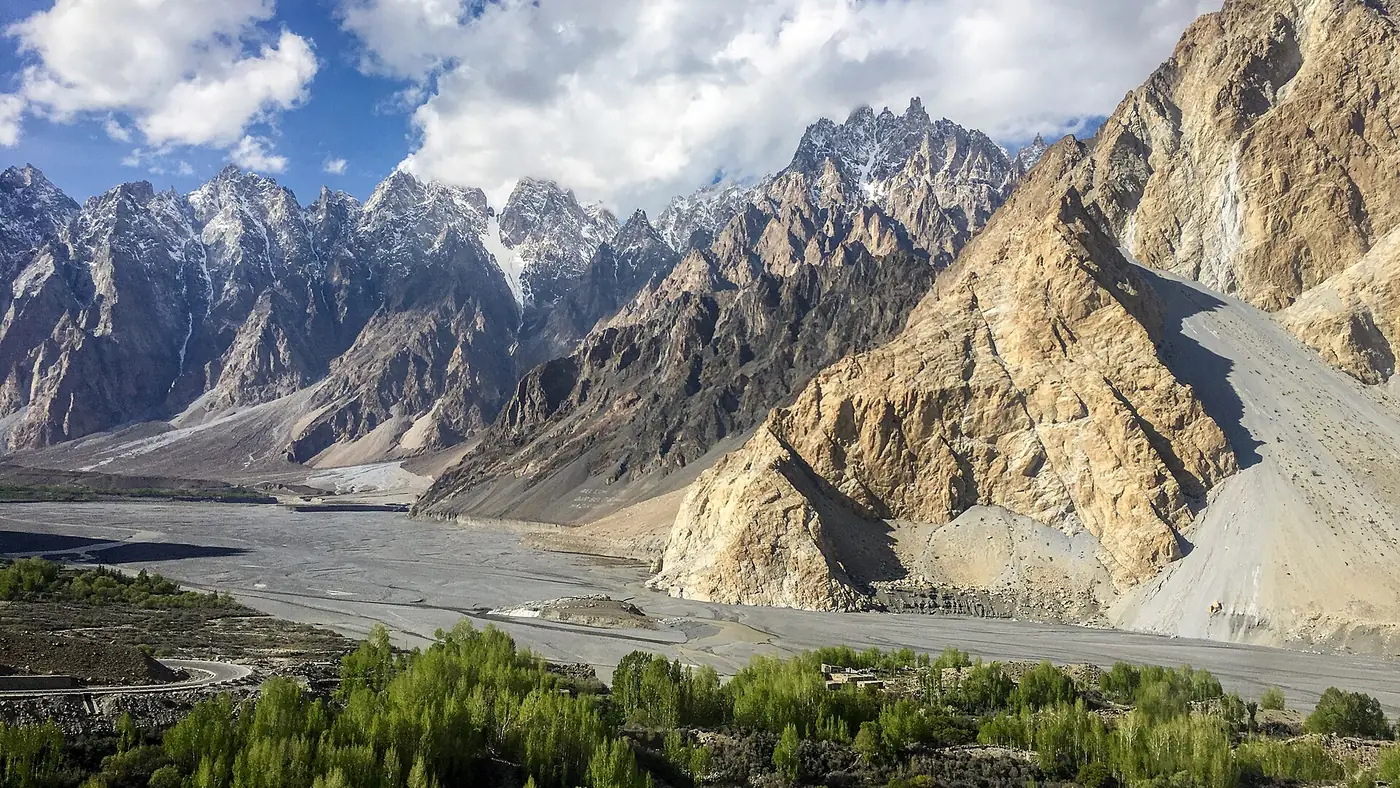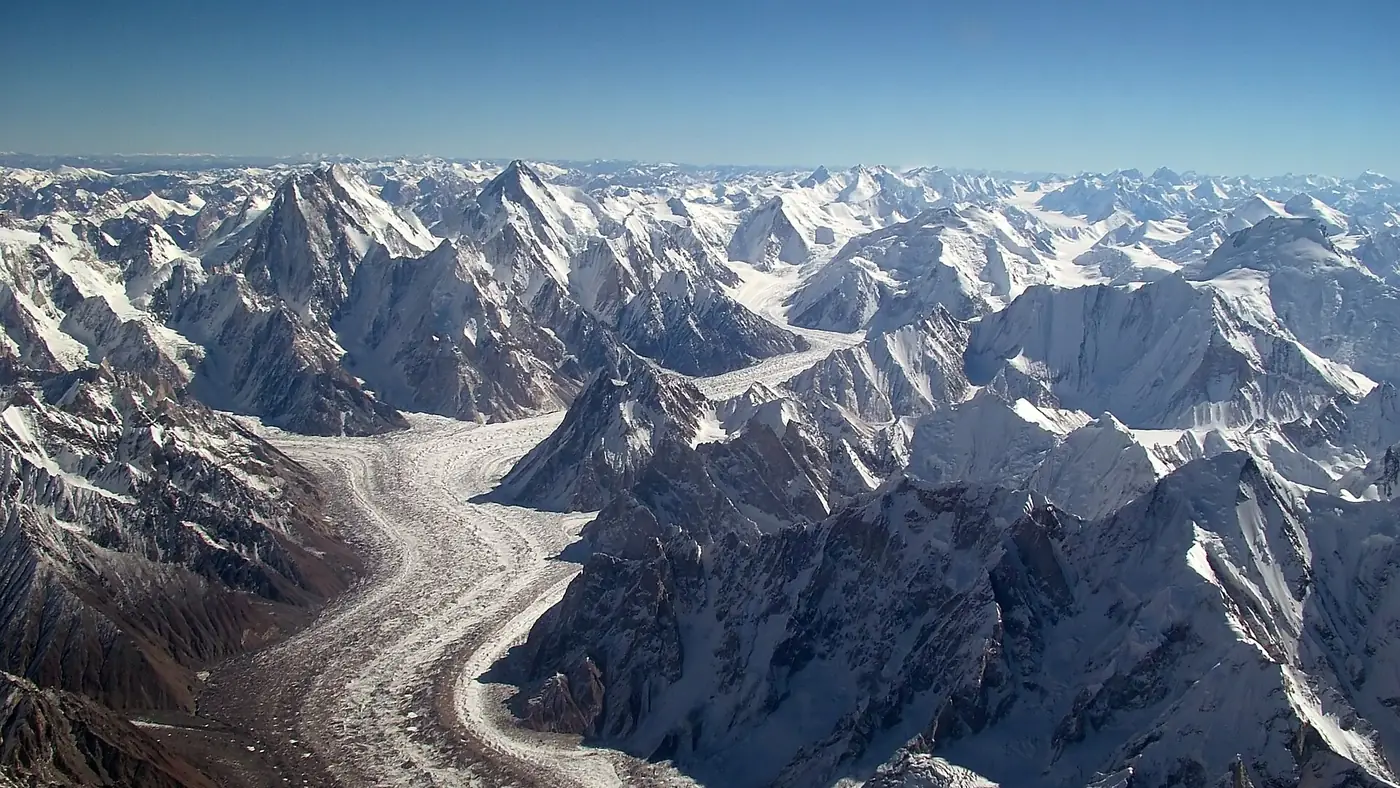
A trekking peak, in Gilgit-Baltistan, is any summit up to 6,500 metres, which Pakistan's tourism rules class as needing no royalty and no expedition-style permit from the Gilgit-Baltistan Council. That makes peaks like Minglik Sar and Bilchar Dobani the usual route into altitude climbing for trekkers who are fit, comfortable on a rope and want a summit rather than just a base camp.
This is not the same as hill walking. Most trekking peaks involve glacier travel, a fixed camp or two above 5,000 metres, and basic use of crampons and an ice axe, so they suit someone building toward bigger objectives rather than a first-ever trek. This guide covers what counts as a trekking peak, the permit rules, a handful of well-used first summits, and what to arrange before you go.
| At a glance | |
|---|---|
| Height range | Roughly 5,500 to 6,500 metres |
| Royalty/permit | None for peaks up to 6,500 m in open zones |
| Restricted-zone fee | About US $50 per person through a licensed agency |
| Season | June to September |
| Skills needed | Glacier travel, crampons, fixed rope; basic mountaineering course helps |
| Guide | Required in practice, even where not legally compulsory |
What makes a peak a "trekking peak"
Pakistan's tourism authorities set 6,500 metres as the line between a peak you can climb without a permit and one that needs formal clearance from the Gilgit-Baltistan Council, a liaison officer and a royalty fee tied to the expedition's size. Below that line, in open zones, there is no fee and no permit at all. The term "trekking peak" describes summits in this band that are well enough known and safe enough in normal conditions to be climbed by a properly equipped trekking party rather than a full mountaineering expedition.
It is a practical category, not an official grading of difficulty. Some trekking peaks are closer to a long, steep walk on snow; others need real rope work near the top. Ask whoever you book with exactly what a given peak involves before you commit.
Permits and paperwork
- Open zone, under 6,500 m: no permit, no royalty, no liaison officer required.
- Restricted zone, under 6,500 m: a trekking permit from the Ministry of Tourism, arranged through a government-licensed agency, at roughly US $50 per person (2026), plus a licensed guide and accident insurance for porters and staff.
- Over 6,500 m: treated as a full expedition peak regardless of zone, with a Gilgit-Baltistan Council permit and fees scaled to altitude and team size.
- Everyone: Pakistani visitors need only a CNIC; foreign nationals need a passport with a valid Pakistan visa, and some areas near the border still require an NOC. Check current rules before booking, since restricted-zone lists change.
First trekking peaks worth knowing
- Minglik Sar (about 6,050 m), Shimshal valley. First climbed in 1988 by Nazir Sabir, and one of the most commonly cited beginner-friendly 6,000-metre summits in the Karakoram, reached from Shimshal after a multi-day approach on glacier.
- Bilchar Dobani (about 6,143 m), between the Bagrot and Haramosh valleys. A moderate glacier climb close to Gilgit, often paired with acclimatisation days lower down.
- Shatong Peak (about 4,500 m), Deosai. Closer to a high walk than a climb, and a reasonable warm-up for the glacier skills a proper trekking peak needs.
Heights on these smaller Karakoram summits vary between sources by fifty to a hundred metres, so treat any figure, including these, as approximate rather than surveyed.
What the climb actually involves
Expect a multi-day approach on foot or jeep track to a base camp, one or two nights at a higher camp on the glacier, and a summit push that starts before dawn. Even the easier trekking peaks cross crevassed ground, so a rope, harness, crampons and an ice axe are standard kit, and knowing how to use them matters more than raw fitness. A short mountaineering course, several are run in Skardu and Gilgit before the summer season, is worth doing if you have not climbed on snow and ice before.
Guides, staff and gear
A licensed local guide is required in restricted zones and is the sensible choice everywhere else too: route-finding on glaciers changes year to year, and a guide who has been up recently knows the current crevasse pattern. Porters carry camp gear to base camp; above that, most parties move as a small self-supported team. Technical gear can be rented in Skardu, but check it carefully before you leave town, since rental stock quality varies.
Is a trekking peak worth it?
If you have already done a multi-day trek in Gilgit-Baltistan and want to try climbing rather than walking, a well-chosen trekking peak is a sensible next step and far cheaper than a permitted expedition. If you have never used crampons or a rope, start with a mountaineering course or an easier objective; the glacier terrain on even the "easy" trekking peaks is unforgiving of basic mistakes. For a first outing in the mountains without any climbing element, our guide to easy treks in Gilgit-Baltistan is the better starting point.
Frequently asked questions
What altitude counts as a trekking peak in Pakistan?
Peaks up to 6,500 metres, which do not need a Gilgit-Baltistan Council expedition permit or royalty fee, though a trekking permit and guide are still required in restricted zones.
Do I need a permit to climb a trekking peak?
Not in an open zone, no. In a restricted zone you need a trekking permit from the Ministry of Tourism, arranged through a licensed agency, plus a licensed guide.
Can a beginner climb a trekking peak in Gilgit-Baltistan?
Only with training or a guide who teaches the basics as you go. These are glacier climbs with real crevasse and rope-work risk, not extensions of ordinary trekking.
What is the best season for trekking peaks?
June to September, when glacier crossings and fixed camps are most predictable. Conditions can still change quickly at these altitudes, so build in spare days.
How is a trekking peak different from a base camp trek?
A base camp trek, such as Rakaposhi or Nanga Parbat base camp, ends at a viewpoint below the mountain. A trekking peak climb continues onto the mountain itself, over glacier and snow, to an actual summit.
Anyone planning a Gilgit-Baltistan trip around a first climb should also see our travel planning guide for how to put the logistics together.