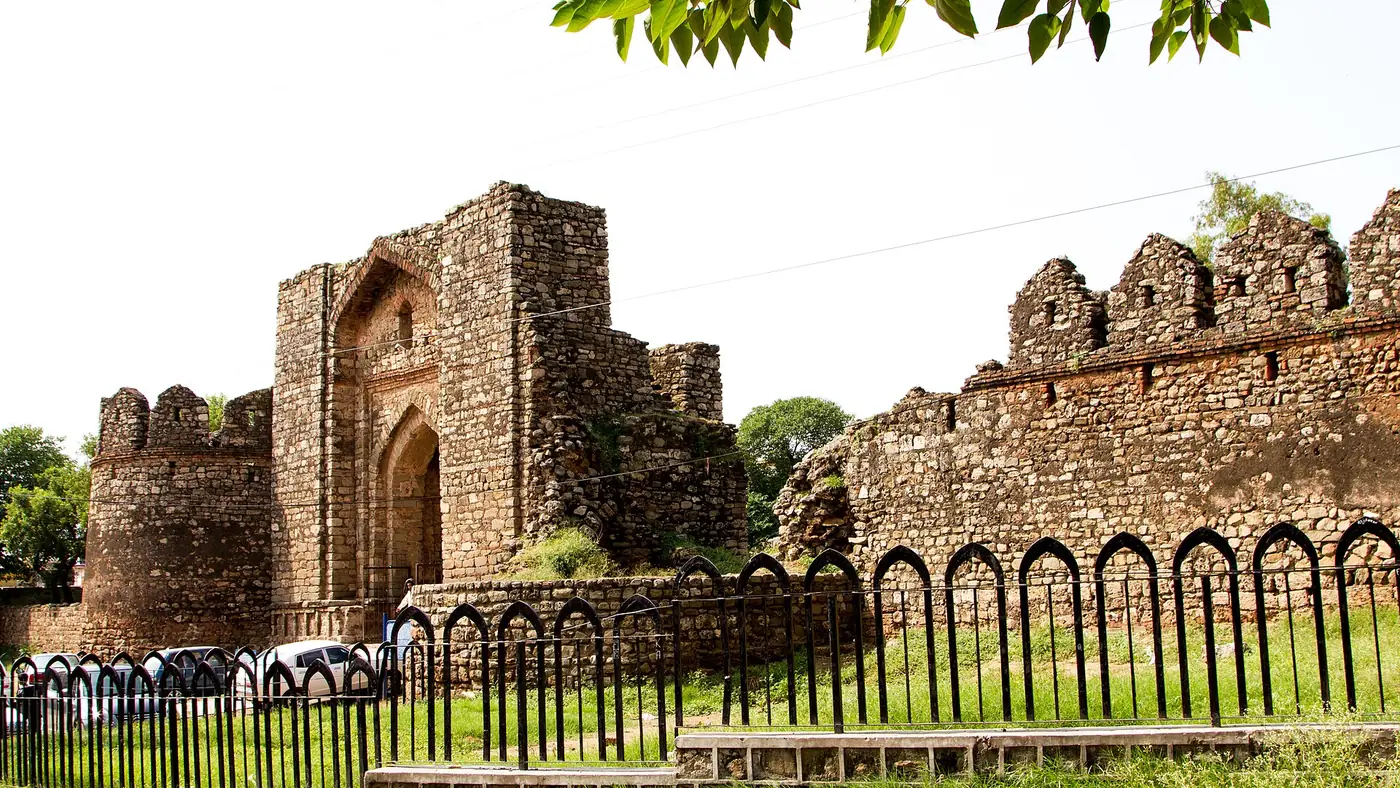
Rawat Fort stands beside the Grand Trunk Road about 17 kilometres east of Rawalpindi, a walled 15th-century caravanserai that the Gakhar clan later turned into a stronghold, and it is free to visit in around thirty to ninety minutes depending on how closely you look. Inside its walls are a domed mosque, the cells where travelling merchants once slept, and the octagonal tomb traditionally said to hold the Gakhar chief Sultan Sarang Khan.
This guide covers what the fort actually is, what remains standing, and how to get there and combine it with the rest of a day east of Rawalpindi.
| At a glance | |
|---|---|
| Location | GT Road, about 17 km east of Rawalpindi |
| Built | Early 15th century, as a caravanserai |
| Later use | Gakhar stronghold, 16th century |
| Entry | Free |
| Time needed | 30 to 90 minutes |
| Condition | Protected heritage site; parts remain unrestored |
What Rawat Fort actually is
The name comes from the Arabic rabat, meaning a fortified inn, and that is what the site began as: a caravanserai on the road between Lahore and Peshawar, built in the early 15th century during the Delhi Sultanate period to shelter merchants and travellers overnight. Rows of small cells set into the fort's walls are thought to have been rented out to those travelling traders, and the layout still reads clearly as an inn built for defence as much as for trade.
The local Gakhar clan, who controlled this part of the Pothohar plateau, later turned the caravanserai into a stronghold. It was here that Sultan Sarang Khan Gakhar, made ruler of the Pothohar region by the Mughal emperor Babur in 1520, made his stand against the forces of Sher Shah Suri. He and many of his men were killed in the fighting in 1546.
Sultan Sarang Khan's tomb
Inside the fort's inner courtyard stands an octagonal domed tomb roughly 16.6 metres across, traditionally identified as Sultan Sarang Khan's grave. Around it lie numerous smaller graves, said locally to be those of his sixteen sons and the men who fought and died alongside him against Sher Shah Suri's army.
The tomb and its courtyard of graves are the most visually striking part of the fort, and the dome is still largely intact even where the surrounding structure has crumbled. Historians differ on some of the finer details of the site's origins, with a few older accounts tracing an earlier structure to the Ghaznavid period in the 11th century, but the standing fort-caravanserai and its Gakhar-era tomb are what you actually see today.
What still stands
Rawat Fort is nearly square in plan, enclosed by high walls with corner towers. Inside are:
- A three-domed mosque, roughly 30 by 12 metres, set against the western wall and still one of the best-preserved parts of the complex.
- Sultan Sarang Khan's octagonal tomb, with its courtyard of smaller graves.
- Rows of small cells along the inner walls, the original merchants' rooms.
- The main gateway, weathered but still standing, through which you enter the courtyard.
Large sections of the fort's interior are in poor condition: cracked masonry, worn stone and uneven ground are the norm rather than the exception. It carries protected status as a heritage site, and funding and restoration work have been announced several times over the past decade, most recently around 2024 and early 2025, but progress has been slow and parts of the site remain neglected. Expect a genuine ruin rather than a restored monument, and watch your footing.
The Gakhars and the Pothohar plateau
The Gakhars were a powerful clan who controlled much of the Pothohar plateau, the rolling ground between the Indus and the Jhelum rivers where Rawalpindi and Rawat both sit, through the Mughal period. Babur, founder of the Mughal empire, relied on Sarang Khan's submission and support to secure this stretch of northern Punjab, and made him its ruler in 1520 in return.
That alliance did not survive Sher Shah Suri's rise. Sher Shah, the Pashtun ruler who briefly displaced the Mughals from Delhi, pushed north through Punjab in the 1540s, and Sarang Khan's stand at Rawat was part of the wider Gakhar resistance to that advance. The fort you see today, reused as a fortress rather than the inn it began as, is a direct result of that conflict, which is why its walls and gate are built for defence rather than simply for shelter.
How to get there
Rawat Fort sits directly beside the GT Road, about 17 kilometres from central Rawalpindi and roughly 30 to 40 minutes by car depending on traffic, longer if you are coming from Islamabad. It is easiest to reach by private car or a hired driver, since it is a roadside stop rather than a destination with its own public transport link.
There are no ticket counters or formal visiting hours; the site is open and free to walk through during daylight. Combine it with a stop at the nearby Mankiala Stupa, a short drive further along the same road, to make a fuller half-day out of the GT Road sites.
Who this suits
Rawat Fort suits anyone interested in Punjab's pre-Mughal and Mughal-era history, and it works well as a short stop for travellers already driving the GT Road east of Rawalpindi rather than as a destination in its own right. It is not a polished tourist site: there are no facilities, no guides posted at the gate, and no explanatory signage to speak of, so a little reading beforehand goes a long way.
If you want ruins with more to see and a fuller day out, Taxila is a much richer stop a short drive northwest of Rawalpindi, with an on-site museum and several excavated cities. Rawat Fort is best treated as a worthwhile half-hour to an hour added to a GT Road trip rather than a trip planned around it alone. Our places to visit in Rawalpindi guide sets it alongside Mankiala and the rest of the city, and our trip planning page can help you fit it into a longer route.
Frequently asked questions
What is Rawat Fort famous for?
It is a 15th-century caravanserai later held by the Gakhar clan, best known for Sultan Sarang Khan's tomb and the graves of the men who died with him fighting Sher Shah Suri in 1546.
Is Rawat Fort free to visit?
Yes. There is no entry fee and no fixed opening hours; it is open to walk through during daylight.
How far is Rawat Fort from Rawalpindi?
About 17 kilometres east of the city on the GT Road, roughly 30 to 40 minutes by car depending on traffic.
Is Rawat Fort in good condition?
Parts of it are, particularly the mosque and the domed tomb, but large sections of the walls and courtyard are unrestored and crumbling. Restoration work has been announced repeatedly over the years but has moved slowly.
Whose tomb is inside Rawat Fort?
The octagonal domed tomb is traditionally attributed to Sultan Sarang Khan Gakhar, the Gakhar chief killed fighting Sher Shah Suri's forces in 1546, with smaller graves around it said to be his sons and companions.
How long should I spend at Rawat Fort?
Thirty to forty-five minutes for a straightforward look at the gateway, mosque and tomb, or up to ninety minutes if you want to take in the masonry and history in more detail.