The Makli Necropolis is a vast cemetery on a low ridge just outside Thatta, about 100 km east of Karachi, with tombs built from the 14th to the 18th centuries for the kings, governors, saints and scholars of lower Sindh. It has been a UNESCO World Heritage Site since 1981. The Sindh antiquities department lists its hours as 8 am to 7 pm in summer and 9 am to 6 pm in winter. Allow two to three hours for the major tombs, go between November and February, and start early: there is almost no shade on the hill.
This guide covers the tombs worth your time, a route across the site, timings and guides, how to handle the heat, and a few notes on photography.
| At a glance | |
|---|---|
| Where | Makli Hill, on the edge of Thatta, Sindh |
| From Karachi | About 100 km on the N-5 National Highway, around 2 hours |
| UNESCO listing | 1981 |
| Size | About 10 km², with an estimated half a million to a million graves |
| Hours (Sindh antiquities) | Summer 8 am to 7 pm; winter 9 am to 6 pm |
| Time needed | 2 to 3 hours for the main tombs; half a day to explore |
| Best months | November to February |
| Best time of day | First thing in the morning, or the last two hours before closing |
What is Makli?
Makli is one of the largest funerary sites in the world: a low, flat-topped ridge about 10 square kilometres in area, covered in graves from about four centuries of Sindh's history. Estimates of the number of burials run from half a million to a million. Most are simple graves; more than 400 are carved platforms; and around 75 are major structures, from walled enclosures to domed tombs.
The tombs fall into two broad periods, and you can see the change as you walk:
- The Samma period (14th to early 16th century), when Thatta was the capital of the Samma kings. Their tombs are built of yellow sandstone and carved in bands of geometric and floral ornament, with motifs drawn from both Muslim and Hindu traditions.
- The Tarkhan and Mughal periods (16th to 18th century), when the governors of Sindh built in both stone and brick, with domes, balconies and panels of blue and turquoise glazed tile.
The tombs worth your time
You could spend days at Makli. For a first visit, these are the monuments that matter.
Tomb of Jam Nizamuddin II
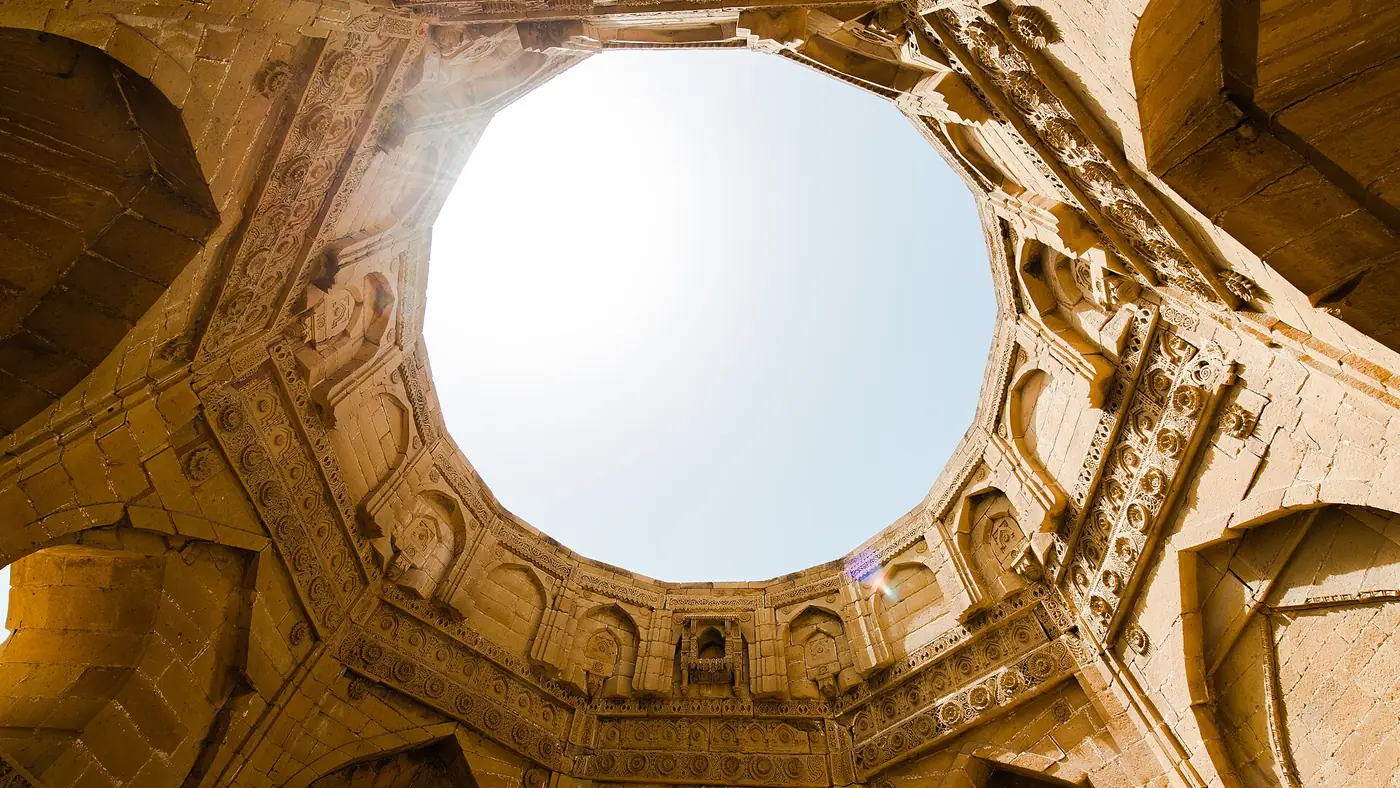
The finest Samma monument, built for the king who ruled Sindh from the 1460s until his death in about 1509. It is a square sandstone building, never given its dome, and its outer walls are wrapped in bands of carving: Quranic inscription, rosettes, lotus and geometric patterns, and a row of carved ducks. A projecting balcony on the outside of the prayer niche follows a style found in Gujarat, and craftsmen from there may have worked on it. It stands in the Samma group at the northern end of the site.
Tomb of Darya Khan
Near Jam Nizamuddin's tomb, the enclosure of Darya Khan, a Samma minister and general, looks more like a small fort than a mausoleum, with thick walls and a gateway. It was completed after 1521.
Tomb of Isa Khan Tarkhan II
The largest structure at Makli and the one most people remember. It was built for Isa Khan Tarkhan the Younger, a Mughal governor who died in 1651: a two-storey stone building with a dome, cupolas, balconies and carved stonework, set in a walled enclosure. Nearby is the earlier enclosure of Isa Khan Tarkhan I, who ruled in the mid-16th century, with its walls covered in carved inscription.
Tomb of Jani Beg Tarkhan
An octagonal brick tomb from about 1600, built for the last independent Tarkhan ruler of Sindh. Its walls are faced with glazed tiles in blue and turquoise, and it is one of the best places at Makli to see how brick and tile work replaced carved stone.
Tomb of Diwan Shurfa Khan
A 17th-century tomb built for a Mughal-era official, of brick with glazed tile decoration. It is often singled out for the quality of its tilework.
The site also holds the tombs of later Tarkhan and Mughal figures such as Sultan Ibrahim and Amir Sultan Muhammad, and hundreds of smaller carved graves that repay slow looking.
A walking route across the hill
The main tombs sit in two broad groups: the Tarkhan and Mughal tombs, including Isa Khan Tarkhan II, Jani Beg and Diwan Shurfa Khan, and the Samma tombs at the northern end, including Jam Nizamuddin II and Darya Khan. The two groups are a long, hot walk apart across open ground, with only rough tracks between them.
A route of two to three hours:
- Start at the Tarkhan group. Isa Khan Tarkhan II's tomb first, while the light is low; take time over the carving inside and out.
- Isa Khan Tarkhan I's enclosure close by, for the carved inscriptions.
- Jani Beg Tarkhan and Diwan Shurfa Khan for the glazed tile.
- Cross to the Samma group. Walk the tracks if it is cool, or ask at the entrance whether you can drive between the groups.
- Jam Nizamuddin II's tomb. Walk slowly round the outside to follow the bands of carving.
- Darya Khan's enclosure on the way back.
Ask at the gate which is the quickest way to each group, because paths and access points change with conservation work. Take water with you; don't expect to find any on the hill.
Timings, entry and guides
The Sindh Directorate General of Antiquities and Archaeology lists Makli's hours as 8 am to 7 pm in summer and 9 am to 6 pm in winter. Arrive at least three hours before closing if you want to see both groups.
Entry has historically cost little or nothing, and no current fee is published. Carry cash in small notes in case a charge is being collected, and ask for a ticket or receipt. The department's Makli page lists a contact number for the site if you need to check anything before you go.
Local men usually offer to guide visitors at the entrance. Some know the site well; others know a few stories. A good guide saves you time finding the tombs and explains who was buried where, which makes the difference at a place with so few signs. Agree the fee and how long you will spend before you start.
Beating the heat
Makli is a bare, stony plateau with almost no trees and very little shade, and the ground throws back the heat. It is the single thing that spoils most visits.
- Go between November and February. From April to October the heat on the hill by late morning is punishing, and dangerous for small children and older people.
- Start early. Be at the gate when it opens, and be finished by late morning. Alternatively, arrive in the last two or three hours before closing.
- Carry more water than you think, a hat and sunscreen, even in winter.
- Wear shoes with grip. The ground is uneven, stony and littered with broken masonry.
- Rest inside the tombs. The interiors of the big stone tombs are much cooler than the open ground.
From Karachi, leaving by 7 am puts you at Makli by about 9, before the worst of the heat. Our guide to day trips from Karachi sets out a full day combining Makli with the Shah Jahan Mosque in Thatta.
Photography tips
Makli rewards a camera, but the light matters more than the equipment.
- Low light is everything. Early morning and late afternoon bring out the depth of the carving; at midday the sandstone looks flat and white.
- Look closely. The best photographs are often details: a carved panel, a band of tile, a doorway framing the next tomb.
- The tile colours on Jani Beg's and Diwan Shurfa Khan's tombs are strongest in soft, indirect light.
- Drones need written permission from the Sindh antiquities department; don't fly one without it.
- People and shrines. Some tombs are still visited by devotees. Ask before photographing anyone, and keep your voice down.
Looking after the site
Makli is fragile. Rain, floods, encroachment, neglect and vandalism have all damaged it, and conservation work is continuing. After recent flood damage the Sindh antiquities department started a project called We Connect Makli with ICCROM, the ALIPH Foundation and EHRF, and set up an emergency response cell on the site.
Visitors can help simply:
- Don't climb on tombs, walls or domes, however solid they look.
- Don't touch carvings or tiles. Oil from hands and loose tiles picked up as souvenirs do real damage.
- Stay on paths where they exist, and don't step on graves.
- Take your rubbish home.
Who Makli suits, and what to add
Makli is the best single day of history within reach of Karachi, and anyone interested in Sindh's past or in Islamic architecture should see it. It suits families with older children, students, photographers and anyone happy to walk on rough ground.
It suits people less well if they can't manage heat or uneven ground; for them a visit to Isa Khan Tarkhan II's tomb alone, early on a winter morning, is still worthwhile. Most people combine Makli with the Shah Jahan Mosque in Thatta, and many drive on to Keenjhar Lake for the afternoon. For help building lower Sindh into a longer trip, start with our trip planning page.
Frequently asked questions
Where is the Makli Necropolis?
On Makli Hill, on the edge of Thatta in Sindh, about 100 km east of Karachi along the N-5 National Highway. The drive takes around two hours.
What are the Makli timings?
The Sindh antiquities department lists the site as open 8 am to 7 pm in summer and 9 am to 6 pm in winter. Arrive early to avoid the heat.
Is there an entry fee for Makli?
No current fee is published, and entry has historically cost little or nothing. Carry some cash in case a charge is being collected, and ask for a receipt.
How long does it take to see Makli?
Two to three hours covers the main tombs in both groups. Allow half a day if you want to explore the smaller graves and take photographs.
Why is Makli a UNESCO World Heritage Site?
Its tombs, built over about four centuries, record the history of Sindh from the Samma kings to the Mughal governors, and combine Muslim, Hindu, Persian and Gujarati influences in stone, brick and glazed tile.
What is the best time to visit Makli?
November to February, early in the morning. The plateau has almost no shade, and from April to October the heat by late morning is severe.