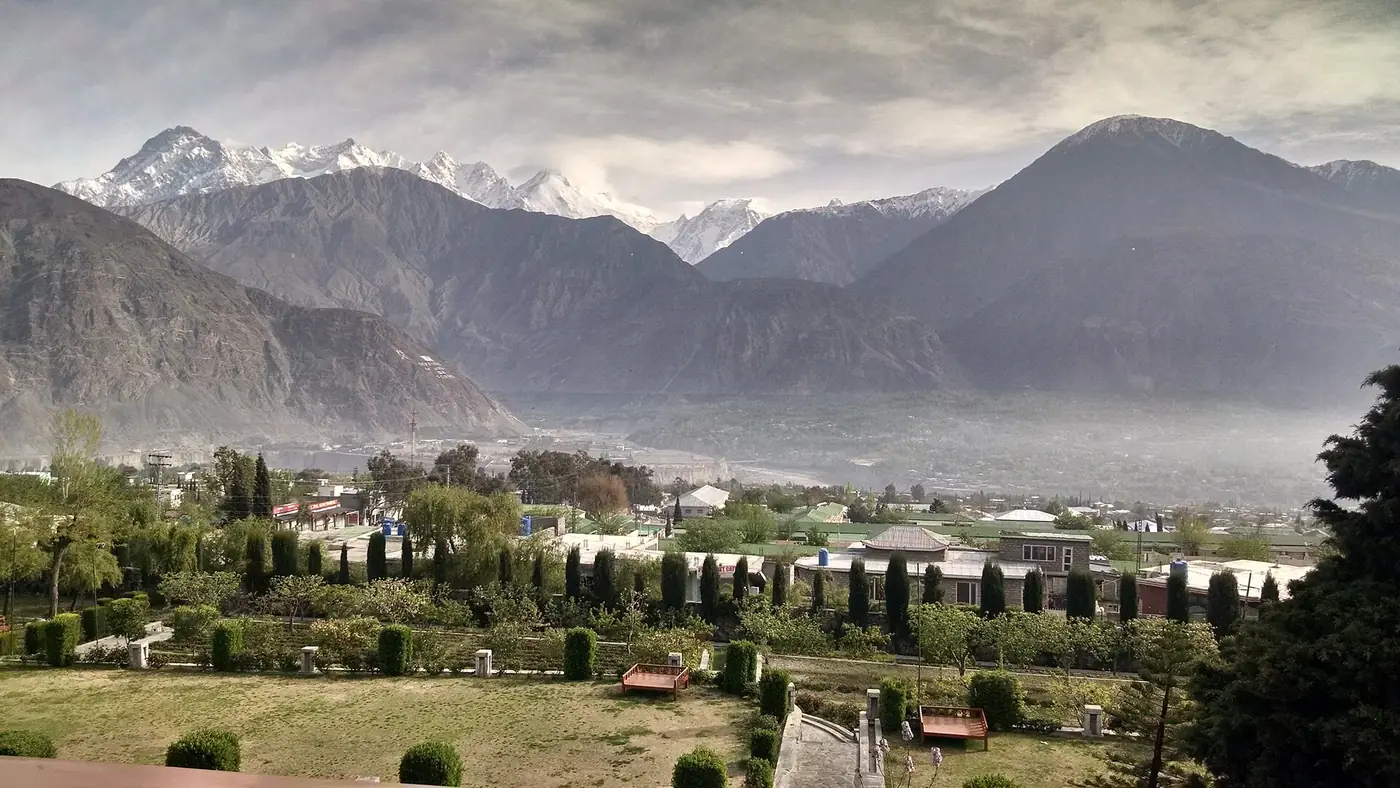

Shina is the main local language around Gilgit, spoken by around 1.1 million people across Gilgit-Baltistan and neighbouring Kohistan. You do not need to learn it to travel comfortably here: Urdu is understood everywhere, and most people working in tourism speak some English too. This guide is a quick orientation to the language itself, useful for understanding what you are hearing and why it changes from valley to valley.
Where Shina is spoken
Shina is spoken across a wide stretch of Gilgit-Baltistan and Khyber Pakhtunkhwa, including Gilgit city, Astore, Chilas, Bunji, Ghizer and Kohistan, with related dialects extending into parts of Indian-administered Kashmir. It is not the only language of the region: Hunza and Nagar speak Burushaski, Baltistan mostly speaks Balti, and Ghizer has its own mix of Khowar, Shina and other local languages. Gilgit city itself sits close to where several of these language areas meet, which is one reason it has long functioned as a trading and administrative centre rather than a single-language town.
Where it fits in the language family
Shina belongs to the Dardic branch of the Indo-Aryan languages, part of the larger Indo-European family. Linguists group it with a cluster of related languages spoken across the western Himalaya and Hindu Kush, sharing features with both Iranian and Sanskrit-derived languages further south and east. It is a tonal language, using pitch as well as consonants and vowels to distinguish words, which is unusual among the languages of Pakistan.
Dialects
Shina is not uniform across the region. The clearest split is between the Gilgiti dialect spoken in and around Gilgit city, and the Astori and Chilasi Kohistani dialects spoken further south along the Indus, which differ enough that speakers from different valleys sometimes notice the gap in each other's speech. This mirrors the region's geography: valleys separated by high mountains developed their own local variations even while speaking what is broadly the same language.
Beyond the Pakistani side of the border
Shina is not confined to Gilgit-Baltistan. Related dialects are spoken across the Line of Control in Indian-administered Kashmir, including the Dras and Gurez valleys and parts of the Kargil district in Ladakh, a reminder that the Dardic-speaking world straddled these valleys long before the current border ran through them. Within Pakistan, most native speakers are in Gilgit-Baltistan itself, with further Shina-speaking communities in Kohistan, in Khyber Pakhtunkhwa.
A largely spoken language
For most of its history, Shina has been passed down orally rather than written. A standardised script, based on an extended version of the Perso-Arabic alphabet used for Urdu, is a relatively recent development, and the Gilgit-Baltistan government has published primers and dictionaries to support it. In practice, almost everything a visitor encounters in Shina will be spoken rather than written, since public signage, menus and official documents across the region are in Urdu and English.
What this means for a visitor
You will hear Shina constantly in Gilgit, Astore and the valleys around them, in markets, on buses and between locals, but you will not need it to get by. Urdu works everywhere, and asking a local how to say a simple word or greeting in Shina, rather than relying on a printed phrase list, tends to go down well and is more reliable than any written translation, given how much the language varies from valley to valley. If you are heading into Hunza or Nagar, note that the local language there is Burushaski, not Shina, so a Shina phrase picked up in Gilgit will not carry over.
Our travel guide covers other practical basics for a first trip north, from connectivity to what to pack.
Frequently asked questions
Is Shina the main language of Gilgit?
Yes, Shina is the main local language of Gilgit city and much of the surrounding region, though Urdu is understood everywhere and is what you should rely on for travel.
Is Shina the same in every valley?
No. There are noticeable differences between the Gilgiti dialect and the Astori and Chilasi Kohistani dialects spoken further along the Indus, reflecting the region's separated valleys.
Do I need to learn Shina to travel in Gilgit-Baltistan?
No. Urdu is understood across the region, and most people working in tourism also speak some English. Shina is useful to recognise, not necessary to speak.
Is Shina written or only spoken?
Historically it has been mostly a spoken language, passed down orally. A standardised written script based on the Urdu alphabet exists but is a recent development, and most public writing in the region is still in Urdu.
Is Burushaski the same as Shina?
No. Burushaski, spoken in Hunza and Nagar, is a language isolate unrelated to Shina, which belongs to the Dardic branch of the Indo-Aryan languages. They are separate languages spoken in neighbouring valleys.