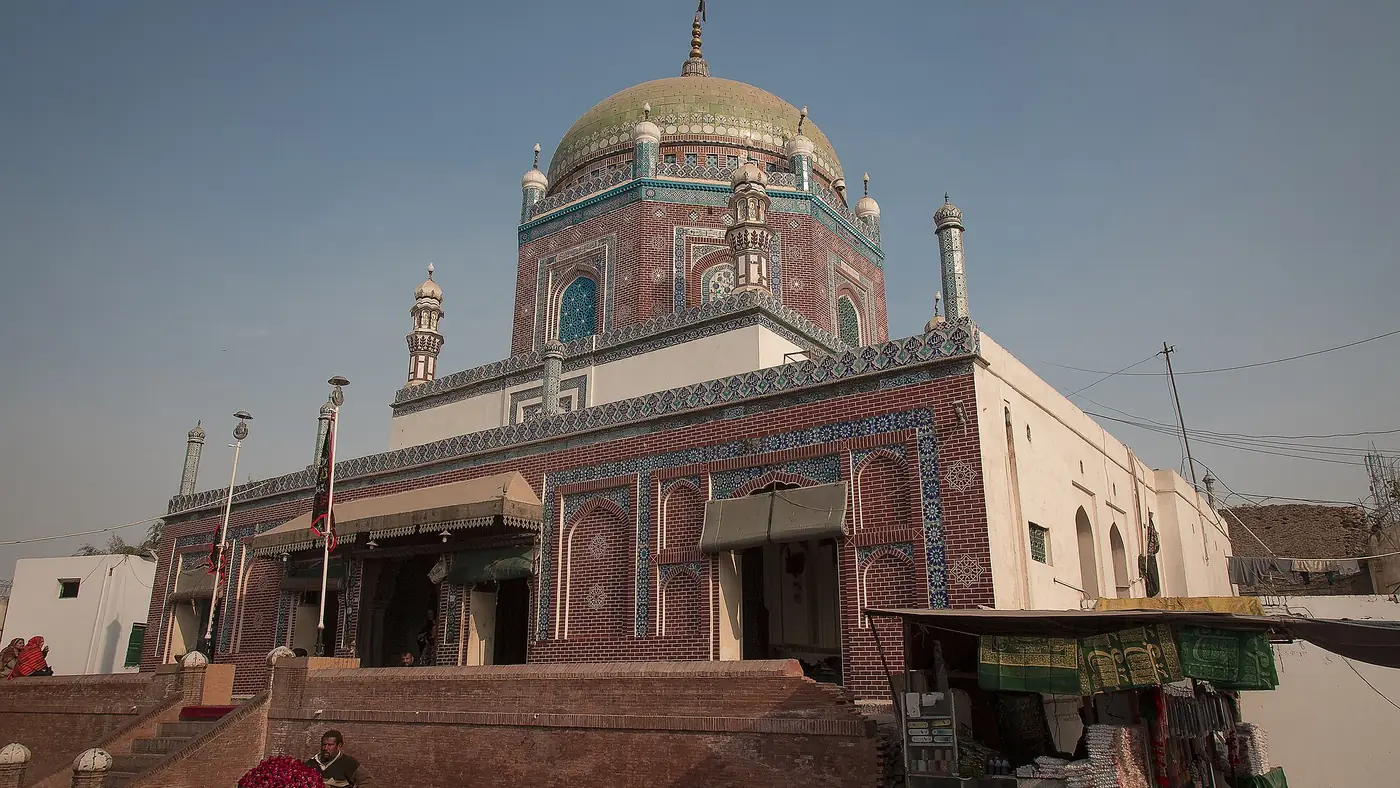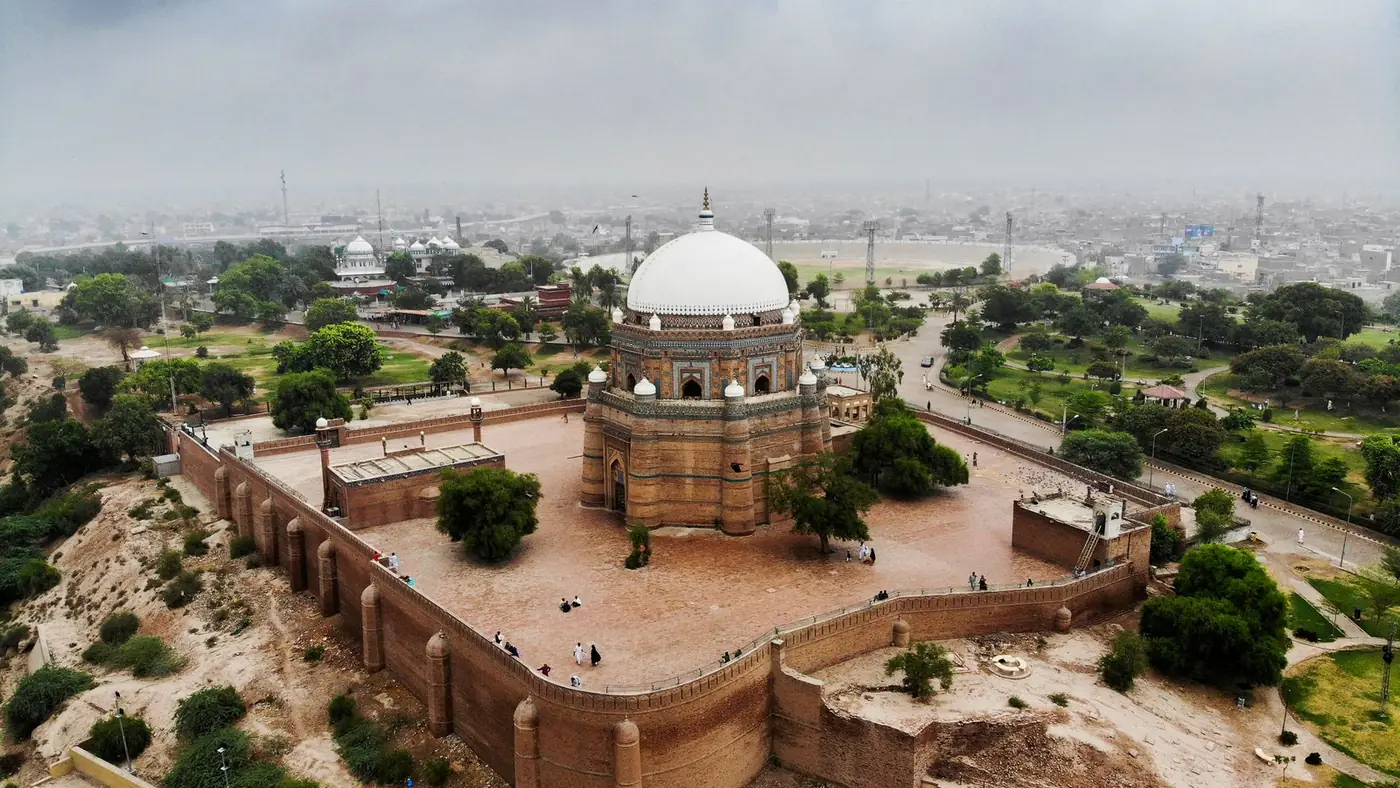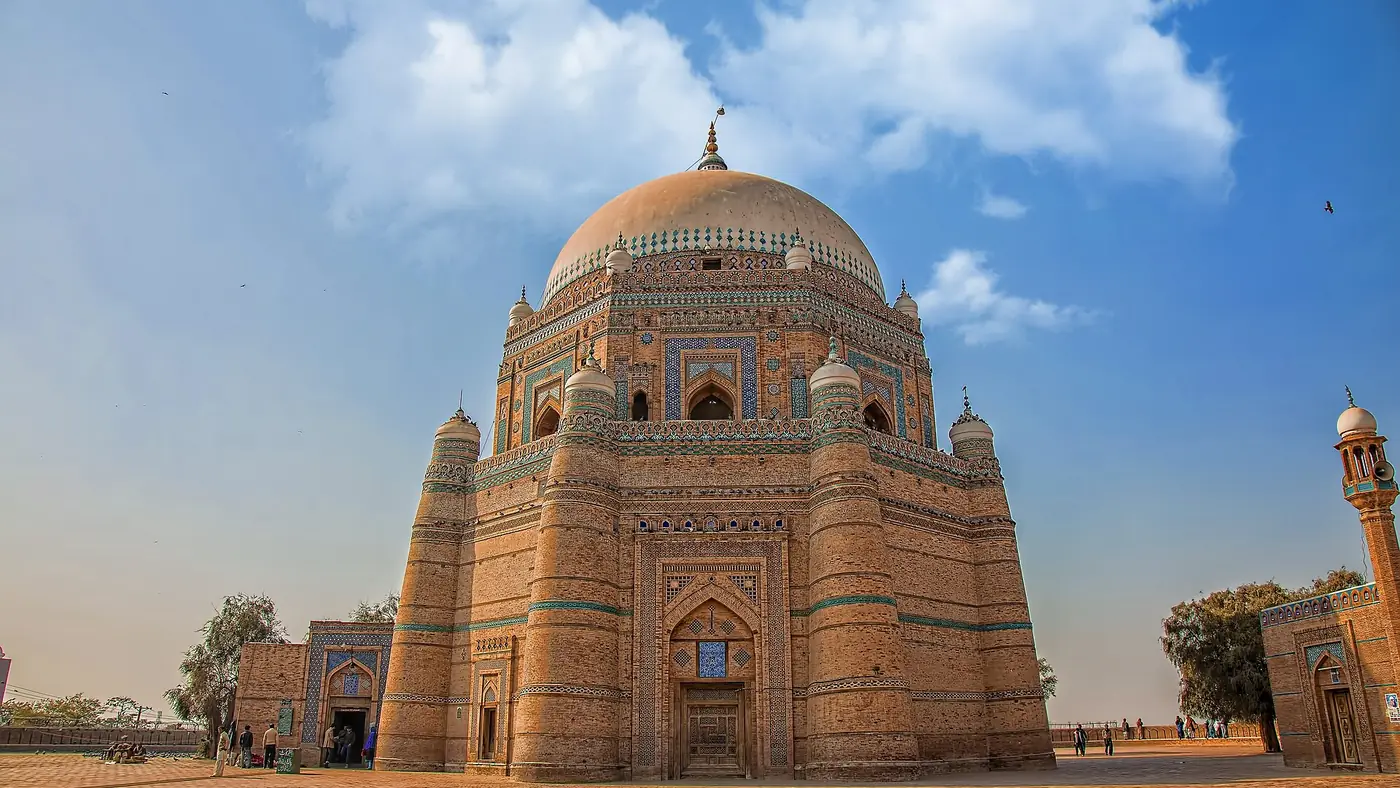
The tomb of Shah Rukn-e-Alam stands on the old fort mound in the centre of Multan, a 35-metre red-brick octagon banded with blue, white and azure tile that is one of the earliest and finest examples of Tughluq-era architecture anywhere. It was built in the 1320s and has held the grave of the Sufi saint Rukn-e-Alam since 1330. You reach it on foot through the Qila Kohna Qasim Bagh complex, and it is free to enter, with shoes off and heads covered as at any working shrine.
This guide covers who Rukn-e-Alam was, how the tomb came to be built, the walk in through the fort mound, what to wear, and when to go for the best light.
| At a glance | |
|---|---|
| Built | 1320–1324, under Ghiyath al-Din Tughluq |
| Housed the saint's grave from | 1330 |
| Height | About 35 metres |
| Material | Red brick, with glazed tile, timber and terracotta ornament |
| Location | Qila Kohna Qasim Bagh, the old fort mound, central Multan |
| Entry | Free; shoes off, heads covered |
| Status | On UNESCO's tentative World Heritage list |
| Best light | Early morning or the hour before sunset |
Who was Shah Rukn-e-Alam?
Sheikh Rukn-ud-Din Abul Fateh, known as Shah Rukn-e-Alam, was a 13th and 14th-century Sufi teacher of the Suhrawardi order and the grandson of Bahauddin Zakariya, whose own shrine stands at the other end of the same fort mound. He died in 1335, and the tomb built for him is still one of the most visited shrines in Multan, the city long known as the city of saints for the density of Sufi tombs within it.
How the tomb came to be built
The building's history is unusual: it was built between 1320 and 1324 by Ghiyath al-Din Tughluq, founder of the Tughluq dynasty, originally as his own tomb during his time as governor of Depalpur, before he became Sultan of Delhi. His son and successor, Muhammad bin Tughluq, later gave the completed building to Rukn-e-Alam's family, and the saint was buried there in 1330 after his death. It is regarded as the earliest surviving example of Tughluq architecture, built before the dynasty's better-known monuments in Delhi.
The building itself
The tomb is a true octagon, about 51 feet across on the inside, with sloping brick walls rising in two tiers to a dome, and corner towers that lean inward in the Tughluq style later carried through to Delhi. The whole structure reaches roughly 35 metres, making it visible across much of central Multan. The exterior is covered in bands of glazed blue, turquoise and white tile, carved brick and timber, and battlements along the parapets, all built of the region's distinctive red brick.
Inside, the space is a single tall chamber, calmer and less crowded than the courtyard outside, with the saint's grave at its centre surrounded by those of family members, beneath one of the earliest carved wooden mihrabs in the region.
In the 1970s the building underwent a six-year restoration led by the Aga Khan Trust for Culture, rebuilding deteriorated foundations and brickwork, replacing damaged tile and timber, and training a new generation of Multani craftsmen in the glazed tile and woodwork techniques the tomb depends on. That programme, recognised with an Aga Khan Award for Architecture, is part of why the tile work you see today still looks close to its original condition.
Getting there through the fort mound
The tomb sits inside Qila Kohna Qasim Bagh, the mound where Multan Fort once stood before it was largely destroyed in the Sikh siege of 1818 and finished off by British guns in 1848–49. There is no single ticketed entrance; you walk up onto the mound through the gardens and shrine courtyards that now occupy the old fort's footprint, with Shah Rukn-e-Alam's tomb at the south-western end and the shrine of Bahauddin Zakariya at the other. Local guides and rickshaw drivers around the old city know the route well if you are not confident finding it yourself.
Wear comfortable shoes for the walk up, since the paths are uneven brick and stone in places, and expect a short queue at busy times, particularly around Friday prayers and any urs (death anniversary) gathering.
What to wear and how to behave
This is a working shrine, not a museum, so the usual etiquette for a Sufi shrine in Pakistan applies:
- Remove your shoes before entering the tomb chamber itself; there is somewhere to leave them at the door.
- Cover your head if you are a woman, and dress modestly, covering arms and legs, for both men and women.
- Keep voices low inside the chamber, and be aware that people are there to pray, not just to look.
- Ask before photographing anyone praying at the grave, even though photography of the building itself is generally fine.
The best time and light for photographs
The tile work and brick catch the light best in the early morning, before the heat of the day sets in and before the courtyard fills, or in the last hour before sunset, when the low sun picks out the texture of the brick and the colour in the glazed tile. Multan is extremely hot from May to August, often past 45°C, which makes an early visit more comfortable as well as better for photographs; November to February is the easier season overall.
Combining the visit with the rest of the fort mound
Because the tomb stands at one end of the same mound as the shrine of Bahauddin Zakariya, most visitors see both in a single trip rather than making two separate journeys. Our Bahauddin Zakariya shrine guide covers that tomb's own history and etiquette. Between the two shrines are the ruins of the Prahladpuri temple and the Qasim Bagh gardens, with a modern viewing tower, the Damdama, that gives a wide view over the city and is a useful way to get your bearings before you head down into the tomb complex itself. Allow two to three hours to take in the whole mound at an unhurried pace, longer if you arrive during a Friday or an urs, when both shrines are busier and the queues move more slowly.
If your time in Multan is limited to a single stop, Shah Rukn-e-Alam's tomb is the one to prioritise: it is the older, larger and more architecturally significant of the two buildings, and it gives the clearest sense of why Multan's brickwork and tile tradition is still spoken of as one of the region's great crafts.
Frequently asked questions
Is there an entry fee for the Shah Rukn-e-Alam tomb?
No. Like Multan's other major shrines, it is free to enter, in keeping with its status as a working place of worship rather than a paid monument.
How do I get to the Shah Rukn-e-Alam tomb?
Walk up through the Qila Kohna Qasim Bagh complex in central Multan; there is no separate ticketed entrance, and the route is well known to local guides and rickshaw drivers.
Can non-Muslims visit the shrine?
Yes. The shrine is open to visitors of any faith, as is normal at Sufi shrines in Pakistan. Dress modestly, remove your shoes at the chamber door, and keep a respectful distance from people who are praying.
Why is the tomb linked to the Tughluq dynasty rather than to Shah Rukn-e-Alam himself?
Ghiyath al-Din Tughluq built it in the 1320s as his own tomb, before he became Sultan of Delhi. His son later gave the finished building to Rukn-e-Alam's family, and the saint was buried there in 1330, five years after Tughluq's own death and burial elsewhere.
Is the Shah Rukn-e-Alam tomb a UNESCO World Heritage Site?
It is on UNESCO's tentative list for World Heritage status, alongside other Multan monuments, but it has not yet been formally inscribed.